Frozen snapshot — do not edit
This is the research file
family-tree-research.mdas it stood when the vault was built (2026-10-31). The vault notes are now the master. Kept so every finding and its wording stays searchable.
Miller–Wiebe and Ramseyer–Neuenschwander family research
Research started October 29, 2026. This is a working evidence log, not a completed genealogical proof. Updated as additional records are examined.
Revision log
-
2026-10-29: Original log (from earlier AI session).
-
2026-10-30: Ramseyer–Neuenschwander side expanded by about two generations on every line:
- Rebecca Smiley’s probable parents (Rev. John Smiley and Mary Conrad) and Conrad grandparents.
- Mary Ellen Schrock’s documented parents (David Schrock and Fanny Plank).
- Andrew J. Neuenschwander’s documented parents (Jacob C. Neuenschwander and Elizabeth Stauffer) and grandparents.
- Sprunger and Reusser grandparents of Bessie.
- Ruth’s own dates (1922–2017).
- Arden D. Ramseyer confirmed as Al Jr.’s brother and author of the family book.
- New section on the Anabaptist/Mennonite context of every line.
- Merged with the complete original file. The Miller, Wiebe and English-ancestor sections are unchanged apart from rows added to the religious-context table.
-
2026-10-30 (second pass, Ramseyer):
- Read Staker’s Ramseyer chapter in full. It cites French civil records for Isaac and Johannes, the 1835 Richmond passenger list, and the 1840/1850 censuses.
- Added Peter Ramseyer’s and Barbara Rich’s dates and Barbara’s reported parents.
- Added Peter’s children and the Ramseyer–Conrad marriages.
- Documented Fanny Plank’s parents through her father’s 1914 obituary, and added the Hostetler, Plank and Kurtz leads.
- Added Mellie Yoder’s parents.
- Corrected one claim from the first pass (see Mary Ellen section).
-
2026-10-30 (third pass, Schrock and Rich gaps):
- Identified Moses Schrock and Christina Gerig as David Schrock’s probable parents.
- Found that Alvin Sr.’s two wives were probably first cousins.
- Found possible Rich relatives in the Paris Township Amish cemetery.
-
2026-10-30 (fourth pass, Miller–Wiebe side):
- Identified Anne’s parents in full: Gerhard A. Wiebe and Anna Gertrude Claassen.
- Documented her grandparents, who came from West Prussia and the Am Trakt settlement in Russia, confirming the family recollection.
- Added Miller, Mast, Hummel and Gonser grandparents.
- Tested the Kuhns link and found a count conflict.
- Found the 1907 Ramseyer-Rich Reunion booklet, which records a family tradition of English descent for the Rich family.
- Added a section on books by family members, including Edna Ramseyer Kaufman’s.
-
2026-10-30 (tenth pass): Expanded the Hochstetler massacre section. The 1912 Descendants of Jacob Hochstetler (a published genealogy, digitized) traces the line from the captive Joseph Hochstetler to Fanny Plank. It states David Schrock was “the son of Moses and Christianna (Gerige) Schrock”, independently of the 1986 family history.
-
2026-10-30: Christopher confirmed that the Nathan Smiley account is not the English-ancestor story he remembers. Section 4 now treats the two separately; the English story remains open.
-
2026-10-30 (ninth pass): Read eight pages of the 1986 family history (The Schrock Ramseyer Story).
- It confirms Nathan Smiley was “a red headed Irish orphan deserted by his mother,” raised by an Amish family named Troyer.
- It names his first wife, Anna Stutzman.
- It confirms David Schrock as “the third son of Moses and Christina Gerig Schrock.”
- It adds Plank, Hostetler, Gerig, Schrock and Zook ancestors.
- It gives Eggiwil as the Ramseyers’ ancestral home.
-
2026-10-30 (eighth pass): Read the full page of the illustrated tree (“Ramseyer, July 1986”). Its roots add Christina Gerig’s parents (Joseph Gerig and Christina Yoder), give dates for Barbara Reich’s parents (Jacob Reich and Louise Eckinger), and show Mellie Yoder’s mother as a Schrock. They name Nathan Smiley’s wife as Margaretha Miller, which conflicts with John Smiley’s obituary.
-
2026-10-30 (seventh pass): Christopher’s photos of the illustrated family tree confirm David Schrock’s parents as Moses Schrock and Christina Gerig, and Moses’s parents as Michael Schrock and Susanna Yoder. Photos saved in
source-images/. -
2026-10-30 (sixth pass): Christopher located his family-held sources: the Johannes & Barbara Ramseyer family record, The Schrock Ramseyer Story, the 1973 Peter Sprunger genealogy, The A. C. Ramseyer Family (Mary Alva Farm), and images of an illustrated family tree. Library catalog details added; the authorship of the Ramseyer family record is resolved.
-
2026-10-30 (fifth pass): Nathan Smiley, Rebecca Smiley’s grandfather and Christopher’s direct ancestor, is described by the Amish historian David Luthy as born in Ireland in 1797 to a British mother and raised in an Amish foster home. This is the strongest candidate yet for the “English ancestor” story (see section 4). Also added the Conrad line back to Jacob Conrad Sr. (born Bern, 1757) and an early Eckinger in Stark County.
Files in this folder
family-tree-research.md: this research log.ancestral-places-europe-map.html: map of the European places where documented ancestors lived. Open it in a browser; it needs an internet connection to draw the map.source-images/: Christopher’s photos of family sources (14 files):tree-00totree-05: the illustrated tree “Ramseyer, July 1986” (the full page plus five close-ups).srs-p06,srs-p38, andsrs-p46tosrs-p51: pages of The Schrock Ramseyer Story (1986).
family-tree-research.backup-2026-10-29.md: the original file before this session’s changes.
Evidence labels
- Documented: a consulted record explicitly names the relationship. Many records below are transcribed obituaries or death-certificate abstracts; this does not mean original civil or parish certificates have been examined.
- Strong inference: no single record names the relationship, but several independent records agree on distinctive details (place, dates, family size, named relatives).
- Family compilation: home-grown family documentation, such as The Schrock Ramseyer Story (1986), its illustrated tree, the 2002 Ramseyer family record, the 1907 reunion booklet, or the 1973 Sprunger genealogy. In the tree these appear as “[1986 family history]”, “[1986 family tree]” and similar. Treat them as strong family evidence, not proof (Christopher’s direction, 2026-10-30). They carry more weight than an anonymous online tree, and agreement with an obituary or record makes a link well supported. They are still not a substitute for a contemporary record, and legends in them (such as the Plank shipboard story) stay labeled as legends.
- Compiled lead: a published genealogy or public family tree (including Find a Grave family links without a cited record) supplies the relationship, but its underlying records still need checking.
- Family recollection: information supplied by Christopher Miller, preserved as a research lead.
- Unresolved: no adequate link found, or sources conflict.
The connections from Christopher to these four grandparents are supplied by Christopher. Intermediate living generations are omitted here.
Religious context: every line is Anabaptist
Christopher notes that every family connection lies within or near the Anabaptist/Mennonite tradition (family recollection). The records so far bear this out on every line. This matters for research: these families married mostly within a few congregations, so the best sources are church periodicals, congregational cemeteries and Mennonite archives, not general newspapers.
| Line | Community | Tradition |
|---|---|---|
| Ramseyer | Stark County, then Oak Grove congregation near Smithville, Wayne County, Ohio | Swiss Amish Mennonite. Staker places Peter’s birth at Maîche, France, a known Swiss Anabaptist refuge area near the Swiss border. The 1910 county history calls the family Amish Mennonite. |
| Smiley | Somerset and Mifflin Counties, Pa., then Elkhart County, Ind., then Oak Grove | Amish Mennonite. John Smiley was an ordained minister (1849) and an Oak Grove leader. |
| Conrad, Zook | Near Smithville | Amish Mennonite (Oak Grove). |
| Schrock, Plank | Orrville and Smithville area | Oak Grove Mennonite Church. |
| Neuenschwander, Stauffer, Lehman, Habegger | Putnam County, Ohio, then Berne, Adams County, Ind. | Swiss Mennonite immigrants. Christian and Anna came from Switzerland in 1845. Berne First Mennonite Church; burials at the MRE (Mennonite Reformed Evangelical) Cemetery. |
| Sprunger, Reusser | Berne, Ind. (Reussers earlier in Stark County, Ohio) | Swiss Mennonite (Berne First Mennonite, MRE Cemetery). |
| Miller, Mast, Hummel, Gonser | Holmes County, Ohio, then Protection, Kansas (1907) | Amish/Amish Mennonite surnames and settlement; obituaries for Noah, Sophronia, David D. and Maggie appear in the (Mennonite) Gospel Herald. |
| Kuhns, Slabaugh | McPherson County, Kansas | Obituaries in the Gospel Herald; Slabaugh is a common Amish surname. |
| Wiebe, Claassen, Toews, Fieguth | West Prussia (Marienburg area, Heubuden congregation) and the Am Trakt settlement near Samara, Russia, then Beatrice, Nebraska | Low German (Dutch-Prussian) Mennonite, documented. Gertrude Toews Claassen was born near Marienburg, about 30 miles southeast of Danzig, and emigrated in 1881 “for freedom of conscience.” Gerhard A. Wiebe’s parents were “from Prussia” and settled in Am Trakt, Russia, before coming to Beatrice. Anne graduated from Bethel College, a Mennonite school. |
The Wiebe line is a third stream: Low German Mennonites from the Vistula area, not Swiss. Later generations stayed in the same world. Alvin Sr. was a Bluffton College trustee and his daughter Edna led an MCC (Mennonite Central Committee) unit. Andrew J. Neuenschwander was a General Conference Mennonite pastor and officer. Al Jr. and Ruth both attended Bluffton.
The two halves of this tree come from different Anabaptist streams. The Ramseyer, Smiley and Schrock side is “Amish Mennonite” (Oak Grove). The Neuenschwander and Sprunger side comes from the 19th-century Swiss Mennonite immigration to Berne. The two met through Bluffton College and the General Conference Mennonite Church.
Where the faith began, and when each family joined (added 2026-10-31)
Christopher asked whether Zwingli shaped the religion. Indirectly, yes. Anabaptism had two separate roots, and the two halves of this tree come from different ones.
1. The Swiss root: Zurich, 1525 (the Ramseyer, Neuenschwander, Sprunger, Lehman, Mast, Hochstetler and Miller/Mishler lines)
How it started in Zurich
- 1519: Huldrych Zwingli began preaching at the Grossmünster in Zurich and led the city’s break with Rome. A circle of younger, educated followers formed around him, among them Conrad Grebel (from a patrician family), Felix Manz (son of a priest) and later George Blaurock (a former priest from the Grisons).
- 1523: At the city’s public debates (disputations) on the Mass and images, Zwingli agreed to let the city council decide how fast to reform. His radical followers saw that as handing the church to the state, and the break began. Studying the New Testament together, they concluded that baptism should follow a personal confession of faith. They argued that infants could not make one, and that the true church was a voluntary body separate from the state.
- January 17, 1525: The council held a disputation on baptism, ruled for Zwingli, ordered all unbaptized infants baptized within eight days, and banned the radicals’ meetings.
- January 21, 1525: The group met at the house of Felix Manz’s mother in Zurich. Blaurock asked Grebel to baptize him, then baptized the others. This is the traditional founding date of Anabaptism. Within days a congregation formed at the nearby village of Zollikon, the first Anabaptist congregation.
- Repression came fast. Grebel died of plague in 1526. Zurich made rebaptism a capital crime, and on January 5, 1527, Felix Manz was drowned in the Limmat River, the first Anabaptist executed by Protestants. In February 1527 the scattered Swiss Brethren agreed the Schleitheim Confession, led by Michael Sattler, who was executed that May. Its seven articles cover believers’ baptism, church discipline, the Lord’s Supper, separation from the world, pastors, nonviolence and refusing oaths. They became the core of Swiss Brethren, Mennonite and Amish practice.
How it spread into Bern: the family districts (chronology from the Swiss Mennonite Conference’s Bernese Anabaptist History outline)
- Soon after 1525: Anabaptists appeared in Bern. In 1528 Bern adopted the Reformation and in the same month ordered rebaptized Anabaptists who would not recant to be executed. The first executions were in 1529, and in 1530 Konrad Eichacher of Steffisburg became the first native Bernese executed.
- 1531, 1532 and 1538: Three official disputations were held between Reformed theologians and Anabaptists, the last in Bern itself. By 1538 “many Anabaptists from the Emme River valley (Emmental), where the movement has become increasingly strong” took part. Bern answered with torture, paid “Anabaptist hunters” and property confiscation.
- From 1534, lists of Anabaptists. New regulations required Anabaptists to be registered in lists. A 1579 mandate had pastors make lists of Anabaptists during annual home visits. These are directory-type records of Swiss Anabaptists going back to the 1500s.
- 1571: Hans Haslibacher of Sumiswald, in the Emmental, was the last Bernese Anabaptist officially executed. About 30 executions are documented.
- 1631: Eggiwil parish was founded to combat Anabaptism. Eggiwil is the Ramseyers’ ancestral home (1986 family history). Later anti-Anabaptist schools and parishes followed at Schwarzenegg (1693), Heimiswil (1704), and Trub, Langnau, Lützelflüh and Sumiswald (1719). Langnau is the Neuenschwander home. So the authorities themselves saw the family districts as Anabaptist strongholds.
- From 1650: Anabaptism kept growing, especially in the Oberaargau, the Emmental and around Thun and the Bernese Oberland, and especially after the failed Peasants’ War of 1653. Bern set up its Anabaptist commission (later the Täuferkammer) in 1659. In 1671 about 700 Bernese Anabaptists were driven out or fled to the Palatinate. In 1693 Bernese pastors complained that “almost everyone” was so well disposed toward the Anabaptists that nobody would listen to preaching against them.
- 1693: the Amish split. Jakob Ammann, born 1644 at Erlenbach in the Simmental, lived at Oberhofen on Lake Thun before moving to Alsace about 1680. In 1693 he broke with elder Hans Reist at a meeting in the Emmental. In the following decades “essentially all Amish Anabaptists (primarily from Thun and Oberland)” left the Bern area. (Context for section 4: the Miller side’s Lake Thun story fits this. The Thun and Oberland Anabaptists were mostly the Amish, and the Miller side’s Mast, Hochstetler and Miller lines were Amish. This is geography, not evidence of a link.)
- 1710–1711: Over 50 Bernese Anabaptists were deported down the Rhine in 1710. In 1711 about 350 left on four ships for the Netherlands. After France expelled Anabaptists from Alsace in 1712, the stream turned to the Jura highlands, ruled by the Prince-Bishop of Basel. They were allowed only on leased land above about 1,000 m, and no proselytizing. Their Jura congregations included Sonnenberg (Mont Soleil, near Tramelan) and Münsterberg (Montagne de Moutier). Those are exactly the places in the Neuenschwander, Lehman and Sprunger records: the 1844 Tramelan marriage, Anna Lehman born at Moutier, and the Münsterberg emigrants who founded Berne, Indiana.
- 1798: Old Bern collapsed and the Helvetic Republic granted religious freedom. Restrictions returned after 1815, followed by the 1816–17 famine. Many families emigrated, among them the founders of the Sonnenberg congregation in Wayne County, Ohio (1819). Military service was made compulsory in 1874, which prompted a final group exodus to North America.
2. The Dutch and North German root: 1530s (the Wiebe, Fieguth, Claassen and Toews lines)
- This root grew separately, from Melchior Hoffman’s preaching at Emden in 1530. After the violent Münster episode of 1534–35, the peaceful remnant was gathered by Menno Simons, a former Catholic priest from Witmarsum in Friesland, who joined in 1536. His name gave us “Mennonite.”
- Persecution under Charles V sent refugees east to Danzig and the Vistula delta from the 1530s on. Menno visited the Prussian congregations in 1549. The Wiebe founder belongs to that first wave (see section 3).
What this means for the family tree. Each family “adopted” Anabaptism at some point between 1525 and about 1700. Before that, its ancestors were Reformed in Switzerland (after Bern’s Reformation of 1528) or Catholic in the Low Countries. That gives a concrete research clue on the Swiss side:
- Ancestors born before their family joined were baptized as infants in the Reformed parish church, so they appear in the Bern parish registers, which start in the 1500s. The generation that joined is often visible: it drops out of the parish registers and shows up in Bern’s Anabaptist records (lists of Anabaptists, confiscations, expulsion and galley sentences). These are held in the Bern state archives as the Täuferakten, the Anabaptist files.
- So for each Swiss line, the target is to find the last generation in the Reformed registers and the first in the Anabaptist records. For the Mast family, Bishop Jacob’s people at Guggisberg were already Anabaptist by about 1700. For the Hochstetlers, the trail leads to the Schwarzenburg district and Alsace (see section 1). For the Ramseyers (Eggiwil) and the Neuenschwanders (Langnau), the Emmental registers and the Täuferakten are where to look next.
- On the Dutch side, the conversion almost certainly came in the 1530s–50s, before surnames were fixed, so documents can’t show it. Y-DNA is the only route (section 3).
How many Anabaptists were there? (added 2026-10-31)
Christopher asked for headcounts at 50-year steps, and whether the whole population is small enough to trace. Counted numbers are rare before 1700, because Anabaptists were illegal and kept no public registers. Bold = an actual count; the rest are estimates or partial figures.
| Year | Where | Number | What it is | Source |
|---|---|---|---|---|
| 1525 | Zurich | a small circle, roughly a dozen | the first adult baptisms | standard histories |
| 1530 | Emden (Dutch/N. German root) | 100+ adults | baptized by Melchior Hoffman on one visit | Wikipedia: Mennonites in the Netherlands |
| 1528–1571 | Bern | about 30 | documented executions | Swiss Mennonite chronology |
| 1600, 1650 | everywhere | no reliable count | Dutch Mennonites were by far the largest group; the Swiss were a hunted minority in the Emmental and Oberland | — |
| 1671 | Bern → Palatinate | about 700 | Bernese Anabaptists driven out or fled | Swiss Mennonite chronology |
| ~1700 | Netherlands | an often-quoted older estimate of about 160,000, which historians consider too high; not verified here | Dutch Mennonites at their peak | — |
| 1700s | Netherlands | fell by about 83%; about 100 congregations closed | decline through assimilation into the Reformed Church | Mennonite Archives of Virginia lecture |
| 1711 | Bern → Netherlands | about 350 | the mass exodus on four Rhine ships (Amish and non-Amish) | Swiss Mennonite chronology |
| 1717–1750 | to North America | about 500 | all the Amish immigrants of the first wave | Wikipedia: Amish |
| 1776 | West Prussia | 12,190 people in 2,637 households, 533 surnames (11,343 family members + 847 servants) | a full census of Mennonites; counted here from Penner’s spreadsheet. Wiebe: 62 households. Toews 27, Warkentin 15, Busenitz 3, Fieguth 0 | 1776 census |
| 1835 | South Russia | about 1,600 families in 72 colonies | Mennonite colonies, from 1789 on | Encyclopedia of Ukraine |
| mid-1800s | to North America | about 1,500 | the second wave of Amish immigrants | Wikipedia: Amish |
| 1914 | Russia | about 100,000 | Mennonites in the colonies and their daughter colonies | Encyclopedia of Ukraine |
| 1920 / 1952 | North America | 5,000 / 19,000 | Old Order Amish | Wikipedia: Amish (Young Center figures) |
| 2000 / 2026 | North America | 166,000 / 421,340 | Old Order Amish | same |
| 2015 | Netherlands | 7,230 members | Dutch Mennonite church | Wikipedia |
What the numbers mean for this family:
- The founding populations were tiny. The whole first wave of Amish to America was about 500 people. The 1711 Bern exodus was about 350. The entire Prussian Mennonite world of 1776 was about 12,000 people sharing about 530 surnames. That is why the same ancestors turn up again and again (Jacob Hochstetler and Bishop Jacob Mast on both sides of Christopher’s tree), and why most American Mennonites of Swiss or Prussian descent share much of the same ancestry.
- Can everyone be traced? For two streams, it largely already has been.
- Low German (Dutch-Prussian-Russian) Mennonites, the Wiebe side: the GRANDMA database (Genealogical Registry and Database of Mennonite Ancestry) is built to hold essentially everyone in that population, linked into families, and Penner’s 1776 census is a complete household directory for that year. GRANDMA’s codes are already in the census, for example #317726 for Abraham Busenitz.
- The Amish, the Miller side: Hugh Gingerich and Rachel Kreider’s Amish and Amish Mennonite Genealogies (1986) set out to trace the 18th-century Amish immigrant families and their descendants. It is the closest thing to a full roster of early American Amish.
- Swiss Anabaptists in Bern: no single database exists, but Bern’s own lists of Anabaptists (from 1534), the pastors’ annual lists (from 1579), and the Täuferkammer files (1659–1743) in the Bern state archives are directory-type sources. They are handwritten and not indexed online, so this is the stream where a human researcher, or a hired Bern archivist, would be needed.
Which of these are online? (checked 2026-10-31)
- Bern’s lists of Anabaptists and Täuferkammer files: not online. They are in the Bern state archives, mostly in the B III series. The archive’s online catalogue (query.sta.be.ch) lists its holdings but has no scans of these files. Shelfmarks cited by researchers include STAB B III 194b, the Anabaptist papers of Oberhofen castle, 1703–23 (Oberhofen was Ammann’s home, on Lake Thun), and a “Täufer Manual” plus district books for Schwarzenburg (the Hochstetler and Mast district). Contact: staatsarchiv@be.ch, +41 31 633 51 01.
- Bern parish registers: online and free. The state archive has put the Reformed parish registers (baptisms, marriages and burials, from the Reformation to 1875) online as large PDFs, parish by parish (www.be.ch/kirchenbuecher). Frutigen, Guttannen and Saanen are missing. They are handwritten in old German script (Kurrent). Eggiwil, Langnau, Trub and Guggisberg are all covered, so the “last generation baptized Reformed” can be looked for there. FamilySearch also has many of these registers as microfilm images.
- GRANDMA: online, by paid subscription at grandmaonline.org. Making an account is free, and a single profile can be viewed by its GRANDMA number without a subscription; searching needs one. It holds 1.4 million+ people. Some Mennonite libraries offer free use on site. It is run by Mennonite Genealogy, Inc., a non-profit.
- Gingerich & Kreider, Amish and Amish Mennonite Genealogies: print only. Pequea Publishers, 1986, 858 pages; revised edition 2007. It covers the first Amish immigrants and their descendants to about 1850. There is no full scan on the Internet Archive. It is sold by Masthof Press (about $90) and held by Mennonite and genealogy libraries.
Mennonite-specific sources to use next:
- MennObits / Gospel Herald obituaries and the MLA Biograph Wiki (Mennonite Weekly Review and The Mennonite).
- Herald of Truth (pre-1908).
- Christlicher Bundesbote, the German-language General Conference paper, for the Berne families.
- GAMEO congregation and family articles.
- Mennonite Church USA Archives.
- Mennonite Historical Library at Goshen College.
- Bluffton University archives.
- Oak Grove and Berne First Mennonite congregational records.
1. Alvin Conrad Ramseyer and Ruth Neuenschwander
Expanded tree
Alvin Conrad "Al" Ramseyer Jr. (9 Mar 1921–16 Apr 2008)
married Ruth S. Neuenschwander (17 Feb 1922–4 Jan 2017), 4 Nov 1945
│
├── Father: Alvin Conrad Ramseyer Sr. (17 Jan 1880–23 Jul 1948)
│   ├── Father: Daniel Ramseyer (30 Jul 1856–6 May 1942)
│   │   ├── Father: Peter/Pierre Ramseyer (Oct/Nov 1822 Maîche, France–24 May 1880)
│   │   │   ├── Father: Johannes/John Ramseyer (3 Apr 1780–4 Jul 1853)   [county history; Staker]
│   │   │   │   ├── Father: Isaac Ramseyer (c.1747–after 1817)          [Staker, from French civil records]
│   │   │   │   └── Mother: Anna Augsbourg/Augspurger                   [Staker, from French civil records]
│   │   │   └── Mother: Barbara Kaufmann (1779–1844)                    [Staker]
│   │   │       ├── Father: Peter Kaufmann (d. 1803)                    [Staker]
│   │   │       └── Mother: Barbara Klopfenstein                        [Staker]
│   │   └── Mother: Barbara Rich/Reich (24 Jun 1826–3 Oct 1894)  [surname: county history]
│   │       ├── Father: Jacob Reich (c.1795–1873)                [Staker + 1986 family tree]
│   │       └── Mother: Louise Eckinger (c.1797–1873)            [Staker + 1986 family tree]
│   └── Mother: Rebecca Smiley (23 Nov 1856–22 Feb 1932)
│       ├── Father: Rev. John Smiley (2 Oct 1822–18 Sep 1879)        [strong inference]
│       │   ├── Father: Nathan Smiley (16 Apr 1797 Ireland–9 Mar 1872) [documented for John; "Irish orphan": 1986 family history + Luthy]
│       │   │   ├── Mother: unnamed Irish/British woman who left him  [1986 family history; Luthy]
│       │   │   └── Foster family: Troyer (Amish), Pennsylvania       [1986 family history]
│       │   └── Mother: Anna Stutzman (Nathan's first wife)          ["Anna": John's obituary; "Stutzman": 1986 family history]
│       └── Mother: Mary Conrad (16 Jan 1825–31 Mar 1912)            [strong inference]
│           ├── Father: Daniel Jacob Conrad (1798 Vaufrey, France–1882)  [compiled lead]
│           │   ├── Father: Rev. Jacob Conrad Sr. (1757 Bern–1829)        [Find a Grave + 1986 family history]
│           │   └── Mother: Barbara Elisabeth Schmucker (1770–1825)       [compiled lead]
│           └── Mother: Catherine M. Zook (1801 Mifflin Co., Pa.–1875)   [Find a Grave + 1986 family history]
│               └── Father: John Zook, "the extensive land owner"         [1986 family history]
└── Mother: Mary Ellen Schrock (16 Jun 1886–20/21 Dec 1972)
    ├── Father: David Schrock (18 Feb 1858–10 Aug 1903)              [documented; "third son of Moses and Christina": 1986 family history]
    │   ├── Father: Moses Schrock (10 Jun 1828–22 Apr 1909)          [family tree + obituaries]
    │   │   ├── Father: Michael Schrock (1782–1860)                  [family tree; Find a Grave]
    │   │   │   └── Father: Casper Schrock, immigrant "probably from Wyningen [Wynigen], Switzerland" [1986 family history]
    │   │   └── Mother: Susanna Yoder (1791–1848 or 1855)            [family tree; Find a Grave]
    │   └── Mother: Christina Gerig (17 Apr 1831/32 Alsace–21 Oct 1909) [family tree + obituaries]
    │       ├── Father: Joseph Gerig                                 [1986 family tree + history]
    │       │   ├── Father: Christian Gerig                          [1986 family history]
    │       │   └── Mother: Elizabeth Goldschmidt                    [1986 family history]
    │       └── Mother: Christine/Christina Yoder                    [1986 family tree + history]
    └── Mother: Fanny H. Plank (23 Feb 1857–28 Feb 1942)             [documented]
        ├── Father: Joseph Plank (3 Mar 1834–26 Mar 1914)            [documented]
        │   ├── Father: Jeptha Plank (1803–1846), 7th child of Jacob and Mary   [Find a Grave + 1986 family history]
        │   │   ├── Father: Jacob Plank (b. 1768 Berks Co., Pa.–1851)    [1986 family history]
        │   │   │   ├── Father: John Melchior Plank (m. 1767 Rotterdam)  [1986 family history]
        │   │   │   └── Mother: Margaret ?                               [1986 family history]
        │   │   └── Mother: Mary Yoder (d. 1850)                         [1986 family history]
        │   └── Mother: Veronica "Fanny" Kurtz (1811–1889), Jeptha's 2nd wife   [Find a Grave + 1986 family history]
        └── Mother: Nancy Hostetler (Feb 1836–25 May 1860)           [documented]
            ├── Father: Christian Hostetler (18 Apr 1801 Juniata Co., Pa.–27 Oct 1875)   [1912 Hochstetler genealogy + Find a Grave + 1986]
            │   ├── Father: John Hostetler (d. by July 1807, Mifflin, Pa.)       [1912 genealogy + 1986]
            │   │   ├── Father: Joseph Hochstetler (b. 1742/44/46–d. Aug 24, 1812), captive 1757–1764  [1912 genealogy; 1776 deed; AMC genealogy + 1986]
            │   │   │   ├── Father: Jacob Hochstetler (1712 Echery, Alsace–1776 Lebanon Co., Pa.); arr. 1738, *Charming Nancy*  [JHFA; 1912 genealogy; 1776 deed]
            │   │   │   │   └── Father: Jacob Hochstetler, Täuferlehrer (c.1666 Winterkraut, Guggisberg–c.1721/23 Markirch), in Markirch from 1697  [archives via Hochstättler; father–son link "believed"]
            │   │   │   │       (wife: Christina Küntzi, probable mother; 2nd wife Verena Zand)  [AMC genealogy]
            │   │   │   └── Mother: Anna, killed Sept 1757; maiden name Lorentz (1912 book, Wikipedia) or Burki, "dau. of Christian Burki" (AMC genealogy)  [unresolved]
            │   │   └── Mother: Anna Blank/Plank, dau. of "Dr. Hans" and Magdalena (Ziegler?) Blank; born Switzerland, came to Pa. 1751  [1912 genealogy; 1776 deed; AMC genealogy + 1986]
            │   └── Mother: Barbara Mast (9 Dec 1765–Aug 1849)            [1912 genealogy + 1986]
            │       └── Father: Jacob Mast (arr. Philadelphia 1750, ship *Brotherhood*)  [1912 genealogy]
            └── Mother: Elizabeth Yoder (1799–1890)                  [Find a Grave + 1986 family history]

Ruth S. Neuenschwander (17 Feb 1922–4 Jan 2017)
├── Father: Rev. Andrew J. Neuenschwander (4 Nov or 4 Dec 1888–19/20 Apr 1972)
│   ├── Father: Jacob C. Neuenschwander (19 Jul 1848–25/26 Feb 1921)     [documented]
│   │   ├── Father: Christian P. Neuenschwander (23 Nov 1812 Bern–5 Nov 1884 Berne, Ind.)   [documented; dates: headstone]
│   │   │   └── Parents: John Neuenschwander & Katharina Fuhrimann           [compiled lead]
│   │   └── Mother: Anna Maria Lehman (23 Feb 1825 Moutier–28 May 1886 Berne), m. 1844 Tramelan   [documented; dates: headstone]
│   │       └── Parents: Peter Lehman & Anna Fuhrimann                       [DOCUMENTED: Langnau Täufer register, 2026-10-31]
│   └── Mother: Elizabeth Stauffer (3 Sep 1855–10 Oct 1919)              [documented]
│       ├── Father: Christian Stauffer (1802–1892)                       [documented name]
│       └── Mother: Fannie/Verena Habegger (1822–1894)                   [documented name]
└── Mother: Bessie Sprunger (23 Feb 1889–23 Jun 1964)
    ├── Father: Christian C. Sprunger (11 Sep 1860–7 Jan 1940)           [documented]
    │   ├── Father: Peter R. Sprunger (28 Jan 1825–28 Nov 1898)          [compiled lead]
    │   │   └── Father: Abraham Sprunger (1797–1889)                     [compiled lead]
    │   └── Mother: Marianna Moser (1829–1894)                           [compiled lead]
    └── Mother: Rosina Reusser (4 Aug 1862–19 Jul 1950)                  [documented]
        ├── Father: Jakob Reusser (21 Jun 1840–20 Jul 1916)              [compiled lead]
        │   ├── Father: David Reusser (1813–1896)                        [compiled lead]
        │   └── Mother: Katharina Utz (1808–1889)                        [compiled lead]
        └── Mother: Katherine Sprunger (1833–1904)                       [compiled lead]
Evidence: the Ramseyer line
- Alvin Jr.: obituary identifies his parents, Smithville birthplace, dates, wife and marriage date. Ruth is listed as his surviving wife of 62 years. Burial at Oak Grove Cemetery. Mennonite Weekly Review, May 2008. Find a Grave: Alvin Conrad “Al” Ramseyer Jr..
- Alvin Sr.: obituary names Daniel and Rebecca Smiley Ramseyer as parents. Born near Paris, Stark County, Ohio. Died of a heart attack on July 23, 1948, aboard the British SS Mauretania, traveling with a Wayne County group to the London Olympics and to visit daughter Edna, then leading an MCC summer unit in Germany. Known as the “Potato King,” named an Ohio Master Farmer, had citrus interests in the Rio Grande Valley of Texas, and was a Bluffton College trustee. Lifelong member of Oak Grove Mennonite Church; funeral there August 4, 1948. MLA obituary (MWR Aug 5 and Aug 19, 1948).
- First marriage: Mellie Yoder of Mingo, Ohio, December 22, 1905; she died May 25, 1907. One daughter: Irene Mildred (Mrs. Musser, 1907–1989). Find a Grave gives Mellie as Grace Melvine “Mellie” Yoder, born Jan 31, 1881 at Mingo, Champaign County, Ohio. It lists her as a daughter of Andrew J. Yoder (1856–1928) and Mary Ann Schrock Yoder (1856–1945) (compiled lead). Find a Grave.
- A third obituary appeared in the Gospel Herald, Aug 31, 1948, pp. 821, 823; it agrees with the MWR. Find a Grave’s header gives his death as “23 Aug 1948, Wooster,” which is an error for July 23, at sea. Find a Grave.
- Second marriage: Mary Ellen Schrock of Orrville, Ohio, April 11, 1909.
- Children surviving in 1948: Irene Musser, Edna (later Dr. Edna Ramseyer Kaufman, 1910–2001), Erma (later Johnson, 1912–2002), Esther (Mrs. Miller, Mission, Texas, 1916–2018), Frances Rebecca (Mrs. Gundy, 1919–2006), Alvin C. Jr., Mary Kathryn (Mrs. Gerig, 1923–1995), Arden Daniel (1927–2017), Phyllis. Later dates and married names come from Find a Grave family links.
- Siblings surviving in 1948: Ward Ramseyer, Amanda Ramseyer, Mary (Mrs. Alvin J. Schrock, Wooster).
- Daniel: obituary gives birth near Paris, Stark County, Ohio, parents Peter and Barbara, death in 1942, and marriage to Rebecca on October 11, 1877. In 1942 his only surviving sibling was Mrs. Mary Sloneger of Madisonburg, Ohio, “the last remaining member of the Peter Ramseyer family of 11 children.” Gospel Herald, May 1942.
- Daniel’s children (Rebecca’s obituary, the 1910 county history, and Daniel’s obituary agree): Alvin C. (1880), Amanda (1883), Melvin (1886, died about age six), Chauncey (1888, died about 1928/29), Mary (1892, Mrs. Alvin J. Schrock), Ward (1894).
- Rebecca: born near Goshen, Indiana, Nov 23, 1856; her parents moved to Wayne County, Ohio, in 1866. “One of a family of eight daughters, six of whom established homes in this community.” Surviving sisters in 1932: Mrs. John Spiker and Mrs. Samuel Smucker. Gospel Herald, March 1932.
Rebecca Smiley’s parents: John Smiley and Mary Conrad (strong inference)
Rebecca’s obituary does not name her parents. Two compilations do name them: Staker’s Amish Mennonites in Tazewell County (Part 5, p. 141) and Rebecca’s Find a Grave memorial. But neither cites a record, so the identification still rests on details that match exactly across independent obituaries:
| Detail | Rebecca’s obituary (1932) | John and Mary Smiley’s obituaries |
|---|---|---|
| Family size | One of eight daughters | Mary: “8 daughters (2 of whom died in their infancy)“ |
| Indiana residence | Born near Goshen, Ind. | Lived near Goshen, Ind., from 1847 |
| Move to Ohio | Parents moved to Wayne Co. in 1866 | Moved to near Smithville in the fall of 1866 |
| Spiker link | Sister Mrs. John Spiker | After John’s death, Mary lived with “her daughter and family, John H. Spiker’s” |
| Church | Oak Grove | John was a leading minister at Oak Grove, 1866–1878 |
- John Smiley: son of Nathan and Anna Smiley; born Somerset County, Pennsylvania, Oct 2, 1822. Moved with his parents to Elkhart County, Indiana, in 1842. Joined the Amish Mennonite Church in Mifflin County, Pa., in 1845. Married Mary Conrad of Wayne County, Ohio, Jan 15, 1846. Ordained minister in 1849. Died suddenly of apparent heart failure while threshing grain on his farm near Smithville, Sept 18, 1879. Buried at Oak Grove. Herald of Truth obituary, Nov 1879, via Find a Grave; GAMEO, Oak Grove Mennonite Church.
- Mary Conrad Smiley: born near Smithville, Ohio, Jan 16, 1825; died Mar 31, 1912. One of 12 children. Wayne County death certificate #18789 (cited on the memorial, not yet examined). Gospel Herald obituary, Apr 1912, via Find a Grave.
- Rebecca’s sisters linked so far (Find a Grave): Lydia Smiley Yoder (1846–1922), Mary Ann Smiley Yoder (1850–1916), Elizabeth Smiley Ramseyer (1853–1928). Rebecca is not yet linked on Find a Grave.
- Two Smiley sisters married two Ramseyer brothers. Elizabeth Smiley married Joseph Ramseyer of Stark County on Nov 27, 1873. Joseph appears among Peter Ramseyer’s eleven children in the 1910 county history. Elizabeth’s children: John, Mary, Clara (Mrs. Howard Miller, died 1918), Homer (Filer, Idaho), William (died in infancy). Gospel Herald, Aug 1928, via Find a Grave.
- The name “Conrad.” Alvin Conrad Ramseyer Sr. was Mary Conrad Smiley’s grandson. The family middle name very likely comes from her. This is a reasonable inference, not a documented fact.
- Nathan Smiley (1797–1872): John’s father. Find a Grave gives him born Apr 16, 1797, died Mar 9, 1872, buried at Elkhart Prairie Cemetery, Goshen, Indiana. That is the same cemetery where D. D. and Maggie Miller, D. Paul’s parents, were buried a century later; this is a coincidence of place, not a known kinship. His second wife was Rebecca Margaret Miller (1810–1884, m. 1831); Rebecca Smiley was probably named for her. John’s mother, Anna, was Nathan’s first wife. Find a Grave. His Irish birth and Amish foster upbringing are covered just below.
- Conrad grandparents (compiled lead): Find a Grave links Mary to parents Daniel Jacob Conrad (1798–1882) and Catherine M. Zook Conrad (1801–1875), and to siblings Leah Conrad Morrell (1828–1872), Daniel Conrad (1832–1861), and Catherine Conrad Smiley (1837–1931, of Winona, Ind.). Catherine apparently also married a Smiley.
- Daniel Jacob Conrad: born Feb 18, 1798, at Vaufrey, Doubs, France, the same French Jura district where Staker places the Ramseyers. Died July 18, 1882, Elkhart County, Indiana; buried Jackson Township Cemetery, Benton. Catherine M. Zook was born Sept 5, 1801, in Mifflin County, Pennsylvania. Find a Grave.
- 1986 family history (p. 50): “Daniel Conrad, son of minister, Jacob Conrad of Beech Church in Stark County, Ohio, came with his parents from France in 1819. Two years later he married Catherine Zook, daughter of John Zook, the extensive land owner.” They had 12 children and lived a short distance from the Michael Schrock homestead. The text calls him “David” twice, evidently a typo.
- Rev. Jacob Conrad Sr. (1757, Bern, Switzerland–Nov 17, 1829, Stark County) and Barbara Elisabeth Schmucker (1770–1825, m. 1785). The memorial says he came from near Montbéliard, France, and became founding pastor of the Beech Mennonite Church in Stark County. He is buried in the Amish Cemetery, Paris Township, where Peter and Barbara Ramseyer were later buried. Compiled lead. Find a Grave.
To confirm: Find Rebecca’s death certificate (Ohio, 1932) or her 1877 Wayne/Stark County marriage record, either of which should name her parents. Also check the 1860 Elkhart County census (John Smiley household with a daughter Rebecca, about 3) and the 1870 Wayne County census. FamilySearch catalog item John Smiley family records [1781–1899] may concern a different John Smiley; check before relying on it.
Nathan Smiley (1797–1872): Irish orphan raised by the Amish
Nathan Smiley was John Smiley’s father and Rebecca Smiley’s grandfather, so he is Christopher’s direct ancestor through Al Ramseyer. (This is not the English-ancestor story Christopher remembers; that story belongs to the Miller side, in section 4.)
The Amish historian David Luthy wrote about Nathan Smiley in “New Names Among the Amish, Part 5: Names Which Came and Went Again,” Family Life, June 1973. As summarized by Amish America, Luthy says:
- Nathan Smiley was born in Ireland in 1797 to a British mother.
- At age four he came to America with his mother and, “for reasons unexplained,” was placed in a foster home in Somerset County, Pennsylvania. The home belonged to an Amish family.
- Nathan joined the Amish church as an adult and married twice: two sons by his first wife, and two daughters and a son by his second.
- He moved to Elkhart County, Indiana, in 1841 (John’s obituary says 1842) as one of the first families of what became a major Amish settlement.
- His son John became an Amish Mennonite minister in 1849. John had seven daughters and no sons, so the Smiley name died out among the Amish.
Why this matters. Nathan is Christopher’s direct ancestor:
- Nathan’s son John’s obituary documents the father–son link (Nathan → John Smiley).
- Rebecca Smiley is John’s daughter (strong inference; see section 1).
- From there the line runs to her son Alvin C. Ramseyer Sr., then to Al Ramseyer Jr., then down to Christopher.
Confirmed by the family’s own 1986 history (added 2026-10-30). The Schrock Ramseyer Story (1986), written by Mary Ellen Schrock Ramseyer’s children, says two things:
- p. 46: “Our foreparents came basically from Switzerland, one exception was Nathan Smiley who was an Irish orphan.”
- p. 51: “His father, Nathan Smiley, was a red headed Irish orphan deserted by his mother after immigrating from Ireland and coming to Philadelphia. An Amish family by the name of Troyer took him into their home and accepted him as a son. Nathan married first Anna Stutzman and second Margaret ?.”
[Photos: source-images/srs-p46-history-foreparents.jpg, srs-p51-ramseyers-smiley.jpg].
So the family itself recorded Nathan’s story in 1986, 13 years after Luthy’s article and independently of it as far as can be told. The two accounts agree on Ireland, a mother who arrived with the child and then left, and an Amish foster family. The family version adds that he had red hair, that they arrived through Philadelphia, and that the foster family was named Troyer. It also says John Smiley’s mother was Anna Stutzman. That fits John’s own obituary (“son of Nathan and Anna”) and shows the 1986 tree’s “Margaretha Miller” mixed up the two wives.
Revised status: family compilation plus an Amish historian’s account. It was recorded independently by Luthy (1973) and by the family (1986). It is strong family evidence, but not proof: no contemporary record yet documents the Irish birth or the foster placement.
Next steps:
- Look for Troyer households in Somerset County, Pennsylvania, around 1800–1820 that took in a boy named Nathan. Also look for Nathan’s 1820s marriage to Anna Stutzman.
- Obtain Luthy’s original article (Family Life, June 1973; held by the Mennonite Historical Library at Goshen College and the Heritage Historical Library, Aylmer, Ontario). See what source he cites for the Irish birth and the foster placement.
- Find the FamilySearch catalog item A brief account of the ancestry of the Smiley family and check whether it concerns this Smiley line.
- Find Nathan’s death record or obituary (March 1872; none found in the Herald of Truth for March to May 1872).
- Check the 1850, 1860 and 1870 censuses, which should give his birthplace as Ireland.
- Ask whether family members remember the story attached to the Smiley name.
Note on the earlier AI’s claim that “Staker establishes an English pregnancy/adoption in this family.” No such passage is in Staker. The earlier AI may have had a garbled version of the Smiley story in mind.
Mary Ellen Schrock and her parents (documented)
- Mary Ellen: born Orrville, Ohio, June 16, 1886. Died at the Glendora Nursing Home, Wooster, Ohio. Survived by 7 daughters, 2 sons, 29 grandchildren and 15 great-grandchildren. Gospel Herald, Feb 1973. Buried at Oak Grove. Find a Grave.
- Death date conflict: the Gospel Herald prints “Dec. 20, 1973,” an obvious typo, since it appeared in February 1973 and gives her age as 86 y. 6 m. 4 d., which fits Dec 20, 1972. Find a Grave gives Dec 21, 1972. Find a Grave also gives her birthplace as “Wayne County, Indiana,” almost certainly an error for Wayne County, Ohio, where Orrville is.
- Fanny H. Plank Schrock: born Wayne County, Ohio, Feb 23, 1857. Married David Schrock Dec 18, 1881. She died Feb 28, 1942, at the Orrville home of her daughter Emma (Mrs. Daniel Musser). Her children named in the obituary: Mrs. Daniel Musser, Mrs. Alvin Ramseyer, Smithville, and Alvin Schrock, Wooster. Surviving brother: Joseph K. Plank of Creston. Member of Oak Grove Mennonite Church. Gospel Herald, March 1942.
- Correction to the first pass: the Gospel Herald obituary does not name Fanny’s parents. That line (“to Joseph and Nancy (Gostetfev) Plank”) appears only in the Find a Grave transcription, probably from her death certificate. Find a Grave.
- Fanny’s parents (documented): her father’s obituary settles it. Joseph Plank was born in Wayne County, Mar 3, 1834, and died Mar 26, 1914. He was a member of the A.M. (Amish Mennonite) Church. “He was united in marriage to Nancy Hostetler, Mar. 18, 1856. To this union were born 2 daughters, Fanny and Elizabeth.” Nancy and Elizabeth died before him. He remarried Elizabeth Hartzler on May 30, 1861, and had two sons. One of them was Joseph K. Plank (1871–1947), so Joseph K. was Fanny’s half-brother. Buried at Oak Grove. Obituary via Find a Grave. The garbled “Gostetfev” is therefore Hostetler. Fanny’s middle initial “H.” is probably for Hostetler, but that is unconfirmed.
- Nancy Hostetler Plank: born Feb 1836, Wayne County; died May 25, 1860; buried Oak Grove. Find a Grave links her to parents Christian Hostetler (1801–1875) and Elizabeth Yoder Hostetler (1799–1890). Her siblings include Rev. David Hostetler (1839–1928) (compiled lead). Find a Grave.
- Joseph Plank’s parents: Jeptha Plank (1803–1846) and Veronica “Fanny” Kurtz Plank (1811–1889). Find a Grave gives them, and the 1986 family history confirms: “Jeptha, the seventh child of Jacob and Mary Plank, married twice. First Barbara Zook and second Fanny Kurtz. There were nine children. Jeptha was a farmer and a mechanic.” Find a Grave.
- The Plank family story (1986 family history, pp. 47–48): “Our maternal great-great-great-great-grandparents were John Melchior Plank and Margaret ?. They were married in 1767 at Rotterdam, Netherlands.”
- The voyage (family legend): while saying goodbye to friends leaving for America, they were invited aboard for the night, and the ship sailed with them still on it. Arriving with no money, they were indentured in Pennsylvania until their passage was paid.
- Berks County to Ohio: they settled in Berks County, where son Jacob was born in 1768. Jacob, his wife Mary Yoder Plank, and their 12 children came from Mifflin County, Pennsylvania, to Wayne County, Ohio, in 1821. They settled in the Little Apple Creek Valley east and northeast of Wooster, an area later nicknamed “Glory Hole.”
- The Amish Plank Cemetery (“President’s Cemetery”), north of Wooster: about 82 burials from 1824 to 1890, mostly Oak Grove members. The family history says the ancestors buried there are Nancy Hostetler Plank (1860), Christian Hostetler (1875), Elizabeth Yoder Hostetler (1890, the last burial), Jacob Plank (1851) and Mary Yoder Plank (1850).
- This conflicts with Find a Grave, which places Nancy at Oak Grove; Geni agrees with the booklet. She may have been moved, or have a memorial at both.
- The Hostetlers (pp. 48–49) (the full story is in “The Hochstetler massacre of 1757” below): Christian and Elizabeth Yoder Hostetler came by wagon from Juniata County, Pennsylvania, about 1829; the homestead still stood in 1986. Christian descended from Jacob Hochstetter (born 1704), who arrived at Philadelphia on the ship Harle on Nov 9, 1738.
- The 1757 attack: the booklet says Delaware Indians burned the Hochstetter home, killed the mother, a son Jacob and a daughter, and carried off the father and two sons, Joseph and Christian. This is the well-known Hochstetler massacre; see the full section below.
- Joseph’s line: Joseph Hostetler married Anna Plank. Their son John Hostetler married Barbara Mast. Christian was the seventh of John and Barbara’s eight children, and Nancy was the seventh of Christian and Elizabeth’s nine.
- David Schrock: born Feb 18, 1858, Ohio; buried Oak Grove. Find a Grave. Death date conflict: Aug 10, 1903 (Find a Grave) vs. Aug 17, 1903 (Fanny’s 1942 Gospel Herald obituary). No Herald of Truth notice found for August or September 1903. His parents are not yet identified.
- David’s parents: Moses Schrock and Christina Gerig (confirmed by the family’s illustrated tree, 2026-10-30). Christopher’s photos of the family’s hand-drawn tree show the branch running Michael Schrock (1782–1860) → Moses Schrock (1828–1909) and Christina Gerig (1831–1909) → David Schrock (1858–1903) and Fannie Plank (1857–1942) → Mary Schrock. The tree is a family compilation, not a civil record. But it agrees independently with the four pieces of evidence below, so the link is now well supported. A Wayne County record (death register, Moses’s estate, or the 1860 census) would still make it fully documented. [Photos:
source-images/tree-02totree-05]. Before the tree turned up, four pieces of evidence pointed to this couple:- Geni, a user-built tree, lists a son David Schrock born Feb 18, 1858, Orrville, among Moses and Christina’s children. That is our David’s exact birth date. Treat it as a compiled lead. Geni, Moses Schrock.
- Moses’s obituary says he was born June 10, 1828 near Smithville and died April 22, 1909 “on the farm where he was born.” He married Christina Gerig Sept 15, 1853, and both belonged to the A.M. Church. “To this union were born six sons and three daughters; three sons … preceded him.” David, who died in 1903, fits as one of those three. Find a Grave gives Moses’s birth as June 5. Gospel Herald, May 1909; Find a Grave.
- Christina’s obituary: born in Alsace, France, April 17, 1832; came to America with her parents at age 9; married Moses in 1853; nine children, six surviving; Amish Mennonite. Died Oct 21, 1909. Gospel Herald, Nov 1909.
- Their documented children’s birth years leave a gap at 1858. Mary Ann was born in 1856 and Joseph, “son of Moses and Christina Gerig Schrock,” Aug 6, 1860. Joseph’s 1938 obituary says he was one of 9 children, 5 of whom had died. Survivors named: Mary Yoder, John J. Schrock (Smithville), Levi N. Schrock (Orrville). David would be among the five deceased, so his absence is expected. Gospel Herald, May 1938.
- The lead this replaces: Samuel and Lydia (Smucker) Schrock. Lydia’s 1905 obituary says they had five children, one dying in infancy. Find a Grave links four adult children, all born 1846–1853. That leaves no room for a son born in 1858, so this couple is unlikely. Find a Grave, Samuel.
- To confirm: look for the 1860 census of Green Township, Wayne County (Moses Schrock household, with David about 2) and the 1870 census. Also try Wayne County probate court’s death register for 1903, or Moses’s 1909 estate file, which should name his heirs, including David’s children.
- Moses’s parents (compiled lead): Michael Schrock (1782–1860) and Susanna Yoder (1791–1855). Find a Grave and Geni both give these names; Moses’s memorial says “son of Michael Schrock.” His brother Stephen S. Schrock (1811–1880, born Somerset County, Pa.) is buried at Oak Grove. Find a Grave, Stephen S..
The 1986 family history on the Schrocks (pp. 49–50):
- David’s parents: “David, the third son of Moses and Christina Gerig Schrock, married Fanny Plank, the first daughter of Joseph and Nancy Hostetler Plank. This couple, our grandparents, bought a farm northeast of the Schrock home place along the Smithville–Orrville Road.” Their children were Emma (1882), Mary Ellen (June 16, 1886) and Alvin J. (1890).
- David’s death: he “suffered a heart attack and died at night during wheat harvest on August 10, 1903.” This settles the Aug 10 vs. 17 conflict in favor of Aug 10.
- Michael and Susanna: “Michael Schrock, son of Casper Schrock an immigrant probably from Wyningen [Wynigen, Canton Bern], Switzerland, and Susanna Yoder (a Hostetler descendant) were married in Somerset County, Pennsylvania in 1828.” The 1830 census shows them in Green Township, Wayne County. Their ten children were Stephen, Tobias, Elizabeth, Sarah, Fanny, Samuel, Barbara, John, Moses, and Michael.
- The 1828 marriage year conflicts with Stephen’s 1811 birth; 1808 or earlier is more likely.
- The list shows that Samuel Schrock (1820–1893), the rejected lead for David’s father, was David’s uncle.
- The homestead: four generations of Schrocks lived on the Michael Schrock homestead: Michael, Moses, Levi, and Raymond. Moses took over his father’s farm. Mary Ellen remembered seeing the four-poster canopy bed in her grandparents Moses and Christina’s bedroom; by 1986 it was in Arden and Mae’s house.
- Gerigs: “The parents of Christina Gerig … were Joseph and Christine Yoder Gerig. Joseph’s parents were Christian and Elizabeth Goldschmidt Gerig.”
- The tour list (p. 6, Aug 15, 1986) confirms more relationships:
- “Joseph & Barbara Yoder Schrock: brother of Mary Ellen’s father, David”;
- “Andrew & Mary Schrock Yoder: Irene Ramseyer Musser’s grandparents”;
- “Moses & Christina Gerig Schrock: grandparents of Mary Ellen S.”;
- “Michael & Susanna Yoder Schrock: great-grandparents of Mary Ellen S.”
Alvin Sr.’s two wives were first cousins. The family tree and the 1986 tour list both show Mellie Yoder’s mother as Mary Schrock, a daughter of Moses. Mellie Yoder’s mother was Mary Ann Schrock Yoder (1856–1945), Moses’s documented daughter (the “Mary Yoder” of Joseph’s obituary). Find a Grave. Mary Ellen’s father would be Mary Ann’s brother David. So Irene Musser (Mellie’s daughter) and Alvin Sr.’s nine other children would be related through their mothers as well as being half-siblings through their father.
- A second Ramseyer–Schrock marriage. Mary Ellen’s brother Alvin J. Schrock (1890–1973) married Alvin Sr.’s sister Mary Viola Ramseyer (1892–1973). So the two Alvins were brothers-in-law twice over. Gospel Herald, Oct 1973. Don’t confuse the two Marys.
The Hochstetler massacre of 1757 and Christopher’s descent from the captive Joseph
The line. Joseph Hochstetler, one of the two boys taken captive in 1757, is Christopher’s 6th-great-grandfather. His father Jacob is a 7th-great-grandfather. (Christopher also descends from Jacob through Joseph’s older brother John, on the Miller side; see section 2.) The descent, through Mary Ellen Schrock and Al Ramseyer:
Jacob Hostettler (Winterkraut, Schwarzenburg, Bern → Alsace, late 1690s)
└── Jacob Hochstetler (1712 Echery, Alsace–1776) × wife (Anna Lorentz?), killed 1757
└── Joseph Hochstetler (c.1746–c.1823), captive 1757–1764 × Anna Plank
    └── John Hostetler (d. 1807, Mifflin, Pa.) × Barbara Mast (1765–1849)
        └── Christian Hostetler (1801–1875) × Elizabeth Yoder (1799–1890)
            └── Nancy Hostetler (1836–1860) × Joseph Plank (1834–1914)
                └── Fanny Plank (1857–1942) × David Schrock (1858–1903)
                    └── Mary Ellen Schrock (1886–1972) × Alvin C. Ramseyer Sr.
                        └── Alvin C. "Al" Ramseyer Jr. (1921–2008) × Ruth Neuenschwander
                            └── (living generations) → Christopher
Sources for the line:
-
The main source is Harvey Hostetler and William F. Hochstetler, Descendants of Jacob Hochstetler, the Immigrant of 1736 (Elgin, Ill., 1912). It is a published genealogy compiled while Fanny Plank Schrock was still living. Read it free at the Internet Archive; see also “Key Hochstetler references” below.
-
Its numbered entries run from Joseph through John (#6527), Christian (#6943), Nancy (#6975) and Fanny (#6976) to Fanny’s children. Entry #6976 reads:
Fanny Plank … was b. Feb. 22, 1857, near Smithville, Ohio, and m. Dec. 16, 1880, at Smithville, Ohio, David Schrock who d. Aug. 10, 1903, aged 45 yrs., 5 mos., 22 days, the son of Moses and Christianna (Gerige) Schrock, Orrville, Ohio. Amish church. Emma C. …; Mary E., June 16, 1886—; Alvin J., July 1, 1890—.
This is an independent, published confirmation of David Schrock’s parents, 74 years before the 1986 family history. It gives the marriage as Dec 16, 1880; Fanny’s 1942 obituary says Dec 18, 1881. Fanny’s birth day also differs: Feb 22 here, Feb 23 in her obituary.
-
Joseph’s marriage: the book’s history chapter says “Joseph’s wife, the mother of his children, was Anna Blank” (Blank is the same name as Plank).
-
A deed from 1776 proves Jacob’s children by name. It is recorded at Lancaster, Pennsylvania, Book R, p. 118, and was made Feb 17, 1776, by “the heirs of Jacob Hochstetter.” It names his widow Anna and his heirs John Hochstetter and wife Catherine, Joseph Hochstetter and Ann, his wife, Barbara Stutsman, widow, and Christian Hochstetter and wife Barbara.
-
John Hostetler is “buried with his father [Joseph] on the Solomon Brubaker farm about a mile east of Mifflin” in Juniata County, Pennsylvania. The inventory of his estate was filed July 20, 1807.
- His wife Barbara Mast (Dec 9, 1765–Aug 1849) was the third child of Jacob Mast, who arrived at Philadelphia Nov 3, 1750, on the ship Brotherhood from Rotterdam. She later married John Zook.
- Their children included Christian (#6943), born Apr 18, 1801, in Juniata County, who died at Wooster Oct 27, 1875.
-
The 1986 family history gives the same line. See “The Hostetlers (pp. 48–49).”
Before 1757: where the Hochstetlers came from and how long they had been in America
| Period | Where | What is known | Source and strength |
|---|---|---|---|
| 1300s–1600s | Schwarzenburg district, Canton Bern (communes of Wahlern, Guggisberg, Rüschegg, Albligen), about 20 miles south of Bern | The Swiss recognize Schwarzenburgland as the Heimat (original home) of the Hostettlers. The name probably comes from the farms or hamlets called Hostett / Hostetten (Hostatt = an orchard by a house). It is still one of the most common names there. Some of the family joined the Anabaptists (Swiss Brethren) in the 1600s and were persecuted by the Reformed authorities of Bern. | JHFA, “Schwarzenburg”; 1912 genealogy, ch. II. Family association research. |
| Late 1690s | Leaving Winterkraut, a hamlet near Guggisberg, about 5 km southeast of Schwarzenburg | The immigrant’s father, also named Jacob, was a Täuferlehrer (Anabaptist teacher). He is documented at Sainte-Marie-aux-Mines from 1697. Tradition places a hiding room in Winterkraut, in Switzerland. See “The immigrant’s father” below. | Bern and Alsace archives (via Hochstättler); JHFA, “Schwarzenburg”. The father–son link is believed, not proven. |
| 1712 | Echery, near Sainte-Marie-aux-Mines, Alsace (now Haut-Rhin, France) | Jacob Hochstetler was born in 1712. Sainte-Marie-aux-Mines was the center of the Swiss Anabaptist refugee community and the place where Jakob Ammann led the 1693 split that created the Amish, so the family was there at the birth of the Amish church. Barbara and John, Jacob’s two oldest children, were born in Europe. | JHFA history. The birth year comes from the 1738 ship list (age 26); the place is from family association research. |
| 1738 | Down the Rhine to Rotterdam, then by sea to Philadelphia | The family arrived at Philadelphia on Nov 9, 1738, on the ship Charming Nancy: “Jacob Hochstetler, age 26,” with his wife and two small children. The Charming Nancy is well known in Amish history for its 1737 voyage, which brought an early group of Amish families. Who else was aboard in 1738 is worth checking on the passenger list. | JHFA, “The Ship”; ship list (published in Strassburger and Hinke, Pennsylvania German Pioneers). |
| 1739–1757 | Northkill, Bern Township, then Lancaster (from 1752 Berks) County, near present Shartlesville | On Feb 27, 1739, Jacob, with Valentine Neu, received a land warrant for 100 acres on the Northkill, named “Ipswich.” He took a second warrant for the same tract alone that October, and added 50 acres in 1747 and 50 more in 1755. Joseph, Christopher’s ancestor, was born there about 1746, so he was American-born. The family had lived on the Northkill about 18½ years when it was attacked in September 1757. | 1912 genealogy, ch. III, from Pennsylvania land warrants. |
Key Hochstetler references (keep these):
- The 1912 family genealogy: Harvey Hostetler and William F. Hochstetler, Descendants of Jacob Hochstetler, the Immigrant of 1736 (Elgin, Ill.: Brethren Publishing House, 1912). It has a free full text and scans at the Internet Archive, with other scans here. Christopher’s line is at entries #6527 (John), #6943 (Christian), #6975 (Nancy) and #6976 (Fanny Plank Schrock). Its “immigrant of 1736” identification has since been corrected to 1738.
- The family association: Jacob Hochstetler Family Association (JHFA): the history overview, Schwarzenburg, the ship (Charming Nancy vs. Harle), Where is Ste. Marie-aux-Mines?, and Anabaptist Preacher in 1720. The JHFA has also published an updated descendants database (the “DJH” numbers).
- Amish Mennonites of Canada, Hochstetler family genealogical introduction (PDF).
- Wikipedia, Hochstetler massacre.
The immigrant’s father, and the Hochstetlers among the first Amish at Sainte-Marie-aux-Mines
Main source: Erwin Hochstättler (Cologne), “Anabaptist Preacher Jacob Hochstetler at Ste. Marie-aux-Mines (Markirch) in 1720.” It was edited by J. Virgil Miller and published by the Jacob Hochstetler Family Association. It is footnoted to records in the Staatsarchiv Bern (the minutes of the Täuferkammer, Bern’s Anabaptist Chamber) and to French and German notarial and census records of Markirch and the Rappoltstein lordship. JHFA, “Anabaptist Preacher in 1720”. Other sources: J. Virgil Miller, Both Sides of the Ocean, excerpted at JHFA; the Amish Mennonites of Canada Hochstetler genealogy, which cites John M. Byler, Trials of the Hochstetler Family (2003); and JHFA, “Schwarzenburg”.
Status: the father’s own life rests on archival records, cited second-hand through Hochstättler’s footnotes. That he was the immigrant’s father is the family association’s best judgment, not proven. No baptism record for the immigrant has been found.
1. Why did he leave Switzerland?
- Anabaptism was illegal in Bern. Since the 1500s the Reformed government of Bern had treated Anabaptists, who refused infant baptism, oaths and military service, as criminals. Through the 1600s it imprisoned them, confiscated their property, sent some to the French or Venetian galleys, paid bounty hunters (Täuferjäger) for each Anabaptist caught, and banished them under pain of worse punishment if they came back. In 1699 a special office, the Täuferkammer (Anabaptist Chamber), took over administering confiscated estates and the anti-Anabaptist mandates. Swiss Mennonite chronology (PDF).
- He was a leader, so he was a prime target. The Bern records call him a Täuferlehrer, an Anabaptist teacher or preacher. Teachers were the people Bern most wanted to catch.
- Prison and banishment: one genealogy says he “fled from prison in 1698.” The Bern record of March 6, 1720 calls him a man “banished” from the country who had promised not to return. The 1698 date sits awkwardly with his appearance in Markirch in 1697. He may have moved back and forth, or one date may be off.
- Why Alsace: Sainte-Marie-aux-Mines (German Markirch), in a mining valley of the Vosges, belonged in part to the lordship of Rappoltstein (Ribeaupierre), held by the Count Palatine Christian. The lords tolerated Swiss Anabaptists as tenant farmers in return for a special protection tax (Schutzgeld). Alsace was French, but its Protestants were still protected by treaty. By the late 1690s dozens of Bernese Anabaptist families had settled in the valley.
2. Where was the hiding room: Winterkraut or Alsace?
Winterkraut, in Switzerland. The JHFA “Schwarzenburg” page places it in the oldest house in the hamlet of Winterkraut, where the father was born and raised. It describes “a secret room under the living area,” said to have hidden Anabaptists from their pursuers, which “has not been opened for centuries.” The writer saw the air holes and tapped the hollow floor. This is tradition, not documented. Nothing places a hiding room in Alsace, where the Anabaptists lived openly under the lord’s protection.
3. His life at Sainte-Marie-aux-Mines, from the archives
| Date | Record | What it shows |
|---|---|---|
| 1697 | List of inhabitants of Markirch | ”Jacob Hochstettler,” an Anabaptist with no property, one of 17 Anabaptists listed. This is the first group of Swiss Anabaptists on French territory who could be called Amish (Miller). |
| 1697 | Notarial record | He witnesses a document for Hans Roth of Steffisburg. He is called a shoemaker, and he buys a meadow, “Le Prince Prey,” in Echery. This is where the “born at Echery” tradition for his son comes from. |
| 1699 | Notarial record | Buys a shelter (fourrier) for 360 livres; he sells it in 1712. In the same year Jakob Ammann is recorded living at La Petite Liepvre, nearby. |
| Mar 9, 1701 | Petition to Count Palatine Christian | ”Jacob Amman, together with Jacob Hochstetler and Hans Zimmermann,” as representatives of the Anabaptist community, object to an official’s handling of orphans’ property. |
| 1702 | Protest | Jacob Hochstetler, together with Jacob Ammann, protests on behalf of their fellow believers against being ordered to serve as Heimburgs (village officials with military duties), “contrary to their religious principles,” and against the terms of the protection tax. |
| 1707 | Lease | Rents property at “Ste. Pierre Liepvre.” One genealogy says that by 1707 he was living at La Petite Liepvre “as a neighbour to Jacob Amman.” |
| 1711 | Purchase | Buys a barn for 900 livres. |
| 1712 | Property list at the expulsion | His property: 1 house, 8 cows, 4 young cows, 1 pig, 3 goats. Ammann owned 2 cows and 3 goats. |
| Oct 1712 | Louis XIV’s expulsion edict | All Anabaptists ordered out of Alsace. Ammann sells his house and leaves; he disappears from the record. This was the year the immigrant Jacob was born. |
| 1713–1718 | Lists | Only six Anabaptist families stayed in the valley, sometimes hiding in Montbéliard or Lorraine: Jacob Hostettler, Nigi (Niklaus) Blanck, David Schertz, Christen Kropf and Michel Blanck. |
| 1719 | Petition, signed in Markirch | Nigi Blanck and Jacob Hostetler ask to have their back protection tax since 1713 reduced. By then the community had grown back to 14 households. |
| Mar 6, 1720 | Bern, Täuferkammer minutes | Täuferlehrer Jacob “Hofstetter,” “born at Winterkraut near Guggisberg” and living in “Maria-Kirch,” had come back to help Anabaptist women emigrate. He was arrested and released from prison after paying his costs and promising “with handshake” not to return. The same day Bern ordered the women sent to their banished husbands. The record calls him minister of the Markirch community. |
| Feb 10, 1721 | Notarial record | His last known signature: he transfers a 600-livre debt to Nicola Blanck. |
| Oct 9, 1723 | Community document | Signed by Nigi Blanck and David Schertz as Vorsteher (ministers). Hochstättler concludes Jacob had died by then. |
The women he went back for were probably from Oberhofen. Hochstättler thinks they came from the Oberhofen district, not Schwarzenburg. Bern had ordered the Vogt of Oberhofen in 1719 to make Anabaptist wives leave by winter’s end.
4. What it means that the Hochstetlers were part of the first Amish community
- The Amish split began among these people. From 1693, Jakob Ammann, an elder who had come from Bern to Alsace, pressed for stricter discipline. He wanted shunning (Meidung) of excommunicated members, communion twice a year instead of once, foot washing, plainness in dress and beards, and no assurance of salvation for sympathetic non-members (the “true-hearted”). When the Emmental leader Hans Reist and others refused, Ammann excommunicated them. The church divided into “Amish” (Ammann’s followers) and the others, who became the Swiss Mennonites. Sainte-Marie-aux-Mines was Ammann’s home base and the center of the Amish side. The Alsace congregations adopted the Dutch Dordrecht Confession (1632), which the Amish still use.
- The Hochstetler father was one of Ammann’s colleagues, not a follower in the crowd. The petitions of 1701 and 1702 put him beside Ammann as an official spokesman for the community. He was a property-holding farmer, wealthier than Ammann by the 1712 list, and a minister himself by 1720.
- The family stayed when Ammann left. After the 1712 expulsion Ammann vanishes from history. Jacob Hochstetler was one of six families who held on in the valley, and he helped rebuild the congregation to 14 households by 1719. He even risked arrest in Switzerland to bring more Anabaptist families out.
- The Blanck connection crossed the ocean. Nigi Blanck succeeded him as elder. The immigrant’s sister Elisabeth married Michel Blanck, probably Nigi’s son, and his sister Verena died in Michel Blanck’s home in 1741, aged 25. In America, Joseph the captive married Anna Blank, Christopher’s ancestor, said to be the daughter of a “Dr. Hans” Blank who came from Switzerland in 1751. Hochstättler calls the Blanck–Hochstetler ties “remarkable in the same way as in America.” The two families may be the same, but that is not proven.
- The immigrant’s siblings, from the AMC genealogy (family research, not all documented):
- Peter, possibly baptized at Wahlern in 1697; a “Pierre Hochstette” moved from Sainte-Marie to Breisach in 1730.
- Elisabeth, born about 1706, married Michel Blank.
- Johannes, born 1710 or 1714, married Anna Wagler.
- Verena, born about 1716 and died 1741; she was buried at Fertrupt near Sainte-Marie.
- The immigrant and the Charming Nancy: the immigrant Jacob grew up in this Amish community in the years after the expulsion, and sailed in 1738 with his wife and their two oldest children, John (about 1730) and Barbara (about 1732). On the Northkill he joined one of the first Amish congregations in America. So in one generation the family went from the founding Amish congregation in Alsace to a founding Amish congregation in Pennsylvania.
- A doubt about the dates: a birth year of 1712 and a first child about 1730 would mean Jacob married at about 17. That is possible but young. Either the 1712 date (from the ship list’s age 26) or the children’s dates may be approximate.
Further reading: Erwin Hochstättler’s articles in the JHFA newsletter (including September 2005); J. Virgil Miller, Both Sides of the Ocean; Paul Hostettler, Von den Täufern im Schwarzenburger Land; John M. Byler, Trials of the Hochstetler Family (2003); the Musée protestant’s “The birth of the Amish community in Alsace”; and the Val d’Argent heritage service’s Amish exhibition material for Sainte-Marie-aux-Mines.
So by 1757 the Hochstetlers had been in America about 19 years. They had left Switzerland about 60 years before that. Jacob was a second-generation refugee, born in Alsace to Swiss parents. For comparison, Peter Ramseyer reached America in 1835, almost a century later. Both families followed the same route, from Canton Bern to the French and Alsatian Jura, then down the Rhine to America.
The Harle mix-up. The 1912 genealogy identified Jacob with the “Jacob Hofstedler, age 32,” who landed from the ship Harle on Sept 1, 1736.
- The correction: in the 1970s, researchers (J. Virgil Miller, then Paul V. Hostetler, the 1912 author’s grandson) proved there were two Jacob Hochstetlers. The Harle man (born 1704) was not Amish. He and his wife Eva had a different set of children, recorded in the Moravian Archives at Bethlehem. The family association now accepts the Charming Nancy Jacob (born 1712) as the ancestor.
- The booklet merged them: the 1986 family booklet’s “born in 1704 … November 9, 1738 in the ship, Harle” combines the two men. The 1704 birth and the ship name belong to the Harle Jacob; the Nov 9, 1738 date belongs to the Charming Nancy.
- One land warrant may be the other man’s: the 1912 book’s earliest warrant, Brecknock Township, June 15, 1738, predates the Charming Nancy arrival. It probably belonged to the Harle Jacob.
Still unknown: the immigrant’s wife’s name. Wikipedia and the 1986 booklet say Anna Lorentz (“a Miss Larentz”). The family association lists her as unnamed, and its reunion reports call her name an open question. The 1776 deed’s widow “Anna” was probably a second wife. Also unknown is exactly where the family lived just before sailing.
What happened (1757–1765). Combined from the full Wikipedia article, which quotes contemporary newspapers, a fort commander’s report and Jacob’s own sworn account, plus the 1912 genealogy and the 1986 family history:
- Background:
- Origins: the Hochstetler family is thought to come from near Schwarzenburg, Canton Bern, Switzerland. Jacob and his family arrived at Philadelphia (Wikipedia: 1738) and by 1739 were farming along Northkill Creek, below the Blue Mountains in present-day Berks County. They helped found the Northkill congregation in 1740, among the first Amish congregations in America.
- The frontier: it lay on the edge of Lenape land lost through the Walking Purchase and other one-sided agreements. By the 1750s many Lenape had moved west and allied with the French. During the French and Indian War, Lenape and Shawnee warriors, sometimes with French soldiers, raided Pennsylvania farms.
- The evening of the attack: the family had hosted neighbors for an apple-paring gathering. After the guests left, the dog barked and Joseph opened the door. He was shot in the leg by one of about ten warriors led by three French scouts. The 1912 genealogy’s preface instead says son Jacob was wounded.
- The refusal to fight: the family owned hunting guns, and Joseph and Christian, aged about 11 and 13, loaded them. Their father refused to let them be used against the attackers, holding to Anabaptist nonresistance. The 1912 genealogy: “He would not disobey God, who had said, ‘Thou shalt not kill.’”
- The fire:
- The cellar: at dawn the warriors set the house on fire and stood guard. The family took refuge in the cellar, wetting the floorboards above with apple cider. When the smoke grew too thick, and no attackers could be seen, they tried to climb out the cellar window.
- The peaches: one warrior, known as Tom Lions, had stayed behind eating peaches from the orchard. He saw Anna (Lorentz) Hochstetler stuck in the window and called the others back.
- The deaths: Anna was stabbed and scalped, and Jacob Jr. and a daughter (name unknown) were killed.
- The capture: Jacob Sr. and Christian were captured. Joseph ran but was soon recaptured.
- A witness: an older married son, John Hochstetler, had come from his neighboring farm and watched from hiding. He is the ancestor of many other Hochstetlers, but not of Christopher.
- Jacob’s captivity and escape:
- The march west: by his own sworn account, given at Fort Augusta on May 5, 1758, before Col. Henry Bouquet, the raiders took him 17 days on foot and by boat to Fort Machault (Franklin, Pennsylvania), then to Fort Presque Isle (Erie). From there he went to the Seneca village of Buckaloons on the Allegheny River “above Venango.”
- The escape: trusted to hunt alone, he escaped in April 1758. He walked east 6 days to the Susquehanna, followed it 4 days, built a bark raft, and floated 5 more days. For the last days he ate only grass. Col. James Burd saw him drifting past Fort Augusta (Sunbury, Pennsylvania) and sent soldiers to bring him ashore.
- The boys: Joseph and Christian were separated from their father at Fort Presque Isle and given or sold to Native families. Christian was adopted by the Lenape chief Custaloga. On Aug 13, 1762 Jacob petitioned Governor James Hamilton for help getting them back. After Bouquet’s 1764 treaty with the Lenape, more than 200 captives were released in October 1764.
- Joseph’s return (Christopher’s ancestor):
- The handover: Joseph was handed over at Fort Augusta. On parting, his Native family urged him to visit and to think of them as “brothers.” The 1912 genealogy, quoting John Hertzler, says “they tried to have him go back with them and live with them.”
- Afterward: Joseph reportedly returned often to the village where he had lived. He always maintained that if his father had let them shoot, the attackers would have fled.
- Later life: he married Anna Plank and settled in Mifflin County, Pennsylvania. He is buried about a mile east of Mifflin, Juniata County, where his son John also lies.
- Christian’s return (family tradition, 1765): handed over at Bouquet’s camp on the Muskingum, Christian made his way home. Arriving at dinnertime in Native dress and haircut, he was offered food by family who did not recognize him. Later, sitting on a stump, he told his father his name in broken German. He later became a minister among the Schwarzenau Brethren (Dunkers).
- Jacob’s later life: he bought a new farm away from the Indian paths, and died about 1775–76. The 1776 deed names his widow (also called Anna, apparently a second wife) and his heirs.
- The wider toll: more than 150 Berks County residents were killed and about 150 taken captive during the war. In 1959 the Pennsylvania Historical and Museum Commission put up a historical marker near Hamburg.
- “Indian blood”: a family saying grew up that the Hochstetlers had “Indian blood.” The 1912 compilers rejected it, since all descendants come through Jacob’s Swiss children and their Swiss spouses. The saying probably came from the boys’ adoption.
- Family recollection (2026-10-30): Christopher has heard this saying in his own family, so it was still being passed down in the 20th century. This matches the pattern the 1912 compilers described. The genealogy still shows no Native ancestry through this line: Joseph and Christian were adopted, not born into a Native family, and every descendant comes through Jacob’s Swiss family. If the family wants to test the saying, an autosomal DNA test is the practical check. Anything Native left over from the 1750s would be very small and hard to detect.
Conflicts and cautions:
- Jacob’s immigration: resolved. He came on the Charming Nancy, Nov 9, 1738, aged 26 (born 1712). The 1912 book’s Harle/1736 identification, and the 1986 booklet’s 1704 birth, belong to a different Jacob. See “The Harle mix-up” above.
- The date of the attack varies. The family history says Sept 19, supported by Capt. Jacob Orndt’s report from Fort Allen dated Sept 20, 1757 (“Jacob Houghstetler and family, five killed and one wounded”). The Pennsylvania Journal implies Sept 29, the Pennsylvania Gazette Sept 30 to Oct 1, and Jacob’s own 1758 statement says Oct 12. The 1986 booklet’s “Nov 20” is out of line with all of them.
- Who was wounded at the door: Joseph (Wikipedia) or Jacob Jr. (1912 preface).
- Wikipedia is a secondary summary. The 1912 genealogy draws on family tradition, Jacob’s petition and the Pennsylvania Archives, but it is also a family-written account.
- A modern reassessment: a 2023 article in the Journal of Mennonite Studies by Beiler and Stoltzfus questions the traditional “massacre” framing and how the story has been used. It is worth reading for a balanced view. Article (PDF).
Further reading: Ervin R. Stutzman’s Return to Northkill novels (Jacob’s Choice, The Return), and Bob Hostetler’s Northkill (2014), tell the story as fiction. Each year the Jacob Hochstetler Family Association holds gatherings and keeps the 1959 Pennsylvania historical marker near Shartlesville and Hamburg.
Peter Ramseyer’s family (1910 county history)
History of Wayne County, Ohio, vol. II (1910), pp. 986–988, biography of Daniel Ramseyer. Transcription.
- Peter arrived in the United States in 1834 and went directly to Stark County. He married with fifty cents in cash and worked for his father-in-law. He later bought a hill farm, then in 1857 bought 160 acres near Paris, Ohio. At his death he owned 412 acres. The family belonged to the Amish Mennonite church.
- Peter’s father John Ramseyer, a Swiss native, came with borrowed passage money. Peter helped repay the debt.
- Peter and Barbara’s eleven children: Jacob, John, Peter, Joseph, Catherine, Leah, Daniel, Mary, Lizzie, Sarah, Amos.
- Daniel received $1,000 from his father at 22. He bought a 124-acre Wayne County farm in 1878 and built a large barn in 1890. By 1910 he owned 322 acres in Greene Township and had given 118 acres to son A. C. He was a Democrat who voted for McKinley.
- Conflicts with the obituaries: the history gives Daniel’s birth as 1853 (obituary: 1856) and his marriage as 1875 (obituaries of both spouses: Oct 11, 1877). It gives Peter’s arrival as 1834, but the Richmond passenger list (below) shows 1835. Prefer the obituaries for Daniel’s dates, and 1835 for the arrival.
Peter and Barbara (Rich) Ramseyer: Staker’s account
Staker, Part 5, pp. 137–142, child #11 of Johannes. Staker cites French civil registers, U.S. censuses and the passenger list throughout.
- Peter/Pierre: born at Maîche, Doubs, France, Nov 5, 1822 per the civil index; his headstone says Oct 5. Died in Stark County, May 24, 1880. On arriving in Ohio he worked on the Sandy and Beaver Canal and used his earnings to buy land at Paris. He and Barbara are buried in the Amish/Old Beech Cemetery, Paris Township, Stark County, under a shared stone. Find a Grave, Peter; Barbara.
- The voyage: the family left Le Havre on the Richmond and arrived at New York July 5, 1835. The passenger list shows laborer “John Ramesay, 56, France,” bound for Ohio, with Barbara, 55; Marie, 23; Joseph, 20; Ellen [Elizabeth], 18; Nicolas, 15; Pierre, 12. Married daughter Catherine came with her husband Jacob Schwartz and three small children. They went up the Hudson, across the Erie Canal and Lake Erie, and down the Ohio–Erie Canal to near Canton. On Aug 13, 1835 Johannes bought 60 acres in Section 33 of Paris Township from Amish immigrants Joseph Sommer and Mary Göerig.
- Censuses: the 1840 census of Paris Township lists “John Ramesayer” with Peter as the male aged 15–19. The 1850 census lists widower John, 70; farmer Peter, 28; Barbara, 24; Jacob, 4; and infant Joseph, all in one household.
- Marriage: Nov 24, 1844, Stark County, in a double wedding with Peter’s older sister Elizabeth, who married Michael Zehr.
- Barbara Rich/Reich: born at Maximo, Stark County, June 24, 1826; died Oct 3, 1894. Staker gives her parents as Jacob Rich/Reich and Louise Eckinger. This fits the county history’s note that Peter worked for his father-in-law. Conflict: the 1850 census gives her birthplace as Germany, while Staker and Find a Grave say Stark County. The Maximo name dates only from about 1853, so “Maximo” is a modern location label. A daughter’s 1927 marriage license calls her “Barbara Richard.”
- Barbara’s parents are a weak lead. Staker names Jacob Rich/Reich and Louise Eckinger but cites no record for them, unlike his French entries. I found no other source naming either. Treat both names as unverified. The surname was present early: Gotleib Eckinger (1776–Oct 25, 1824) is buried at Indian Run Cemetery, East Canton, Stark County. Find a Grave. Indian Run does not appear to be an Amish cemetery, so if Louise Eckinger was his daughter, Barbara’s mother may have come from outside the Amish community. This is unproven.
- Possible relatives buried with Barbara in the Amish Cemetery, Paris Township (cemetery search):
- Leah Reich Yoder: born Stark County, Jan 10, 1828; died July 18, 1891; wife of Joseph Yoder (1818–1891). Born 18 months after Barbara, in the same county, and buried in the same cemetery, she is a good candidate for Barbara’s sister. Unproven. Find a Grave.
- Daniel Rich: died May 8, 1857, aged 50 y. 1 m. 11 d., so born about March 1807. Buried with his wife Catharine Rich, who died June 3, 1871, aged 52. Too young to be Barbara’s father; possibly an uncle or older relative. Find a Grave.
- Emmeline Rich (d. 1884), relationship unknown.
- Possible Rich connection (unresolved): Peter’s sister Babeli/Barbara Ramseyer married Joseph Rich of Lutter, Upper Alsace, in 1823. As a widow she came to Orrville, Ohio, in 1853. It is not known whether Joseph’s family was related to Barbara Rich’s father Jacob.
Peter and Barbara’s children. The county history names eleven: Jacob, John, Peter, Joseph, Catherine, Leah, Daniel, Mary, Lizzie, Sarah, Amos. Staker and Find a Grave add these details:
| Child | Dates | Spouse | Source |
|---|---|---|---|
| Jacob | b. c.1846 | — | 1850 census |
| Joseph | 19 Feb 1850–28 Nov 1926 | Elizabeth Smiley (Rebecca’s sister), m. 1873 | Elizabeth’s obituary; Oak Grove stone |
| Catherine | 2 Feb 1852–22 May 1927 | John C. Conrad (1843–1925), son of Martin and Anna Conrad; m. Dec 8, 1870 | Staker; Oak Grove stone |
| Leah | 1854–1920 | — Sommer | Find a Grave |
| Daniel | 30 Jul 1856–6 May 1942 | Rebecca Smiley, m. 1877 | obituaries |
| Mary | 1859–1944 | — Schloneger/Sloneger (Madisonburg, Ohio) | Daniel’s obituary; Find a Grave |
| Elizabeth “Lizzie” | 10 Jul 1862–2 May 1896 | Jacob Conrad (1849–1926), son of Daniel Conrad and Catherine Krabill; m. 1881 | Staker |
| Sarah | 18 Nov 1865–28 Oct 1930 | (1) David Hooley, m. 1884; (2) Cornelius Maaswinkel, m. 1927 | Staker |
| Amos | 1868–1936 | — | Find a Grave |
| Amanda | 1871–1936 | — Krabill, later Roth | Find a Grave |
| John, Peter | — | — | county history only |
A tightly connected group of families. Daniel and Joseph married Smiley sisters. Catherine and Lizzie married Conrads. Their grandmother Mary Conrad Smiley was also a Conrad. Alvin Sr.’s sister Mary married Mary Ellen Schrock’s brother. These overlaps are typical of the Oak Grove and Stark County Amish Mennonite community. They also mean shared DNA matches may come through more than one line.
The Rich family’s English-descent tradition (1907)
The 1907 Ramseyer-Rich Reunion booklet says of Joseph Rich, who married Peter Ramseyer’s sister Barbara in 1823:
Joseph Rich was of far distant English descent. According to tradition there lived in England about A.D. 1200 two brothers by the name Rich … differences arose between them and … the one and his family left England, going into other parts of Europe (Holland, Germany and Switzerland) and the spelling of the name was changed from Rich to Riech, Reich and back to Rich again.
- This is a Ramseyer-side tradition. It is separate from the Miller-side English-ancestor story in section 4.
- Joseph Rich is not Christopher’s direct ancestor; he married Daniel’s aunt. But Daniel’s mother was Barbara Reich/Rich, and her family has not been traced.
- If Barbara’s Rich family was kin to Joseph’s, this tradition would belong to Christopher’s direct line, through Al Ramseyer.
- The tradition is medieval (about 1200) and describes a family emigrating from England to the Continent.
Earlier Ramseyer ancestry: compiled leads
Staker’s compilation supplies this proposed sequence, continuing backward from Daniel’s father:
Peter/Pierre Ramseyer (1822–1880) × Barbara Rich/Reich (1826–1894)
└── Johannes/Hans Ramseyer (1780–1853) × Barbara Kaufmann (1779–1844)
    └── Isaac Ramseyer (c.1747–after 1817) × Anna Augsbourg/Augspurger
        └── Christian Ramseyer (baptized 1700) × Edith Balsiger
            └── Christian Ramseyer (baptized 1672) × Christina Gosteli
                └── Ulrich Ramseyer × Barbara Stauffer
                    └── Hans Ramseyer (baptized 1594) × Anna Haldimann
                        └── Ludi/Ludwig Ramseyer × Madlen Huser
                            └── Peter Ramseyer (c.1534) × Christina Trachsel
Each lower line represents the preceding man’s reported parents. These are leads, not a fully verified chain. Staker places Peter’s birth in Maîche, France, and Johannes’s family on the Richmond arriving New York July 5, 1835. Earlier dates contain contradictions, particularly for Ulrich and Ludi. Staker, Part 5, pp. 122–141.
The Wayne County history independently identifies Daniel’s parents as Peter and Barbara Reich and Peter’s father as John. See the conflicts noted above.
The 1907 Ramseyer-Rich Reunion booklet. John A. Liechty, Brief Outline Containing List of Names of Families Connected with the Ramseyer-Rich Reunion (Louisville, Ohio, 1907). It is digitized from the Allen County Public Library. Internet Archive.
- Origin: the reunion began in September 1902 at the home of Peter Rich near Sterling, Wayne County, with 147 attending. Mary A. Ramseyer, daughter of Joseph and Elizabeth Smiley Ramseyer, was corresponding secretary.
- What it says about Johannes: “John Ramseyer … was born in Eckenweil, Canton Berne, Switzerland, in 1776, and died in 1853 on July 4.” His wife Barbara Kauffman was “born in Alsace, France, in 1777.” They had four sons and six daughters and were Amish Mennonite.
- Conflict: this is family tradition from 1907. Staker’s French civil records give Johannes’s birth as 1780 and show the family in Neuchâtel and the Doubs. “Eckenweil” is very likely Eggiwil in the Emmental, Canton Bern. That would make the Eggiwil Ramseier webpage from the earlier research worth a second look as the family’s possible ancestral home, even though the specific family on it is not ours.
- Peter’s family: listed in full. It confirms “Peter Ramseyer (Barbara Reich)” with the children Jacob, John, Peter, Joseph (m. Lizzie Smiley), Catharine (m. John Conrad), Leah (m. John Sommer), Daniel (m. Rebecca Smiley), Mary (m. Christian Schloneger), Elizabeth (m. Jacob Conrad), Sarah (m. David Hooley), Amos (m. Lillie Shaffer), and Amanda (m. Michael Krabill). Daniel’s entry lists “Alvin Ramseyer (Grace Melvine Yoder), Irene Mildred Ramseyer” and Daniel’s other children. It does not give Barbara Reich’s parents.
- The “Rich” of the title is not Barbara Reich’s family. It is the family of Peter’s sister Barbara Ramseyer and her husband Joseph Rich. See “The Rich family’s English-descent tradition (1907)” below.
The 1986 family history on the Ramseyers (The Schrock Ramseyer Story, pp. 50–51):
- Origins: “Peter Ramseyer the tenth child of Johann and Barbara Kaufman Ramseyer immigrated from Maiche, France with his sister, Maria, and two brothers, Joseph and Nikolus, to Minerva, Stark County, Ohio in 1834.” It adds that “Eggiwil, Switzerland was their ancestral home territory.” The family fled to the Jura Mountains of Switzerland and France because of persecution over adult baptism. Johann, “a farmer and an Anabaptist, did not want his children to participate in the French wars and since he was not a French citizen, could not buy land.”
- The journey: New York, then the Hudson to Albany, the Erie Canal to Buffalo, Lake Erie, and the Ohio and Erie Canal to Canal Fulton. “Legend has it that Peter had 50¢ left upon arrival … but got work on canal construction.”
- Barbara Reich: “Peter married Barbara Reich, daughter of Jacob Reich and Louise Eckinger and farmed near Paris, Ohio.” This is a third source for her parents, after Staker and the 1986 tree.
- The farm: Edna remembered seeing the log cabin Peter built as their first home. The house and barn he built in 1859 were still standing in 1979, when “the big Ramseyer reunion” toured them. The barn was used in early days for summer Amish Mennonite services. Peter and Barbara “are buried on a hill near the homesite.”
- Conflict: the booklet has Peter coming in 1834 with three siblings. The Richmond passenger list (Staker) shows him arriving July 5, 1835 at age 12, with his parents and siblings. Prefer the passenger list.
- Agreement: the booklet’s “Eggiwil” agrees with the 1907 booklet’s “Eckenweil, Canton Berne.” Two independent family sources now name Eggiwil as the ancestral home.
What Staker actually documents for the top three generations. Unlike the older generations, these rest on French civil records that Staker quotes directly:
- Johannes (#1) and Barbara Kaufmann: married May 30, 1800 at Mancenans-Lizerne, Doubs (civil index: “Jean Ramsheyer and Barbe Kaufman”). Barbara was born on St. André farm at Florimont (Territoire de Belfort) in 1779, a daughter of Peter Kaufmann and Barbara Klopfenstein. Johannes died in Stark County July 4, 1853, and Barbara in 1844. They are thought to be buried in the Amish/Old Beech Cemetery.
- Johannes as son of Isaac (strong inference): Johannes’s daughter Babeli died at Mancenans-Lizerne in 1804. The death entry was witnessed by her father “Jean Ramezin, 24” and her uncle “Christ Ramezin, 21.” Christ’s own 1809 marriage entry names his parents as Isaque Ramesin and Anne Hausbourg. Four other civil entries (1809–1817) name Isaac Ramezin and Anna Augsbourg (spelled many ways) as parents of Johannes’s siblings. Isaac was alive and signing “Isach Ramseier” in 1817, aged 70.
- Where they lived: the Ramseyers lived on a farm “behind the château” of the Château de l’Hermitage at Mancenans-Lizerne, near Maîche, tending its orchards. The estate was seized as national property in 1792. Earlier children were born at Les Brenets and Le Locle in Neuchâtel, Switzerland. So the family moved from Swiss Neuchâtel into the French Jura during the Revolution, which suggests why Peter was born in France to a Swiss family.
- Why they left (context only): Staker connects the region’s emigration to the 1793 “Petite Vendée” uprising and later French conscription. The 1835 emigration coincided with son Joseph turning 21, the age of conscription.
- Siblings who stayed in Europe: Johannes Jr. (d. 1839 at Moos, Alsace), Anna, Barbara (later came to Ohio and Iowa as the widow Rich), and Marguerite (d. 1839 in Switzerland).
- A Ramseyer at Berne, Indiana: Peter’s sister Anna Ramseyer Schwartz (1804–1872) came to Allen and Adams Counties, Indiana, in 1853. She died at Berne, where the Neuenschwander and Sprunger families lived. She is buried in Huser Cemetery there. This is the first known tie between the two halves of the tree, two generations before Al and Ruth married. It is a coincidence of place, not a known kinship.
Family book (written by relatives; Christopher has a copy): The Family Record of Johannes & Barbara (Kaufman) Ramseyer, 1780–2002, compiled with Edna Ramseyer Kaufman and published by Arden Ramseyer (see “Family-held books and papers”). Christopher reports Arden was the brother of his grandfather Al (Alvin Jr.) (family recollection). Two records confirm it:
- Alvin Sr.’s 1948 obituary lists “Arden D. Ramseyer” among his children.
- Find a Grave links Arden Daniel Ramseyer (1927–2017) as a son of Alvin Sr. and Mary Ellen Schrock. Find a Grave.
This is the most important source to obtain. It probably covers the descendants of Johannes and Barbara, including Peter’s eleven children and Daniel’s line. Check whether family members still have copies. Kidron Historical Society catalog.
Corrections to the earlier AI research
| Earlier claim | Evidence found |
|---|---|
| Daniel died in 1941 | His obituary says May 6, 1942. |
| Daniel was born in Illinois | His obituary says near Paris, Stark County, Ohio. |
| Daniel married Rebecca in 1875 | His obituary says October 11, 1877. |
| Daniel’s mother was Verena/Freni Zug | His obituary names Barbara; other sources identify Reich/Rich. |
| Staker establishes an English pregnancy/adoption in this family | No supporting passage located. The earlier narrative supplied no demonstrated parent-child link for this story. |
| Ruth’s dates not established | Born Feb 17, 1922, Philadelphia; died Jan 4, 2017, Smithville (obituary). |
The Swiss webpage originally supplied concerns a different, later Ramseier family. No connection to this American branch has been established. Original Swiss page. But the 1907 reunion booklet’s “Eckenweil, Canton Berne” suggests Eggiwil may be the family’s older home; see above.
Family-held books and papers (Christopher’s physical copies, 2026-10-30)
| Item | What it is | Digital or library record |
|---|---|---|
| The Family Record of Johannes & Barbara (Kaufman) Ramseyer, 1780–2002 | Hardcover, about 800 pages. Christopher’s copy credits Edna Ramseyer Kaufman. | Catalogued, not digitized. Published Smithville, Ohio, by Arden Ramseyer, 2002; lii + 818 pp.; includes “Old Ramseyer family recipes” (pp. xxxv–xlv), a bibliography (p. 815) and an index. Contributors: Edna Ramseyer Kaufman (1910–2001), Mae Miller Ramseyer (b. 1928), and one other family member. OCLC 51656575. Open Library. |
| The Schrock Ramseyer Story | About 60 pages, printed locally in Wooster, Ohio, plastic-grip binding. Contents seen so far: the illustrated tree “Ramseyer, July 1986”; a “Tour of Historical Foreparents Homes and Farms, August 15, 1986” (p. 6), evidently for a 1986 family reunion; autobiographical pages by each child’s family (Al’s is p. 38); and “History Relating to the Foreparents of Mary Ellen Schrock and Alvin C. Ramseyer” (pp. 46 onward). Photographed pages are in source-images/srs-*. Per Christopher, it appears to have been written by her children to celebrate her life, printed 1986, almost certainly Mary Ellen Schrock Ramseyer (1886–1972). 1986 was the centennial of her birth (June 16, 1886), mother of Edna, Al, Arden and their siblings. | None found in Internet Archive or Open Library. A private family printing. A memoir by her own children is likely the best source for her parents, David Schrock and Fanny Plank, and for David’s parents. |
| Genealogical Record of the Descendants of Peter Sprunger, 1757–1840, 3rd ed. | Arthur L. Sprunger, Berne, Indiana, 1973. About 500 pages of numbered “branch” family listings. | None found online; the Allen County Public Library Genealogy Center and the Mennonite Historical Library (Goshen) are the likeliest holders. |
| The A. C. Ramseyer Family (Mary Alva Farm) | A folder collection of fewer than 20 pages. | Private. “Mary Alva” almost certainly joins the names of Mary Ellen Schrock and Alvin C. Ramseyer Sr. Edna gave the same name to the Mary Alva House she built and gave to Bluffton College in 1958–59. So the farm near Smithville was evidently called Mary Alva Farm. |
| Illustrated family tree | A hand-drawn tree with leafy branches; photographed sections saved in source-images/. | Private. |
What the illustrated tree shows (photos from 2026-10-30):
| Name on tree | Dates on tree | Agrees with this file? |
|---|---|---|
| Alvin Conrad Ramseyer | 1-17-1880 – 7-23-1948 | Yes. It also confirms the July 23 death date; Find a Grave’s “Aug 23” is wrong. |
| Grace Melvine Yoder | 1-30-1881 – 5-25-1907 | Birth Jan 30 vs. Jan 31 on Find a Grave; death agrees. |
| Mary Ellen Schrock | 6-16-1886 – 12-21-1972 | Yes. It supports Dec 21 over the Gospel Herald’s Dec 20. |
| David Schrock | 1858–1903 | Yes. |
| Fannie Plank | 1857–1942 | Yes. |
| Moses Schrock | 1828–1909 | Yes. Shown as David’s father. |
| Christina Gerig | 1831–1909 | Her obituary gives April 17, 1832. |
| Michael Schrock | 1782–1860 | Yes. Shown as Moses’s father. |
| Susanna Yoder | 1791–1848, as read from the photo | Find a Grave gives 1855. Recheck the original. |
The full page (photo) is headed “Ramseyer, July 1986”. It is spiral-bound, so it is probably part of the 1986 Schrock Ramseyer Story. The trunk is Alvin Conrad Ramseyer with his two wives. The branches are his children’s families as of 1986, which include living people and are not transcribed here. The roots are the ancestors. Read from the photo (dates in small hand lettering; a ”?” marks a hard-to-read digit):
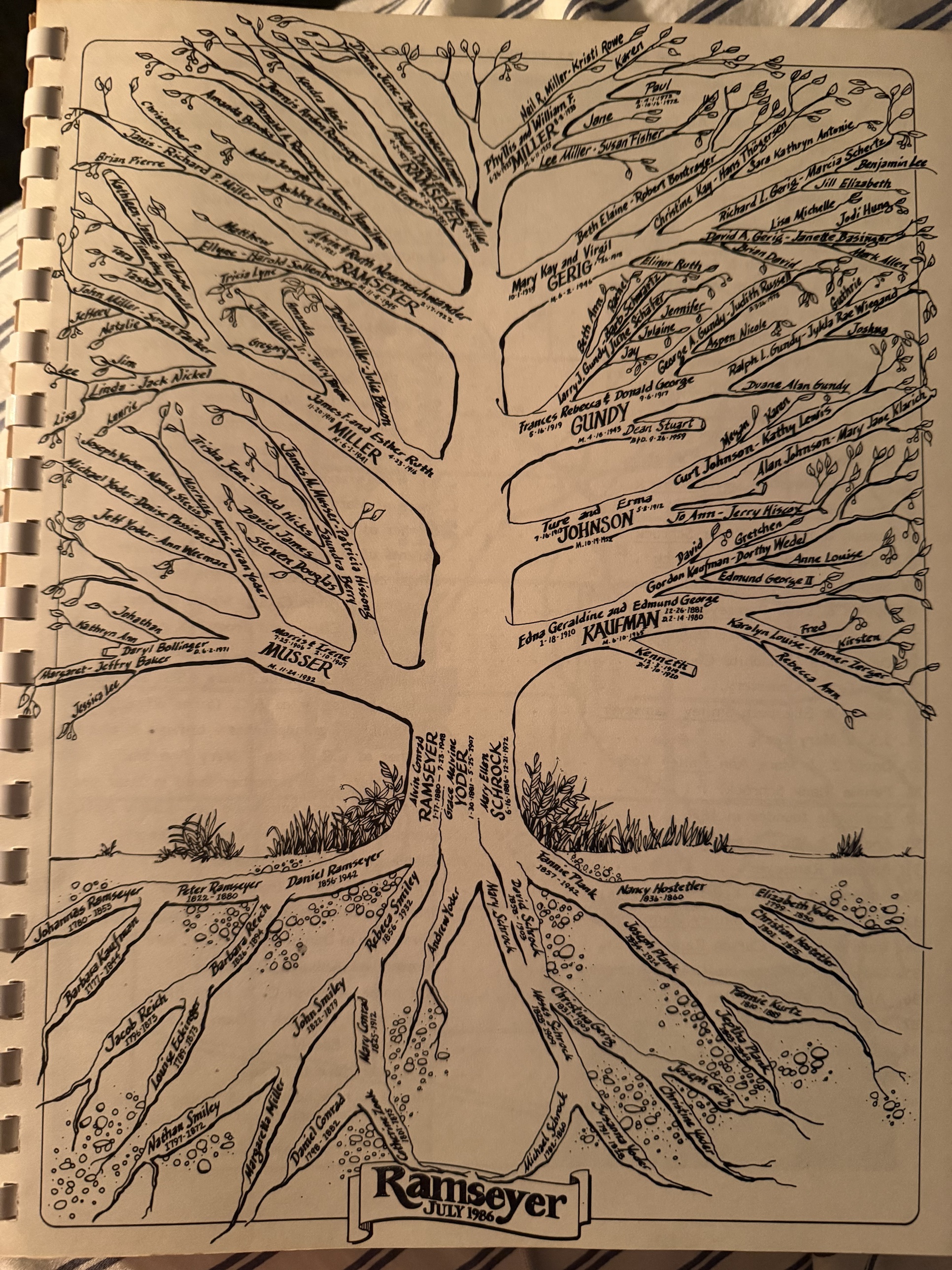
| Root | Dates on tree | Compared with this file |
|---|---|---|
| Johannes Ramseyer | 1780–1853 | Agrees with Staker. |
| Barbara Kauffman | 1777–1844 | Agrees with the 1907 booklet; Staker says 1779. |
| Peter Ramseyer | 1822–1880 | Agrees. |
| Barbara Reich | 1826–1894 | Agrees. |
| Jacob Reich | 179?–187? (about 1795–1873) | Barbara’s father. Agrees with Staker; the tree adds dates. |
| Louise Eckinger | 179?–1873 | Barbara’s mother. Agrees with Staker. |
| Daniel Ramseyer | 1856–1942 | Agrees. |
| Rebecca Smiley | 1856–1932 | Agrees. |
| John Smiley | 1822–1879 | Agrees. The tree shows him as Rebecca’s father, a third compiled source for the Smiley link. |
| Mary Conrad | 1825–1912 | Agrees. |
| Nathan Smiley | 1797–1872 | Agrees. |
| Margaretha Miller | — | Shown as Nathan’s wife and John’s mother. Conflict: John’s 1879 obituary names his mother Anna. Find a Grave gives Nathan’s second wife as Rebecca Margaret Miller, married 1831, nine years after John’s birth. The tree has probably put the second wife in the first wife’s place. |
| Daniel Conrad | 1798–1882 | Agrees (Daniel Jacob Conrad). |
| Catherine Zook | (1801–1875) | Agrees. |
| Andrew Yoder | — | Mellie’s father; agrees. |
| Mary Schrock | — | Mellie’s mother, drawn as a branch of the Schrock root. This confirms that Alvin Sr.’s two wives were first cousins. |
| David Schrock | 1858–1903 | Agrees. |
| Fannie Plank | 1857–1942 | Agrees. |
| Joseph Plank | 1834–1914 | Agrees. |
| Nancy Hostetler | 1836–1860 | Agrees. |
| Christian Hostetler | 1801–1875 | Agrees with Find a Grave. |
| Elizabeth Yoder | 1799–1890 | Agrees (Nancy Hostetler’s mother). |
| Jeptha Plank | (1803–1846) | Agrees. |
| Fannie Kurtz | 1810/11–1889 | Agrees (Veronica “Fanny” Kurtz Plank). |
| Moses Schrock | 1828–1909 | Agrees. |
| Christina Gerig | 1831–1909 | Year differs from her obituary (1832). |
| Joseph Gerig | — | New: Christina Gerig’s father. |
| Christina Yoder | — | New: Christina Gerig’s mother. |
| Michael Schrock | 1782–1860 | Agrees. |
| Susanna Yoder | 1791–184? | Find a Grave says 1855. |
Evaluation. The 1986 tree is a family compilation made 50 to 200 years after the events. Where it can be checked, it agrees with the obituaries and records almost everywhere. That makes it a good guide, though it is not proof. It independently supports four links that rested on compiled sources:
- Rebecca Smiley’s parents;
- Barbara Reich’s parents;
- the Schrock line;
- the Plank and Hostetler grandparents.
It also may have been one of the sources behind later compilations such as Find a Grave and Staker, so its agreement with them is not fully independent.
Authorship of the Ramseyer family record is resolved. The book covers the family to 2002, but Edna died in August 2001. The catalog lists Arden as publisher and Edna as a contributor. So both recollections are right: Edna was a principal compiler, as Christopher’s copy shows, and Arden (Al’s brother) completed and published it. This is now the most important single source for the Ramseyer line. It should be checked for:
- the Swiss and French origins of Johannes and Barbara, including Eckenweil/Eggiwil vs. Neuchâtel and Maîche;
- Barbara Reich’s parents;
- the Smiley entries, including any account of Nathan Smiley’s Irish birth;
- David Schrock’s parents;
- any English-ancestor story;
- the bibliography on p. 815.
The Sprunger book confirms the Neuenschwander–Sprunger link. The bookmarked p. 39 entry (“third generation, 5th branch”) gives Bessie Sprunger, born Feb 23, 1889, at Berne, married to Rev. Andrew J. Neuenschwander, son of Jacob C. This matches Bessie’s and Andrew’s obituaries. Bessie’s daughter is Ruth (born Feb 17, 1922), Christopher’s grandmother, documented by Ruth’s own obituary.
The book’s progenitor, Peter Sprunger (1757–1840), should be the head of Bessie’s paternal line. Find a Grave gives that line as Christian C. Sprunger (1860–1940) → Peter R. Sprunger (1825–1898) → Abraham Sprunger (1797–1889). The book’s branch numbering should show whether Abraham was a son of Peter (1757–1840). It should also show whether Rosina Reusser’s mother, Katherine Sprunger, descends from the same Peter. That would explain Bessie’s Sprunger ancestry on both sides.
What to look up in the physical sources (most useful first):
- Ramseyer record: the entries for Peter (b. 1822) and Barbara Reich, and Daniel and Rebecca Smiley. Does it name Barbara’s parents, or Rebecca’s? Does it mention Nathan Smiley or an English or Irish ancestor?
- The Schrock Ramseyer Story (written by Mary Ellen’s children): the date, and whether it names David Schrock’s parents or describes her childhood near Orrville. If it says Moses Schrock and Christina Gerig, that confirms the strong lead in this file.
- Sprunger book: the chain of entries above Bessie (her father Christian C., his father, and so on up to Peter, 1757–1840), and whether her mother Rosina Reusser’s line also appears.
- Illustrated tree and the Mary Alva Farm folder: names and dates that differ from this file, especially for the Smiley, Schrock, Reich and Kurtz lines.
- Ramseyer record, opening chapters: Johannes’s birthplace and the sources the compilers used.
Books by family members and related compilations
Christopher recalls a large genealogical book by an aunt, possibly Edna Ramseyer Kaufman or Irene Ramseyer Musser, and has a paper copy (family recollection). The records show Edna as Al’s full sister (daughter of Mary Ellen Schrock) and Irene as his half-sister (daughter of Mellie Yoder). Found so far:
| Book | Author | Digital copy | Notes |
|---|---|---|---|
| Melting Pot of Mennonite Cookery, 1874–1974 (Bethel College Women’s Association, 1974; 2nd ed. 1975) | Edna Ramseyer Kaufman, compiler | Internet Archive (borrow only, 372 pp.); 2nd ed. | Her only book found in catalogs. A cookbook, not a genealogy. |
| The Family Record of Johannes & Barbara (Kaufman) Ramseyer, 1780–2002 | Compiled with Edna Ramseyer Kaufman; published by Arden Ramseyer (Al’s brother), 2002 | none (catalogued: OCLC 51656575) | Christopher has a copy. See “Family-held books and papers” above. |
| Brief Outline … Ramseyer-Rich Reunion (1907) | John A. Liechty | Internet Archive (free) | See above. |
| The Peter Kaufman and Freni Strausz Kaufman Family Record, 1844–1963; Jacob Schrag Family Record, 1836–1974 | Edmund G. Kaufman (Edna’s husband) | IA; IA | Edmund’s own families, Christopher’s step-relatives by marriage. Edna may have helped; the 1974 Schrag book dates from their marriage. |
| General Conference Mennonite Pioneers (1973) | Edmund G. Kaufman | IA | Large biographical volume. Could be the “large book” if the memory is of the Kaufman household. Check whether it includes Rev. A. J. Neuenschwander. |
| Neuenschwander Family Record … Christian Neuenschwander, 1812–1958 | Albert Neuenschwander (1958) | IA (free) | A different family. That Christian died at Pandora, Ohio, in 1905, and his son Jacob was born in 1849. Ours (Andrew’s grandfather) died at Berne in the 1880s; Jacob C. was born in 1848. Do not merge them. |
Edna Geraldine Ramseyer Kaufman (1910–2001): Al’s sister
Side research, 2026-10-30. Edna was the eldest child of Alvin C. Ramseyer Sr. and Mary Ellen Schrock, and a principal compiler of the 2002 Ramseyer family record. Her middle name, Geraldine, comes from the 1986 family tree (“Edna Geraldine and Edmund George Kaufman”).
| When | What | Source |
|---|---|---|
| Jan 18, 1910 | Born in Wayne County, Ohio, to Alvin C. and Mary (Schrock) Ramseyer. | MLA obituary |
| 1930s | B.S., Bluffton College. Later a doctorate in home economics from Ohio State University; dissertation title and year not yet found. | MLA obituary |
| 1936–1965 | Professor of home economics, head of the department, and dean of women at Bluffton College. She “taught the entire home economics curriculum, advised international students and was dining room hostess.” | MLA obituary |
| 1939 | As a doctoral student, joined a co-ed Quaker (AFSC) work camp. | Goshen College faculty history (below) |
| 1940 | Mennonite Central Committee relief worker in Vichy France. MCC and the Quakers opened a “convalescent home” near Marseille for malnourished children from French internment camps, and “Edna Ramseyer, a young MCC worker from Bluffton, Ohio, took charge of the house in La Rouvière.” She handed it over to the Swiss Mennonite Charlotte Gerber in December 1940; Gerber went on to open MCC’s Villa Saint-Christophe for children from the Rivesaltes camp. Edna’s obituary describes the work as “dietician and supervisor of the Spanish refugee colony in Marseilles”; the Goshen history says “Spanish refugee children.” | Intersections: MCC Theory and Practice Quarterly, “MCC and National Socialism” (PDF), citing her papers |
| 1940 | Her own words, on the back of a photo of the girls in her care, whom she listed as French, Alsatian and German Jewish: “Can you see a difference? I guess children are very similar. Too similar to fight about the differences.” | Same, citing Edna Ramseyer Kaufman Papers, MS 300, Box 9, Mennonite Library and Archives, Bethel College |
| 1941–42 | Dietician at CPS Camp 13, the Mennonite Central Committee’s first Civilian Public Service camp, at Bluffton, Indiana (June 1941–March 1942). She worked there with camp matron Alta Schrock. | CPS Unit 13 (CPS archive) |
| Early 1940s | Back at Bluffton, then taught nutrition at Goshen College’s Civilian Public Service relief school. | Goshen history |
| 1945 | Led a women’s summer service unit at Hudson River State Hospital, Poughkeepsie, NY (CPS Unit 144, a mental-hospital unit), where she taught “introduction to relief.” On July 9, Eleanor Roosevelt and her secretary visited the units “at the invitation of Edna Ramseyer, to discuss foreign relief training.” This page says she had worked with refugee children “in Spain.” Her other sources place that work in France, with Spanish refugee children, so “Spain” is probably a slip. | CPS Unit 144 (CPS archive) |
| 1948 | Her father’s obituary (1948) lists “Edna Ramseyer of Bluffton, O.,” then serving as leader of an MCC summer unit in Germany. That was postwar relief work. | Alvin C. Ramseyer obituary, MLA |
| Aug 12, 1943 | Founded the “C.O. Girls” at Goshen College. Women students gathered at the administration building, “proclaimed themselves ‘C. O. Girls,’” and drafted a constitution for a women’s conscientious objector society. This asked how women could take part in alternative service when only men were drafted. Edna later told historian Rachel Waltner Goossen she had always stressed “a motif of service, never ‘a new role for women.’” Goossen: “by encouraging young women to participate more directly in Civilian Public Service, she implicitly raised questions of gender and power.” | Goshen College faculty history, n. 14; Rachel Waltner Goossen, Women Against the Good War: Conscientious Objection and Gender on the American Home Front, 1941–1947 (UNC Press, 1997) (Internet Archive, borrow only) |
| Aug 1947 | Spoke at the Sixth Conference on Mennonite Cultural Problems, Goshen, on “Open Doors for Mennonite Women in Social Work.” She urged professional training for church women in social work, nursing, dietetics and voluntary service: “no religious worker can serve as he should without a social vision.” | Proceedings (Internet Archive) |
| 1958–59 | Planned and built the Mary Alva House, a home-management house for home economics students, named for her parents, and deeded it to Bluffton College. It is still used by family and consumer science majors. | MLA obituary |
| 1962 | Taught with Operation Crossroads Africa in Gabon. | MLA obituary |
| June 10, 1965 | Married, at Smithville, Dr. Edmund G. Kaufman (1891–1980). He had been a missionary educator in China (1917–25), was president of Bethel College 1932–52, and founded Bethel’s Mennonite Library and Archives, the archive that now holds her papers. She was his third wife. | Edmund’s MWR obituary, Feb 21, 1980 |
| c.1966–67 | Spent “two years in India” with Edmund. His obituary says he “traveled in India in 1967” and taught at the Punjab Agricultural University; it garbles the place and dates (“Cairo, Egypt, 1950–51”). | Both obituaries; dates unresolved |
| 1967–1975 | Professor of home economics at Bethel College, North Newton, Kansas; dean of women 1968–69; counselor 1969–70; half-time at Hesston College 1970–71. Revived the Bethel College Women’s Association. | MLA obituary |
| 1974 | Compiled Melting Pot of Mennonite Cookery, 1874–1974 for Bethel’s centennial of the Russian Mennonite migration to Kansas. | Internet Archive |
| 1981–1990 | Wrote the column “Homemaker’s Notebook” in Mennonite Weekly Review. Kept baking bread for Bethel faculty coffees: “You could smell the bread baking when you entered the building,” said Bethel President Doug Penner, “and she would always provide the recipe.” | MLA obituary |
| 2001 | A principal compiler of The Family Record of Johannes & Barbara (Kaufman) Ramseyer; it was published by her brother Arden in 2002 and includes “Old Ramseyer family recipes.” | Open Library; Christopher’s copy |
| Aug 5, 2001 | Died at Schowalter Villa, Hesston, Kansas, aged 91. | MLA obituary (link) |
Her papers survive. The Edna Ramseyer Kaufman Papers (MS 300) at the Mennonite Library and Archives, Bethel College, North Newton, Kansas, fill 7.45 cubic feet, roughly 7 or 8 record boxes. They include her France photographs (Box 9). No online folder list was found. The archives’ collection index is here. This is probably the richest unexplored source in the whole family: wartime letters from France, the C.O. Girls, Bluffton, Gabon, India, and her genealogy notes for the 2002 Ramseyer book. A request to the MLA could get a box list.
Her doctorate (searched 2026-10-30, not found online). Ohio State only approved a Ph.D. in home economics in 1947, and the first was awarded in 1949 (OSU School of Home Economics history, 1896–1970). Home economists before that took the Ph.D. in other departments. So either her degree dates from 1949 or later, or it was in another department, such as Education, and is described loosely as “in home economics.” She was a doctoral student by 1939. Open Library, Google Books and the Internet Archive have no thesis by her. WorldCat, HathiTrust and OSU’s library catalog block automated searching. The quickest routes are: (1) search WorldCat or ProQuest Dissertations yourself for author “Ramseyer, Edna”; (2) ask OSU Libraries’ Ask-a-Librarian service; (3) her papers at Bethel (the request letter already asks).
Still open: her Ohio State dissertation title and year; the exact years in India; whether the La Rouvière children included Spanish refugees as well as children from French internment camps; and Goossen’s full account of the C.O. Girls (chapter text not available online).
Resolved 2026-10-30: the “large genealogical book” is the Johannes & Barbara Ramseyer family record (see “Family-held books and papers”).
Evidence: Ruth and the Neuenschwander line
- Ruth S. Neuenschwander Ramseyer: born Feb 17, 1922, in Philadelphia, Pa., to A. J. and Bessie Sprunger Neuenschwander. Her father had a pastorate at First Mennonite Church, Philadelphia; that it was his post in 1922 is an inference from her birthplace. Graduated from Quakertown (Pa.) High School and from Bluffton College in 1943. Taught home economics at Chester High School and Wooster High School. Died at home in Smithville Jan 4, 2017. Service at Oak Grove Mennonite Church; buried at Oak Grove. Obituary via Find a Grave.
- Alvin and Ruth’s wedding: a contemporary college bulletin identifies Ruth’s father as Rev. A. J. Neuenschwander and her twin brother as Robert. Bluffton bulletin.
- Ruth’s siblings: twin Robert Sprunger Neuenschwander (1922–1998; Dr. Robert S., West Covina, Calif.), Gordon E. Neuenschwander (1927–1996; Wexford, Pa.), and two who died in infancy: Elizabeth Ann (1918) and Andrew (1920). Andrew’s newspaper obituary says “two children died in infancy.” Bessie’s obituary says “three children … preceded in death,” which may count differently.
- Andrew J. Neuenschwander: born in Berne, Ind., “a son of Jacob C. and Elizabeth Stauffer-Neuenschwander.” Married Bessie Sprunger Sept 2, 1917. Bluffton College and Witmarsum Seminary graduate. Pastorates: Apostolic Mennonite (Trenton, Ohio), First Mennonite (Philadelphia), First Mennonite (Upland, Calif.), Swamp Mennonite (Quakertown, Pa.), and Hope Mennonite (Columbiana, Ohio, by 1961–64). He and Bessie lived “for many years” at Wadsworth, Ohio, before Columbiana (Bessie’s obituary). Served the General Conference as vice-president and as field secretary of the Young People’s committee and Publication Board. Died at Lutheran Hospital, Fort Wayne; buried at MRE Cemetery, Berne. Decatur Daily Democrat, Apr 21, 1972, via Find a Grave; MLA obituary.
- Date conflicts: birth is Nov 4, 1888 in the newspaper obituary, Find a Grave and SSDI, but Dec 4, 1888 in The Mennonite. Prefer Nov 4. Death: he died on a Wednesday at 5:15 p.m. In April 1972, Wednesday fell on the 19th (MWR and Find a Grave). The Mennonite and one Find a Grave transcription give April 20.
- Jacob C. Neuenschwander: born July 19, 1848, Putnam County, Ohio; died Feb 1921, Monroe Township, Adams County, Ind. His Indiana death certificate names his father Christian and mother Anna Lehman, and his late wife Elizabeth Stauffer. Find a Grave gives Feb 25; the certificate abstract says Feb 26. A 1907 county biography says he married Elizabeth Stauffer in 1872 and they had twelve children, five dying in infancy. It names the survivors as Anna, Adam, Lovina, Emanuel, David, Theressa, and Andrew, “who is at home.” He was a Mennonite church member and later a Prohibitionist. Snow, History of Adams County, Indiana (1907), p. 399, and death certificate abstract, via Find a Grave.
Berne, Indiana: the Swiss Mennonite settlement (expanded 2026-10-30)
- Where they came from. Berne was settled in 1852 by Mennonites who came directly from Switzerland, from the congregation at Münsterberg, a mountain community above Moutier in the Bernese Jura. They named the town after the capital of their home canton. Wikipedia; GAMEO, Münsterberg.
- The first party. It numbered roughly 70 to 100 people, depending on the source. One account says a company of about a hundred left Münster (Moutier) in March 1852. GAMEO’s First Mennonite Church article speaks of “another group of 80 persons, mostly members of the Sprunger family or their relatives by marriage.” GAMEO names Peter S. Lehman as a leader of the emigration; he was the Berne congregation’s first elder, 1852–53. GAMEO, First Mennonite Church (Berne).
- Earlier and later Swiss in Adams County. A Swiss Mennonite Baumgartner family had already settled in nearby French Township in 1838. Another wave left Münsterberg after 1874, when Switzerland stopped exempting Mennonites from military service.
- The church.
- The first meetinghouse was a small frame building on West Main Street. The large frame church begun in 1879 could seat about 1,500, “perhaps the largest seating capacity of any church in Adams county.” Snow, History of Adams County (1907).
- Rev. S. F. Sprunger was its minister for more than 30 years. First Mennonite of Berne is described as one of the largest Mennonite congregations in North America.
- Berne hosted the General Conference Mennonite Church in 1884, 1902, 1926 and 1947. It was home to the denomination’s publishing house, the Mennonite Book Concern, from 1884 to 1939.
- Christopher’s Neuenschwander, Sprunger, Stauffer and Reusser ancestors are buried in its MRE Cemetery.
- The town. The railroad arrived on Christmas Day 1871, a post office followed in 1872, and Berne became a city in 1887. In 1907 Snow wrote that one could call “every other resident” a Lehman, Sprunger or Hilty and be right.
- Where Christopher’s families fit.
- The Sprungers came with the 1852 founding group from Münsterberg.
- The Neuenschwanders and Lehmans came by a different route: from the Bernese Jura in 1845, through Ohio and Iowa, joining the Berne community later.
- The Stauffers and Habeggers were already farming in Monroe Township by 1855, when Elizabeth Stauffer was born there.
Christian and Anna (Lehman) Neuenschwander (expanded 2026-10-30)
| Christian P. “Crist” Neuenschwander | Anna Maria Lehman | |
|---|---|---|
| Born | Nov 23, 1812, “Bern, Switzerland” | Feb 23, 1825, Moutier, Bern, in the Bernese Jura, the Münsterberg congregation’s town |
| Parents | John Neuenschwander (1776–1838) and Katharina Fuhrimann (1782–1853) | Peter Lehman (1782–1861) and Anna Fuhrimann (1788–?) |
| Married | Oct 26, 1844, Tramelan, Bern (Bernese Jura) | same |
| Died | Nov 5, 1884, Berne, Indiana | May 28, 1886, Berne, Indiana |
| Buried | MRE Cemetery, Berne | MRE Cemetery, Berne |
Sources: Find a Grave, Christian and Anna. The dates are from headstones. The parents, birthplaces and marriage come from an attached Ancestry tree (“hawkridge/vaughan”), so they are compiled leads. The same tree’s “marriage 28 Mar 1854, Wells, York, Maine” is plainly an error, since their children were born from 1848. Snow (1907) says only “natives of Switzerland.”
- Their story, fitting the pieces together.
- Switzerland, 1844–45: married at Tramelan in the Bernese Jura in October 1844, they emigrated in 1845 (Snow).
- Putnam County, Ohio, 1845–about 1849: the Swiss Mennonite settlement around Bluffton and Pandora. Jacob C. was born there July 19, 1848.
- Iowa, about 1849–50s: Snow says they “removed to Iowa” after about four years in Ohio. The Iowa county is unknown.
- Adams County, Indiana: they settled in Monroe Township near Berne, joining the Swiss community there.
- Children (Find a Grave lists 13; Snow says 14): Jacob C. (1848–1921, Christopher’s ancestor), Rachel Stauffer (1849–1877), Adelina Liechty (1851–1909), Christian C. (1853–1937), Abraham C. (1855–1887), David C. (1857–1935), Anna (1859–1864), Verena “Fannie” Schneck (1860–1934), Joel (1862), Maria (1863–1864), Elizabeth Lehman (1863–1950), Lea Franz (1865–1934, wife of Dr. Franz of Berne), and Lydia (1868–1878). Five died as children.
- Death dates: Find a Grave preferred. Snow (1907) says Christian died in 1887 and Anna in 1889. The headstone dates on Find a Grave are 1884 and 1886. Prefer the stones; Snow’s dates were written about 20 years later from family recollection.
- Two Fuhrimann mothers. Christian’s mother (Katharina) and Anna’s mother (Anna) were both Fuhrimanns, so the couple may have been cousins. This is unverified.
- Anna’s father is not the Berne leader. The 1852 Berne leader Peter S. Lehman was born Nov 17, 1821 and died Feb 3, 1899 at Berne. His parents are given as Peter Lehman and Catharina Tschanz, and he married Verena Sprunger (Ancestry and Geneanet indexes). Born in 1821 to a different mother, he can’t be Anna’s father (born 1782) and is unlikely to be her full brother. A wider family connection is possible but unknown.
- Christian’s Swiss home. “Bern” is probably the canton, not the city. A Geneanet index entry gives a Christian Neuenschwander born 1811 at Höfen, Canton Bern, married to Anna Lehman. The Fuhrimann mother also points to the Emmental or Thun area, where the name is common. Not confirmed.
Tracing their parents (2026-10-30)
The Langnau register of Anabaptist families (K Langnau 36) has the Neuenschwanders too (read 2026-10-31). Transcribed by Claude from the scans; [uncertain words] are bracketed.
-
Page 16: Johannes Neuenschwander, son of Bendicht and Elisabeth Leeman, of Langnau (cf. page 9), living at Souboz, married Catharina Fuhrimann on 2 Dec 1806. Children:
- Jacob, 2 Apr 1808
- Johannes, 5 Mar 1810
- Christen, 6 Sep 1812
- Catharina, 5 Jan 1815
- Elisabeth, 13 Dec 1818
- [Abraham?], 24 Mar 1821
- Barbara, 7 Nov 1823
-
Page 16, next entry: Michel Neuenschwander, “brother of the above” (cf. page 9), married Barbara Fuhrimann; banns 8 Oct 1807. He died 27 Oct 1859, aged 74 years 3 months 27 days. Children from 1808 to 1831. This is the La Sagneule Michael (1785–1859) from the Bixler book. So two Neuenschwander brothers did marry two Fuhrimann women, as guessed earlier.
-
Page 9: their parents. Bendicht (Benedikt) Neuenschwander, son of the late Peter, of Langnau, living at Souboz, married Elisabeth Leeman (also of Langnau). Children:
- Peter, 28 Aug 1766
- Barbara, 14 May 1769
- Elisabeth, 8 Mar 1773
- Bendicht, 23 Aug 1774
- Johannes, 8 Apr 1776
- Ulrich, 25 Sep 1778
- (no number 7 in the list)
- Christen, 5 Apr 1782
- Michel, 30 Jun 1785
- Jacob, 27 Jun 1788
This gives the compiled “Johannes born 1776” an exact date and parents, and takes the line back to Peter Neuenschwander (deceased by the time of the entry).
-
Pages 9–10: the Putnam County pioneer Michael’s line (corrects a lead). Michael Neuenschwander, son of the late Peter, of Langnau, at Münster, married Barbara Steiner of Signau. Their children include Michael, born 9 Mar 1778. Page 10 then has that Michael, son of the late Michael, at Florimont, canton de Delle, arrondissement de Belfort, Haut-Rhin, married Anna Ernst (attested by the mayor of Florimont), with children Johannes (1810) and Daniel (1812). He is the 1833 Putnam County pioneer (1778–1852). His brother Daniel, also at Florimont, married a woman named [Schumacher?] on 20 Oct 1808.
-
Page 7: two more families of sons of the late Peter at Münster (Moutier). Christian Neuenschwander and Elisabeth [Ummel?] had children 1767–1788, including a Johannes born 6 May 1776. Hans Neuenschwander and Anna Gerber had children 1776–1788, including a Hans born 9 Apr 1776. So Peter Neuenschwander had at least four sons in the Jura: Christian, Hans, Michael and Bendicht.
⚠ Which Christen is ours? Unresolved.
| A. Christen, son of Johannes (page 16) | B. Christen, son of Peter (page 18) | |
|---|---|---|
| Born | 6 Sep 1812 | 23 Nov 1812, the headstone date |
| Parents | Johannes (born 8 Apr 1776) and Catharina Fuhrimann, as in the compiled tree | Peter Neuenschwander of Langnau, at Perrefitte (parish of Moutier), and Elisabeth [Hutmacher?], married 10 Oct 1810 |
| Siblings | Jacob, Johannes, Catharina, Elisabeth, [Abraham], Barbara | Johannes (1811), Anna (1814), Elisabeth (1816) |
The compiled tree pairs the headstone birth date with candidate A’s parents. One of the two must be wrong. The parents are a specific, two-name match, and Catharina Fuhrimann is said to have died in Ohio in 1853. That leans toward A, with the headstone date wrong, but it is not proven. Records that would settle it:
- Christian’s marriage record. The Tramelan Reformed marriage register (K Tramelan 16) was checked on 2026-10-31 for 1844 and has no Neuenschwander marriage around 26 Oct 1844. Still to check: the Tramelan banns register 1840–61 (K Tramelan 18), and the Moutier and Corgémont registers.
- His Ohio or Indiana death record or obituary, if it names his parents.
- Whether Catharina Fuhrimann and candidate A’s siblings appear in Putnam County, Ohio.
Page images saved in source-images/ (bern-K-Langnau-36-…).
Christian’s parents: Johannes Neuenschwander and Katharina Fuhrimann (compiled leads).
- Johannes Neuenschwander: born April 8, 1776, at Langnau im Emmental, Canton Bern; died 1838 (MyHeritage tree, via search summary). Langnau may be the family’s Swiss home town (Heimatort, the place of citizenship) rather than where they lived. Many Jura Anabaptists kept an Emmental citizenship.
- Katharina Fuhrimann: 1782–1853, died in Ohio (MyHeritage tree). If right, Christian’s widowed mother also emigrated, presumably to the Swiss settlement in Putnam County.
- Not to be confused with a Christian Neuenschwander born 1779 at Langnau who died 1864 at Riley, Putnam County (Geneanet), or the Christian who died there in 1839, son of a Daniel.
Why the family went to Putnam County, Ohio (corrected 2026-10-30).
- The pioneer was a different man. The first Swiss Mennonite pioneer in northwest Ohio, honored by a plaque near Bluffton as having come “in the Spring of 1833,” is Michael Neuenschwander, 1778–1852, born in France and buried at the Old Mennonite Cemetery, Bluffton. His wife was Anna Ernst (1780–1846), daughter of Jacob Ernst and Katerina Lehman. They married July 16, 1809, at Florimont, France, the same Territoire de Belfort village as Barbara Kaufmann on the Ramseyer side. Their children include Johannes B. (1810–1889) and Michael (1823–1893). Find a Grave, Michael; Anna; plaque (Bluffton Icon).
- A separate Michael married the Fuhrimann. Michael Neuenschwander (1785–1859), born at La Sagneule in the Bernese Jura, married Barbara Fuhrimann (born 1784, La Sagneule) in 1807, according to the family book Nussbaum & Neuenschwander by Paul and Elma Bixler (1986). RootsWeb. The first version of this section wrongly merged him with the 1833 pioneer.
- What’s still plausible: Christian’s parents (Johannes Neuenschwander and Katharina Fuhrimann) and the La Sagneule couple (Michael and Barbara Fuhrimann) may have been two brothers married to two sisters, but that is unproven. The Putnam County settlement had several Neuenschwander families from about 1833, which explains in general why Christian and Anna went there in 1845. How they were related to the pioneer Michael is unknown.
- They lived in the Jura. Both families point to the Bernese Jura rather than the Emmental: La Sagneule for the Fuhrimanns, and Tramelan, where Christian married. That fits the Jura Anabaptist community that later produced Berne, Indiana.
Anna’s parents: Peter Lehman and Anna Fuhrimann: DOCUMENTED (2026-10-31).
The original record is in the Langnau register of Anabaptist families, Heimatrodel der Täuferfamilien von Langnau, 1791–1870. It is held by the Bern state archives as K Langnau 36 (catalog entry; PDF scan, 74 pages, 7.8 MB).
What the volume is. It opens with an extract from the Bern council minutes. David Baumgartner of Langnau, an Anabaptist “settled in the Bishopric of Basel” (the Jura), had petitioned on behalf of himself and fellow members of his congregation living there. He asked that their children and descendants be entered in Langnau’s citizenship roll (Heimatrodel) and given certificates of citizenship (Heimatscheine), and the council agreed. So the register lists Anabaptist families of Langnau citizenship living in the Jura, which is exactly the Neuenschwander and Lehman situation.
Page 32, transcribed by Claude from the scan. Words in brackets are uncertain.
Leeman. Peter – Ulrichs und der Maria Th[ü]ler ehelicher Sohn /pag. 4/ – geb. 14. März 1782 zu Corgémont – verehelicht zu Mo[utier] 15. Aug. 1820 mit Anna Fuhrimann, [Jos.?] Tochter von Oeschenbach, K[irchgemeinde] Rohrbach, geb. 29. Feb. 1788. NB: sind copul. von Hr. Pfr. Walthard zu Moutier – vide Ehe-Rodel No. 4 pag. 19.
Kinder: 1. Christen, geb. 22. Aug. 1820 · 2. Abraham, geb. 17. März 1822 · 3. Peter, geb. 29. Sept. 1823 · 4. Anna, geb. 25. Hornung [February] 1825 · 5. Jacob, geb. 8. Juni 1828.
In English: Peter, legitimate son of Ulrich and Maria Th[ü]ler, born 14 March 1782 at Corgémont, married at Moutier on 15 Aug 1820 Anna Fuhrimann, born 29 Feb 1788, daughter of [Jos.?] of Oeschenbach in the parish of Rohrbach. The couple were married by Pastor Walthard of Moutier (marriage register no. 4, p. 19).
- This confirms the compiled tree on every point: Peter born 1782, Anna Fuhrimann born 1788, and a daughter Anna born in February 1825. The headstone says Feb 23 and the register Feb 25, so they differ by two days; the register is the earlier record.
- New facts:
- The family’s legal home (Heimatort) was Langnau.
- Peter was born at Corgémont in the Jura.
- His parents were Ulrich Leeman and Maria Th[ü]ler. The page 4 entry shows Ulrich living at Delsberg (Delémont) and lists his sons Peter (14 Mar 1782) and Christen (9 Apr 1784).
- Anna Fuhrimann’s home was Oeschenbach, in the parish of Rohrbach (Oberaargau district).
- Anna Lehman’s full siblings were Christen, Abraham, Peter and Jacob.
- Peter’s brother Christen (page 32) married Regina Aeschlimann [?] at Bern in 1827 and had children from 1832. Another Leeman entry on page 5, Peter son of Ulrich, born 1763 and married to Barbara Hofstetter in 1787, is a different Peter.
- Next:
- The Moutier marriage register (K Moutier) for 15 Aug 1820, to see Anna Fuhrimann’s father’s name.
- The Rohrbach registers, for Anna Fuhrimann’s 1788 baptism.
- The Corgémont registers, for Peter’s 1782 birth.
- The rest of this Langnau volume, for Neuenschwander families (not yet scanned page by page).
- No record found yet. Geneanet lists several Peter Lehmans of the Moutier and Courtelary area. One was born 1782 with a Moutier connection (tree of “michaeljelrod”); the page couldn’t be opened because the site asks for a bot check. Another, born 1780 at Jean Faivre (Courtelary) and died 1860 at Moutier, had a wife named Barbara Sprunger and so doesn’t match.
- A Fuhrimann tie. Anna’s mother was also a Fuhrimann, like Christian’s mother and Michael Neuenschwander’s wife. If all three were related, the Fuhrimanns of La Sagneule connect several of these Jura families.
Best next sources:
- Paul and Elma Bixler, Nussbaum & Neuenschwander (1986);
- the “Rita Gay (Sprunger) Burke Genealogy” cited with it;
- Swiss parish registers for Tramelan (the 1844 marriage), Moutier/Court (Anna’s 1825 baptism) and Langnau (Johannes’s 1776 baptism and the family’s citizenship);
- the Putnam County, Ohio cemeteries, for Katharina Fuhrimann Neuenschwander’s death in 1853. Checked 2026-10-30: no Find a Grave memorial was found for her. The Old Mennonite Cemetery at Bluffton holds the pioneer Michael (d. 1852) and Anna Ernst (d. 1846). Her grave may be unmarked or under another spelling.
About Swiss records for these families (2026-10-30).
-
Infant baptisms are missing. Anabaptists rejected infant baptism, so their children were usually not entered in the Reformed parish baptism registers. Births like Christian’s (1812) or Anna’s (1825) may not appear there at all.
-
What is more likely to survive:
- marriages, which Bern required to be registered (Tramelan, 1844);
- the family’s citizenship (Heimatort) records, possibly Langnau;
- Anabaptist church books kept by the Jura congregations themselves (Sonnenberg, Münsterberg, Courgenay), parts of which have been transcribed by Swiss Mennonite historians.
-
Where to look: the Bern parish registers are held by the Staatsarchiv Bern, and many are filmed on FamilySearch, which needs a free login. The specialist sources are the Schweizerischer Verein für Täufergeschichte (Swiss Anabaptist history society) and the Jura Mennonite congregations’ own archives; the exact repository still needs to be identified.
-
Christian P. and Anna (Lehman) Neuenschwander (from Snow, 1907): natives of Switzerland. Came to Ohio in 1845, lived about four years in Ohio, then Iowa, then Adams County, Ind. Fourteen children (Snow, 1907). Conflict: Snow says Christian died in 1887 and Anna in 1889. Find a Grave lists Christian “Crist” Neuenschwander (1812–1884) and Anna Lehman Neuenschwander (1825–1886).
-
Elizabeth Stauffer Neuenschwander: born Sept 3, 1855, Monroe Township, Adams County; died Oct 10, 1919, Berne. Her Indiana death certificate names her parents as Christian Stauffer and Fannie Habegger. Find a Grave calls the mother Verena Habegger (1822–1894). “Fanny” is the usual Swiss short form of Verena, so these are the same person. Christian Stauffer is given as 1823–1901. Snow (1907) says both parents were natives of Switzerland. Find a Grave.
Evidence: the Sprunger and Reusser lines
- Bessie Sprunger Neuenschwander: born Berne, Feb 23, 1889, “a daughter of Christian C. and Rosina Reusser Sprunger.” A former teacher who attended Bluffton one year. She served nine years as Central District Women’s Missionary Society secretary. Died June 23, 1964 at Columbiana, Ohio; buried MRE Cemetery, Berne. Surviving siblings: B. Franklin, Victor and Paul Sprunger; Mrs. Rena (Sprunger) Zuercher (printed “Reusser”); Mrs. M. A. (Gertrude) Thomas. Predeceased: sister Ella; brothers Oswald, Asa, Wesley. MLA obituary.
- Christian C. Sprunger: born Sept 11, 1860, Adams County, Ind.; died at home in Berne Jan 7, 1940, after strokes; retired farmer. Survived by his widow Rosina, six sons, and three daughters, including Mrs. A. J. Neuenschwander of Quakertown, Pa. Also survived by brother Benjamin and sisters Mrs. Anna Liechty and Mrs. Marianna Stucky. Buried MRE Cemetery. Journal-Gazette, Jan 8, 1940, via Find a Grave.
- The ten children of Christian and Rosina (Find a Grave; confirmed in substance by Asa’s 1955 obituary): Ella (1883–1893), Oswald O. (1884–1961), Asa (1886–1955), Bessie (1889–1964), Wesley Roy (1891–1952), Rena (Zuercher, 1893–1974), Benjamin Franklin (1895–1983), Victor Peter (1898–1986), Paul Emmett (1901–1989), Gertrude Linda (Thomas, 1903–1980). Asa Sprunger, Find a Grave.
- Peter R. Sprunger (1825–1898) and Marianna Moser (1829–1894) (compiled lead): Find a Grave links them as Christian C.’s parents. Their children Anna Liechty, Mary Ann Stucky and Benjamin match the siblings named in Christian C.’s obituary, which is good supporting evidence. Peter is linked to a father Abraham Sprunger (1797–1889). Find a Grave.
- Rosina Reusser Sprunger: born Aug 4, 1862; died July 19, 1950; married 1882; buried MRE Cemetery. Find a Grave and Geni both give her parents as Jakob Reusser and Katharina/Katherine Sprunger (1833–1904). Find a Grave; Geni. Find a Grave adds siblings Caroline Habegger, William, Mary Anna Gilliom, Emma Rohrer, Dr. Amos, Adina Orr and Henry Menno Reusser.
- Jakob Reusser (compiled lead): born June 21, 1840, Canton, Stark County, Ohio; died July 20, 1916, Berne. He is linked to parents David Reusser (1813–1896) and Katharina Utz (1808–1889). He remarried in 1906 to Maryann R. Sprunger. Caution: the memorial flags itself as a possible duplicate, and lists a “sibling” Jacob with identical dates. Rosina’s 1862 birth makes Jakob a father at 21, which is plausible but should be checked. Find a Grave.
- Sprunger origins (context, GAMEO “Sprunger name”): the American Mennonite Sprungers trace to a family from Thurgau. A Jacob Sprunger is said to have fled Thurgau about 1741 and settled in the Jura Mountains. A son named Peter in that line fits the Peter Sprunger (1757–1840) who heads Christopher’s 1973 Sprunger genealogy. The 1852 emigrants to Berne were largely his descendants. Christopher’s copy of the 1973 book should state Peter’s parents and home village directly. GAMEO, Sprunger name.
- Christian Neuenschwander’s Swiss home (lead only): a Geneanet index entry links a Christian Neuenschwander, born 1811 at Höfen, Canton Bern, with wife Anna Lehman, to Snow’s History of Adams County. The dates don’t agree with Find a Grave (1812–1884) or Snow (died 1887), so this is unconfirmed. Do not confuse him with the Christian Neuenschwander (1812–1905) of Pandora, Ohio, whose 1958 family record is a different family, or with the Christian who died in Putnam County in 1839.
- Sprunger to Sprunger: Rosina’s mother was herself a Sprunger, so Bessie had Sprunger ancestry on both sides. This is common in the tightly knit Berne Swiss community. The exact relationship between the two Sprunger families is not yet worked out.
Open questions, Ramseyer–Neuenschwander side
-
Confirm Rebecca Smiley’s parents with a record that names them (1932 death certificate, 1877 marriage record, or the 1860/1870 census).
-
Identify David Schrock’s parents.The 1986 family history states “third son of Moses and Christina Gerig Schrock.” A civil record (1860 census, 1903 death register, or Moses’s estate) would make it fully documented.David’s death dateis Aug 10, 1903, per the family history. -
Confirm Barbara Rich’s parents (Jacob Reich, about 1795–1873, and Louise Eckinger, about 1797–1873, per Staker and the 1986 family tree) with Stark County records:
- the 1830/1840 Paris and Washington Township censuses, looking for a Jacob Rich household;
- Stark County probate;
- Leah Reich Yoder’s obituary or death record, as a possible sister.
Also settle Barbara’s birthplace (Stark County vs. “Germany” in 1850).
-
Obtain Arden Ramseyer’s Family Record of Johannes & Barbara (Kaufman) Ramseyer.
-
Resolve Peter Ramseyer’s arrival.Settled by the Richmond passenger list (July 5, 1835). His birth at Maîche rests on the French civil index cited by Staker; the exact day (Oct 5 headstone vs. Nov 5 index) is still open. -
Check Christian P. Neuenschwander’s death year (1884 vs. 1887) and Swiss origin. Check the Stauffer, Habegger, Sprunger, Moser and Reusser lines back to their Swiss or Jura origins; Berne-area Swiss Mennonite compilations will help.
2. D. Paul Miller
Documented tree
D. Paul / David Paul Miller (30 Aug 1917–3 Nov 2018)
married Anna B. / Anne Wiebe, 14 Aug 1948
│
├── Father: David D. / D. D. Miller (2 May 1889–20 Jan 1976)
│   ├── Father: Noah E. Miller (29 Jul 1860–21 May 1910)
│   │   ├── Father: Eli D. Miller (8 Nov 1835–22 Mar 1913)            [documented]
│   │   │   ├── Father: Daniel D. Miller (1806–1865)                  [Find a Grave + 1911 Mast genealogy ("Daniel and Kate (Weaver) Miller")]
│   │   │   └── Mother: Catherine "Kate" Weaver (1811–1893)           [same]
│   │   └── Mother: Mary Mast (7 Jul 1837–31 Jan 1908), m. 23 Dec 1858   [documented; 1911 Mast genealogy #1592]
│   │       ├── Father: Rev. Abraham Mast (21 Sep 1802–18 Nov 1877), ordained 1840   [1911 Mast genealogy #1557]
│   │       │   └── Father: Christian Mast, m. 1800 Susanna Kurtz      [1911 Mast genealogy #1513]
│   │       │       └── Father: Bishop Jacob Mast (1738 Switzerland–8 Feb 1808), arr. 1750 on the Brotherhood  [1911 Mast genealogy #1]
│   │       │           ├── Father: unknown Mast (Christen or Ulrich, per WikiTree; Jacob, per Geni), of Guggisberg, Bern  [unresolved]
│   │       │           │   └── (tree) Hans Mast (b. 10 Mar 1661, Guggisberg) × Anna Mischler → Peter Mast (b. 1636, Guggisberg) × Barbara Stöckli → Benedict Mast (c.1597) × Barbara Marti  [compiled lead: WikiTree]
│   │       │           └── Wife: Magdalena Holly/Hooley (c.1740–26 Oct 1820)
│   │       └── Mother: Veronica Kurtz (7 May 1800–8 Jun 1845)         [1911 Mast genealogy]
│   │           ├── Father: Joseph Kurtz, of Juniata Co., Pa.          [1911 Mast genealogy]
│   │           └── Mother: Fanny Miller (b. 18 Sep 1769, Berks Co.)   [1911 Mast genealogy #169; 1912 Hochstetler genealogy]
│   │               ├── Father: "Daniel" Miller [1911/1912 books] = Christian (Daniel) Miller Jr. (c.1734–1777) [AAMG via WikiTree]
│   │               │   └── Father (Version B, unproven): Christian Miller Sr. (c.1706–1785), from Bern; arr. 1742, Francis and Elizabeth
│   │               └── Mother: Veronica "Freny" Mishler (c.1736–1785), arr. 1749, Phoenix  [1911 Mast; AAMG via WikiTree]
│   │                   ├── Father: Joseph Ulrich Mishler (c.1700–1756)   [WikiTree]
│   │                   │   └── Father: Ulrich Mishler (b. 14 Jan 1688, Wahlern, Bern)  [WikiTree]
│   │                   └── Mother: Anna Dorothea Mueller (c.1700–1789)   [WikiTree]
│   └── Mother: Sophronia Elizabeth Hummel (2 Oct 1861–16 Dec 1935)
│       ├── Father: William C. Hummel (27 Mar 1837–25 May 1912)       [documented]
│       └── Mother: Martha Gonser (16 Nov 1839–15 May 1908)           [documented]
│           ├── Father: Anthony G. Gonser (1817–1887)                 [compiled lead]
│           └── Mother: Elizabeth Warnes/Varnes (1821–1897)           [compiled lead]
└── Mother: Maggie Mae Kuhns (6 Apr 1890–19 Jun 1970)
    ├── Father: Samuel Kuhns (20 Jul 1843–12 Jan 1918)                [documented]
    └── Mother: Magdalena Slabaugh (16 Jun 1847–20 Dec 1925)       [1912 Hochstetler genealogy #3162 + obituaries]
        ├── Father: John Slabaugh (25 Apr 1806–24 Aug 1861, Berlin, Ohio)   [1912 genealogy]
        │   └── Father: John Slabaugh, came from Germany about age 18 with his mother (née Yoder)  [1912 genealogy]
        └── Mother: Susanna Nisly (2 Aug 1816–3 Mar 1885)           [1912 genealogy #3125]
            ├── Father: Rev. Christian Nisly, Amish minister; emigrated 1804  [1912 genealogy]
            └── Mother: Sarah Miller (d. 1 Jun 1857, Baltic, Ohio)  [1912 genealogy #3063]
                ├── Father: Rev. Abraham Miller (b. 13 May 1766, Berks Co., Pa.–c.1821), Amish minister  [1912 genealogy]
                │   └── Father: Daniel Miller, arr. Philadelphia 11 Aug 1760, ship *Patience*  [1912 genealogy]
                └── Mother: Anna ("Anelli") Hochstetler           [1912 genealogy #3062]
                    └── Father: John Hochstetler (c.1735 Europe–1805, Elklick, Somerset Co., Pa.), eldest son of the immigrant Jacob  [1912 genealogy #2]
Evidence and details
- D. Paul: born Protection, Kansas; died Normal, Illinois. Obituary names parents David and Maggie and his marriage to Anna Wiebe. 2018 funeral notice transcription.
- David D.: born Holmes County, Ohio; obituary identifies parents Noah and Saphronia (Hemmel), spelling variants of the names in Sophronia’s own obituary. Married Maggie June 16, 1914. Gospel Herald, February 1976.
- Maggie: born McPherson County, Kansas. Obituary names Samuel Kuhns as her father and D. Paul among her children. It names surviving sisters Emma Taton and Lula Klinglesmith, useful for identifying their mother. Gospel Herald, July 1970.
- Sophronia: obituary identifies her parents William Hummel and Martha Gonser, her marriage to Noah on January 12, 1882, Noah’s parents Eli D. Miller and Mary Mast, and son David D. of Protection. The family moved to Protection in 1907. Gospel Herald, January 1936.
- Noah: obituary supplies his birth and death dates and confirms wife Sophronia E. Hummel. Gospel Herald, June 1910.
Expanded evidence (2026-10-30)
- Noah E. Miller’s obituary: born Holmes County, Ohio; married Sophronia E. Hummel of Millersburg in 1882; 10 sons and 4 daughters, all living. The family lived in Ohio, Kansas, Oklahoma and Texas before moving to Comanche County, Kansas, about 1908. Survived by “an aged father, 2 brothers, and 2 sisters”; the father, still living in Holmes County, came for the funeral. He joined the Mennonite Church about 1886 and was Sunday school superintendent at Protection. Herald of Truth obituary via Find a Grave.
- Eli D. Miller (Nov 8, 1835, Berlin, Holmes County–Mar 22, 1913) and Mary Mast (July 7, 1837–Jan 31, 1908) are buried in the Abraham Mast Cemetery, Hardy Township, Holmes County. Sophronia’s obituary documents the parent link. Find a Grave links Eli to parents Daniel D. Miller (1806–1865) and Catherine Weaver (1811–1893), which agrees with the FamilySearch profile, and Mary to Abraham Mast (1802–1877) and Veronica Kurtz (1800–1845). Eli; Mary.
- William C. Hummel: born Mar 27, 1837, New Bedford, Coshocton County, Ohio; died May 25, 1912, Glenmont, Holmes County. Married Martha Gonser in 1858; buried at Walnut Creek Cemetery. Find a Grave lists ten children including Sophronia. Find a Grave.
- Martha Gonser Hummel’s parents (compiled lead): Anthony G. Gonser (1817–1887) and Elizabeth Warnes/Varnes (1821–1897), married Oct 25, 1838. Find a Grave.
- A family that joined the Mennonites. Sophronia’s obituary says that “since her marriage she has been a faithful member of the Mennonite Church.” Hummel and Gonser are not typical Amish surnames. So this branch was “near” the Anabaptist world rather than born into it. That makes it one of the more likely places for non-Anabaptist ancestry, including English (see section 4).
- Date conflict: Find a Grave gives D. D. Miller’s wife Maggie’s birth as May 2, 1890, but her obituary says Apr 6, 1890. May 2 is D. D.’s own birthday (1889), so Find a Grave has probably confused the two. D. Paul, Maggie and D. D. are buried at Ropp Cemetery, Hudson, Illinois (D. Paul) and Elkhart Prairie Cemetery, Goshen, Indiana (D. D. and Maggie).
D. Paul’s Mast and Kurtz lines, from the 1911 Mast genealogy
Source: C. Z. Mast, A Brief History of Bishop Jacob Mast and Other Mast Pioneers; and a Complete Genealogical Family Register (Elkhart, Ind., 1911). Internet Archive (free full text). It is a published family compilation, made while Eli D. Miller was still living.
- #1592 Mary Mast: born July 7, 1837; married Dec 23, 1858, Eli D. Miller, born Nov 8, 1835, “son of Daniel and Kate (Weaver) Miller, of Holmes Co.” This supports Find a Grave’s Daniel D. Miller and Catherine Weaver. Children include Noah E. Miller, married to Sophronia Hummel. The family were members of the Amish Mennonite Church.
- #1593 Noah E. Miller: married Jan 12, 1882, to Sophronia Hummel, “daughter of William and Martha (Gondsor) Hummel.” The children listed include David, b. May 2, 1889, D. Paul’s father.
- #1557 Rev. Abraham Mast: born Sept 21, 1802; lived at Berlin, Holmes County; ordained a minister in 1840. He married Jan 8, 1826, Veronica Kurtz (May 7, 1800–June 8, 1845, of pneumonia). His second wife (1846) was her sister Elizabeth Kurtz. “Both wives were daughters of Joseph and Frances (Miller) Kurtz, of Juniata Co., Pa.”
- #1513 Christian Mast: Abraham’s father, the 10th child of Bishop Jacob Mast. He married Susanna Kurtz on Jan 5, 1800, and lived later at Millersburg, Holmes County. The book describes him as a tall man with curly hair, blue eyes and “a pleasant smile.”
- #1 Bishop Jacob Mast: born 1738 in Switzerland. He came to America as an orphan with his sisters and brother John, in the care of an uncle, Johannes Mast, on the ship Brotherhood, which landed at Philadelphia Nov 3, 1750, from Rotterdam by way of Cowes. They settled in the Northkill Amish congregation, the same community as the Hochstetlers. He married Magdalena, daughter of fellow passenger Michael Holly (Hooley). After an Indian attack in 1760 the family moved to the Conestoga Valley on the Berks–Chester County line. He became one of the leading Amish bishops of his day.
- #169 Fanny Miller: born Sept 18, 1769, in Berks County; married Joseph Kurtz. Her father was #119 Daniel Miller, who “presumably came from Germany” with his first wife, a Kenagy, on the ship Patience. After she died he returned to Europe, married Veronica Mishler, and came back to farm near Shillington, Berks County. The Mast book gives the Patience landing as Aug 11, 1750; the 1912 Hochstetler book says 1760. Check the published ship list.
Who was immigrant “Daniel Miller”? Two versions (added 2026-10-30)
Version A: the 1911 Mast and 1912 Hochstetler books.
- “Daniel Miller,” born in Europe, “presumably came from Germany” with a first wife named Kenagy on the ship Patience. The 1911 book gives the landing as Aug 11, 1750; the 1912 book says 1760.
- He went back to Europe after his first wife died, married Veronica Mishler (born about 1736) there, returned, and farmed near Shillington, Berks County.
- Their children: Christian (1760–1832, Amish minister, married Catharine Kurtz), Elizabeth (married a Kenagy), Jacob, Abraham (1766, married Anna Hostetler; Kuhns line), Susanna (married a Stutzman), Fanny (1769, married Joseph Kurtz; Mast line), Barbara (married Solomon Yoder), and Magdalena (married a Hershberger). They were Amish Mennonite.
- 1911 Mast genealogy, #119.
Version B: modern Amish genealogy (WikiTree, managed by the Palatine Migration Project). It cites Hugh F. Gingerich and Rachel W. Kreider, Amish and Amish Mennonite Genealogies (AAMG), pp. 269–270, the standard reference.
- Veronica “Freny” Mishler (born about 1736; died 1785, Shillington, Berks County) came to Philadelphia as a girl on the Phoenix in 1749 with her family. She married in Pennsylvania about 1758–60 Christian Miller Jr. (about 1734–1777), a widower, often called “Christian Daniel Miller.” The children listed match Version A: Christian, Elizabeth, Jacob, Abraham, Susanna, Veronica (that is, Fanny), Barbara (Yoder) and Magdalena. WikiTree: Veronica Mishler.
- Veronica’s parents: Joseph Ulrich Mishler (about 1700–1756, Switzerland) and Anna Dorothea Mueller (about 1700–1789). Her grandfather was Ulrich Mishler, born Jan 14, 1688, at Wahlern, Canton Bern, in the Schwarzenburg district, the same district as the Hochstetlers’ Winterkraut.
- Christian Jr.’s father: Christian Miller Sr. (born about 1706–08, reportedly at Bern, Switzerland; died 1785). He arrived at Philadelphia on the Francis and Elizabeth, Sept 21, 1742, alongside the related Amish families Zug, Yoder and Gnaegi. He warranted land in Penn Township, Berks County, in 1747, which was part of the Northkill Amish settlement. WikiTree: Christian Miller Sr..
- WikiTree’s own cautions: the 1750 Patience list has a “Daniel” Miller but no Christian, “which is probably the source of people giving Christian the middle name Daniel.” It has removed the name “Daniel” for lack of evidence. It also says two or more Christian Millers (Lynn Township vs. Northkill) have been conflated in online trees. A paternal-line Y-DNA test (haplogroup R-M512) is attached to the profile.
Assessment. Both versions agree on the essentials: the wife Veronica Mishler, the Berks County farm near Shillington, the eight children (including Abraham and Fanny), and an Amish Mennonite family. They disagree on the man’s first name, his ship, and where the marriage took place. Version B rests on AAMG and on ship lists that can be checked: the Phoenix in 1749 and the Francis and Elizabeth in 1742. Version A rests on early-1900s family tradition. Prefer Version B as the working identification, but treat the Christian Sr. to Christian Jr. link as unproven. WikiTree’s own notes flag conflation, and no record found yet names Christian Jr.’s father.
If Version B holds, this line also reaches back to the Northkill Amish of the 1740s and to Canton Bern: the Millers reportedly from Bern, and the Mishlers from Wahlern, near Schwarzenburg.
To confirm: read AAMG (Gingerich and Kreider) pp. 269–270, and J. Virgil Miller’s Anniversary History of the Family of John “Hannas” Miller, Sr.. Also check the Phoenix (1749), Francis and Elizabeth (1742) and Patience (1750) lists in Strassburger and Hinke, Pennsylvania German Pioneers.
How far back Bishop Jacob Mast goes (added 2026-10-30)
What the 1911 Mast genealogy says.
- Origins: Jacob was “born in 1738 in Switzerland, Europe, of Swiss parents,” and came “an orphan boy.” The family is “an old one, originally from Switzerland,” and he was “undoubtedly driven from his native land by religious persecution.” The book names neither his parents nor his village.
- The voyage: his uncle Johannes Mast brought him, his younger brother John and four sisters on the Brotherhood, which landed Nov 3, 1750. The original list, certified in 1911, shows “Johannes Mast” (spelled “Nast” in one transcription) with Andreas and Michael Holly.
- His work as bishop: he visited Amish Mennonite congregations in Berks, Lancaster, Chester, Somerset and Cambria counties every year.
- His death: he died in 1808 (WikiTree: Feb 8) and is buried at Pine Grove Cemetery, near Elverson, on the Berks–Chester line. His wife Magdalena Holly died Oct 26, 1820, aged 80, and lies beside him. The Lancaster Mennonite Historical Society holds his coat and wedding vest.
- His children (12, from the 1911 book via WikiTree): John, Magdalena (Zook), Barbara (married 1st John Hochstetler, 2nd John Zug), Jacob, David, Mary (Coffman), Nancy (Kurtz), Fanny (Zug), Elizabeth (Holly), Christian (married Susan Kurtz), Esther (Zug, then Holly), and Daniel. Barbara and Christian are Christopher’s two lines.
What later research adds (compiled, not proven):
| Source | Father | Earlier line | Place |
|---|---|---|---|
| WikiTree, Mast-18 (Palatine Migration Project) | “either Christen Mast or Ulrich Mast”; shown as “Unknown Mast” | Grandfather Hans Mast (born Mar 10, 1661) × Anna Mischler; great-grandfather Peter Mast (born Jan 1, 1636) × Barbara Stöckli; 2nd-great-grandfather Benedict Mast (born about 1597) × Barbara Marti | Guggisberg, Canton Bern |
| Geni (per search summary; not opened) | Jacob Mast × Barbara Berkey | not checked | Guggisberg, Bern |
| Ancestry public tree | ”John Hooley and Veronica Mueller” | — | — (almost certainly his wife’s family, confused; ignore) |
Assessment. The father is not known. Only a parish baptism at Guggisberg, or Swiss records of the Mast orphans, could settle it. The Guggisberg origin is the consensus of the modern trees, but it is still a compiled lead. The Hans–Peter–Benedict line would apply only if Jacob’s unknown father was one of Hans Mast’s sons, so treat it as a hypothesis.
The Schwarzenburg district again. If Guggisberg holds, it is the third of Christopher’s lines from this small district south of Bern:
- the Hochstetlers of Winterkraut, near Guggisberg, documented in Bern’s 1720 records;
- the Masts of Guggisberg (compiled lead);
- the Mishlers of Wahlern, through Ulrich Mishler, born 1688 (compiled lead). A Mischler wife also appears in the Mast line: Anna Mischler, married to Hans Mast.
All three families went to the Northkill Amish settlement in Pennsylvania in the 1740s and 1750s. Pin 2 on the Europe map (Winterkraut and Guggisberg) now stands for three lines.
Magdalena Holly’s father: the 1911 book says Michael Holly, a fellow passenger. Mast Family Stories and other trees say Johannes Hooley, also on the ship. The Brotherhood list shows Andreas and Michael Holly.
Further reading: Mast Family Stories, which has research papers on Uncle Johannes Mast and the 1750 voyage; and GAMEO, “Mast, Jacob (1738–1808)”.
Two more double ancestors
Bishop Jacob Mast is Christopher’s ancestor on both sides:
- Ramseyer side: his 3rd child Barbara Mast (#563; Dec 9, 1765–Aug 1849) married John Hostetler, son of Joseph the captive. The Mast book’s footnote says Joseph married “Anna Blank, daughter of Hans Blank, who arrived at Philadelphia, Pa., Oct. 4, 1751, on ship ‘Queen of Denmark.’” The line continues through Christian Hostetler, Nancy, Fanny Plank and Mary Ellen to Al Ramseyer.
- Miller side: his 10th child Christian Mast was the father of Abraham Mast. The line continues through Mary Mast, Noah E. Miller and David D. Miller to D. Paul.
Immigrant Daniel Miller (the Patience) is a double ancestor on the Miller side:
- through his son Rev. Abraham Miller (b. 1766), via Sarah Miller, Susanna Nisly and Magdalena Slabaugh to Maggie Kuhns;
- through his daughter Fanny Miller (b. 1769), via Veronica Kurtz and Mary Mast to Noah E. Miller.
So D. Paul’s mother (Maggie Kuhns) and his father (David D. Miller) were themselves distant cousins.
So far, Christopher has these double connections:
| Ancestor | Through | Through |
|---|---|---|
| Jacob Hochstetler (arr. 1738) | his son Joseph, Ramseyer side | his son John, Miller side (Kuhns) |
| Bishop Jacob Mast (arr. 1750) | his daughter Barbara, Ramseyer side | his son Christian, Miller side (Mast) |
| “Daniel” (Christian) Miller and Veronica Mishler | their son Abraham, Miller side (Kuhns) | their daughter Fanny, Miller side (Mast) |
This is the pedigree collapse typical of the Northkill Amish community. Both Bishop Jacob Mast and Jacob Hochstetler belonged to the Northkill congregation in the 1750s, and both families were attacked there.
The Hummels and Gonsers are still unknown. A web search found Holmes County Gonsers in the records of the Salem Reformed Church, a German Reformed congregation, not an Anabaptist one. That fits Sophronia joining the Mennonites only at marriage. It is a lead only; no record yet connects Anthony G. Gonser or William C. Hummel to it.
Maggie Kuhns’s mother: Magdalena Slabaugh (resolved 2026-10-30)
Resolved by the 1912 Hochstetler genealogy. Entry #3162 reads: “Magdalena Slabaugh … Manchester, Oklahoma, was b. June 16, 1847, at Walnutcreek, Ohio, and m. Samuel Kuhns. George, Aug. 17, 1864—; Sarah …; Amanda …; Susan …; John …; Abraham, Jan. 13, 1876—Nov. 12, 1904; Saloma …; Samuel …; Katie …; Emma …; Maggie, Apr. 6, 1890—.”
This was published in 1912 while Magdalena was alive, and it gives Maggie’s exact birth date from her obituary. It lists 11 children. That agrees with Find a Grave’s seven daughters and conflicts with the “ten children, six daughters” of both parents’ obituaries, so the obituaries probably miscounted. Lula Klinglesmith is still unexplained. She may have been a sister-in-law or foster sister, or her name may be garbled in the 1970 obituary. 1912 genealogy (Internet Archive).
The older analysis is kept below for the record.
- For:
- Maggie’s obituary calls her “daughter of Mr. and Mrs. Samuel Kuhns,” born in McPherson County, Kansas, in 1890. Gospel Herald, July 1970.
- Samuel Kuhns’s obituary says the family “lived in Ohio, Indiana, Kansas, and in 1892 moved to Oklahoma,” which fits a Kansas birth in 1890. He married Magdalene Slabaugh in 1863 (her obituary says 1864) and had no other known wife. Gospel Herald, Jan 1918.
- Find a Grave links Maggie and her sister Emma Kuhns Taton (1887–1983) to this couple. Emma is the “Mrs. Emma Taton” of Maggie’s obituary. Find a Grave, Maggie; Emma.
- Against, or not yet explained:
- Samuel’s 1918 obituary says they had 4 sons and 6 daughters, with 3 sons and 6 daughters surviving. Magdalene’s 1925 obituary says ten children, with three sons and six daughters surviving. Find a Grave lists seven daughters, all living in 1925: Sarah, Amanda, Susan, Saloma, Katie, Emma, Maggie. One of those seven may not belong.
- Magdalene was nearly 43 when Maggie was born.
- Maggie’s other surviving sister in 1970, Lula Klinglesmith, matches none of Magdalene’s children. Every Find a Grave sister except Emma had died by 1962.
- So it is possible that Maggie, Lula, or both were grandchildren or foster children raised by Samuel and Magdalene. That is unproven.
- To resolve: the 1895 Kansas state census or the 1900 Oklahoma census (Samuel Kuhns household, with relationships stated), Maggie’s 1914 Oklahoma marriage record, and an obituary for Lula Klinglesmith.
- Magdalene Slabaugh: born Walnut Creek Township, Holmes County, June 16, 1847; died near Manchester, Oklahoma, Dec 20, 1925. Find a Grave links her to mother Susanna Nisly Slabaugh (1816–1885). Find a Grave.
The Miller side also descends from Jacob Hochstetler, through his son John
The 1912 genealogy traces Maggie Kuhns’s mother’s line back to the immigrant. The page headers (SARAH, ANNA, JOHN, JACOB) confirm the chain:
Jacob Hochstetler (1712–1776), immigrant on the Charming Nancy, 1738
└── John Hochstetler (#2), born in Europe c.1735, came at about age 3; he watched the 1757 attack from hiding.
    Moved to Somerset Co., Pa., about 1784; will 1805. Married (1) Catherine Hertzler.
    └── Anna "Anelli" Hochstetler (#3062) × Rev. Abraham Miller (b. 1766, Berks Co.; Amish minister,
        son of Daniel Miller, who arrived at Philadelphia Aug 11, 1760, on the ship Patience)
        └── Sarah Miller (#3063; d. 1857, Baltic, Ohio) × Rev. Christian Nisly (Amish minister; m. 1807)
            └── Susanna Nisly (#3125; 1816–1885) × John Slabaugh (1806–1861, Berlin, Ohio)
                └── Magdalena Slabaugh (#3162; 1847–1925) × Samuel Kuhns
                    └── Maggie Kuhns (1890–1970) × David D. Miller
                        └── D. Paul Miller (1917–2018) × Anne Wiebe
                            └── (living generations) → Christopher
What this means:
- Christopher descends from Jacob Hochstetler twice: through John on the Miller side and through Joseph, the captive, on the Ramseyer side. John and Joseph were brothers, so D. Paul Miller and Al Ramseyer were distant cousins through the Hochstetlers. This is the kind of overlap expected in this tightly knit population.
- Jacob is a 7th-great-grandfather on both sides. On the Miller side the line runs through John and then Anna, Sarah, Susanna, Magdalena and Maggie. On the Ramseyer side it runs through Joseph and then John, Christian, Nancy, Fanny and Mary Ellen. That makes John Hochstetler a 6th-great-grandfather, the same as his brother Joseph.
- New immigrant ancestors on the Miller side:
- Daniel Miller, arrived Aug 11, 1760, on the Patience. He died near Shillington, Berks County; Montgomery’s History of Berks County, p. 802, has an account of the family. This Miller line is separate from D. Paul’s direct Miller surname line through Eli D. Miller, as far as is known.
- Christian Nisly. The book quotes his date book: he left “the old country” May 7, 1804, and reached “the home of Christel Zug” on Oct 12, 1804.
- John Slabaugh the elder, who came “from Germany” at about 18 with his mother (née Yoder) and sister, and settled in Somerset County.
- Not found in the 1912 book: Eli D. Miller and Mary Mast, Abraham Mast and Fanny Kurtz, and the Hummels and Gonsers appear only as spouses of Hochstetler descendants, not as descendants themselves. So D. Paul’s Miller, Mast, Hummel and Gonser lines are not Hochstetler lines, as far as this book shows.
A possible cross-link between the trees (unverified): Mary Mast’s mother was Veronica Kurtz (1800–1845), and Fanny Plank Schrock’s grandmother was Veronica “Fanny” Kurtz Plank (1811–1889). Both were Holmes/Wayne County Amish Kurtzes, so they may be relatives. If so, Christopher’s Miller and Ramseyer sides would share Kurtz ancestry.
Unresolved Miller/Kuhns leads
- A public FamilySearch profile identifies Eli D. Miller (1835–1913), wife Maria Mast, son Noah E., and parents Daniel D. Miller Sr. and Catherine Weaver. This is a compiled lead, awaiting inspection of supporting records. FamilySearch profile.
- Samuel Kuhns (1843–1918) and Magdalene Slabaugh (1847–1925) are possible parents of Maggie, but their consulted obituaries do not name her. Do not attach this couple as proven. Their notices disagree on marriage year, 1863 versus 1864. Samuel obituary; Magdalene obituary.
3. Anna B. / Anne Wiebe Miller
Anna Bertha "Anne" Wiebe (19 Sep 1914–5 Feb 2010)
├── Father: Gerhard A. Wiebe (22 Jun 1873 Lysanderhöh, Am Trakt, Russia–17 Jun 1942)   [documented]
│   ├── Father: Rev. Aron J. Wiebe (14 Sep 1845 Altenau, Grosses Werder–11 May 1922 Paso Robles)  [documented; birthplace: amtrakt.de, Reid tree]
│   │   ├── Father: Jacob Wiebe (c.1815)                                             [compiled lead: Reid tree]
│   │   └── Mother: Anna Entz (c.1820)                                               [compiled lead: Reid tree]
│   └── Mother: Maria Fieguth (28 Nov 1847 Palschau, Grosses Werder–31 Aug 1890/91 Lysanderhöh)  [documented; details: amtrakt.de]
│       ├── Father: Gerhard Fieguth (6 Oct 1823 Koczelitzke or Warnau–21 Jun 1896 Lysanderhöh)  [amtrakt.de; Reid tree]
│       │   ├── Father: Anton Fieguth (10 Mar 1772 Ladekopp–10 Oct 1844 Koczelitzke)  [Reid tree; baptism 1791 Ladekopp church book: strong]
│       │   │   ├── Father: Johann Fieguth (18 Feb 1707 Krebsfelde–22 Jun 1780 Ladekopperfeld)  [same]
│       │   │   └── Mother: Anna Busenitz (1744–1797), dau. of Abraham Busenitz & Anna Penner  [same; Abraham in 1776 census: strong]
│       │   └── Mother: Maria Wiens (6 Sep 1788 Warnau–12 May 1872 Altenau)          [same]
│       └── Mother: Catharine Epp (11 May 1826 Palschau–10 Nov 1886 Lysanderhöh)     [amtrakt.de; Reid tree]
└── Mother: Anna Gertrude Claassen (29 Jul 1878 Münsterberg near Marienburg–18 Sep 1971)  [documented]
    ├── Father: Johann Claassen (4 Dec 1840 Klein Lichtenau–31 May 1886 Beatrice)    [documented; birthplace: Reid tree]
    │   ├── Father: Johann Claassen (29 Oct 1810 Marienburg–16 Apr 1874 Koldau)     [compiled lead: Reid tree]
    │   │   └── Parents: Peter Claassen & Margarete Wiebe                           [compiled lead: Reid tree]
    │   └── Mother: Anna Warkentin (1816–1848, Klein Lichtenau), dau. of Abraham Warkentin & Anna Enss  [compiled lead]
    └── Mother: Gertrude Toews (1 Feb 1850 Altmünsterberg–5 Feb 1943)               [documented]
        ├── Father: Jacob Toews (17 May 1819 Heubuden–5 Jul 1877)                    [documented name; dates: Reid tree]
        │   └── Parents: Peter Toews & Katharina Siemens                            [compiled lead: Reid tree]
        └── Mother: Sara Reimer (15 May 1828 Marienburg–c.1883)                      [documented name; dates: Reid tree]
Gerhard A. Wiebe: born at Lysanderhöh, Am Trakt, in the Saratov/Samara region of Russia, June 22, 1873. The eldest child of Aron J. Wiebe and Maria Wiebe née Fieguth, “who were from Prussia”; his mother died at Lysanderhöh in 1892.
- Church: baptized at Pentecost 1889 by Elder Johann Quiring.
- Immigration: arrived at Beatrice, Nebraska, July 4, 1894, with his stepbrother; his parents and siblings followed about two years later. The family went to Paso Robles, California, where his father was preacher of the San Marcos Mennonite congregation. Gerhard returned to Beatrice.
- Marriage and family: married Anna Gertrude Claassen on Dec 1, 1898. They had two sons and five daughters, including Anna, then unmarried.
- Death: killed in a haying accident June 17, 1942. Buried First Mennonite Church Cemetery, Beatrice.
- Sources: Christlicher Bundesbote, July 21, 1942, p. 14 (German); Find a Grave.
Anna Gertrude Claassen Wiebe: “born near Marienburg, Germany.” Her daughter Hilda Krahn wrote a long tribute describing her as one of the last pioneers of the Beatrice Mennonite community. MWR, Nov 4, 1971. Find a Grave lists all seven children, including Anna Bertha Wiebe Miller. Find a Grave.
Gertrude Toews Claassen:
- Birth and parents: born Feb 1, 1850, at Altmünsterberg near Marienburg, West Prussia, to Jacob and Sarah (Reimer) Toews.
- Church: baptized in 1867 by Elder Gerhard Penner into the Heubuden Mennonite congregation.
- Marriage and farm: married Johann Claassen on June 3, 1869. They farmed her parents’ farm until 1881, when they sold it and emigrated “because of freedom of conscience” (German wegen Gewissensfreiheit). Mennonites left West Prussia in those years largely because they were losing their exemption from military service.
- In Nebraska: settled that fall on a farm west of Beatrice. Johann died May 31, 1886. She died Feb 5, 1943.
- Sources: Christlicher Bundesbote, Feb 23, 1943, and MWR, Feb 18, 1943.
Rev. Aron J. Wiebe: born in Russia Sept 14, 1845; minister from 1896; died at Paso Robles, California, May 11, 1922. Buried Willow Creek Mennonite Cemetery. His second wife was Johanna Fieguth (1851–1931, m. 1893). Find a Grave says his first wife Marie Fieguth died in 1891; Gerhard’s obituary says 1892. Find a Grave.
Family recollection confirmed: “the Wiebes came through Prussia near Danzig.” Marienburg is about 30 miles southeast of Danzig (Gdańsk), and Heubuden was one of the main Vistula Delta Mennonite congregations. The Wiebe line itself went from Prussia to the Am Trakt settlement on the Volga before reaching Nebraska.
Marriage date conflict: D. Paul’s obituary and the original research give Aug 14, 1948. Anne’s Find a Grave memorial text says “Aug 1947,” but its family links say 1948.
Expanded 2026-10-30. Sources are the Am Trakt family site (amtrakt.de: Fieguth; Maria Fieguth) and the Reid–Schroeder family tree (Aron J. Wiebe family). The Reid tree cites the Deutsches Geschlechterbuch (vol. 1964, p. 90) for the Fieguths and the Beatrice First Mennonite Church record book for the Claassens and Wiebes. Both are compiled sources, so treat them as strong leads.
- All of these villages lie in the Grosses Werder, the big Mennonite delta island around Marienburg: Altenau, Prangenau, Palschau, Koczelitzke, Ladekopp, Krebsfelde, Klein Lichtenau, Heubuden and Altmünsterberg. Both the Wiebe and Claassen sides of Anne’s family came from within a few miles of each other.
- Aron J. Wiebe, son of Jacob Wiebe and Anna Entz, was born at Altenau Sept 14, 1845. He married Maria Fieguth on July 16, 1872, and their son Gerhard was born at Lysanderhöh in June 1873, so the couple moved to Am Trakt in 1872–73. Aron was a preacher in the Am Trakt church. Some of his brothers stayed in West Prussia; one, Jacob, also went to Lysanderhöh.
- Maria’s death: she died of cancer at Lysanderhöh. Johann Dyck’s diary entry for Aug 19, 1890 (old style), which is Aug 31 new style, reads: “Heute Abend die Frau Ar. Wiebe an Krebs gestorben” (“This evening Mrs. Ar. Wiebe died of cancer”). That supports 1890, against the 1891 and 1892 in other sources.
- The Fieguths: Gerhard Fieguth (born 1823) and Catharine Epp (born 1826), married 1847, came “from Prussia to Russia” in 1869 and settled at Lysanderhöh. They had 14 children, seven of whom grew up. Gerhard’s birthplace is Koczelitzke on amtrakt.de and Warnau on the Reid tree.
- A sister married the widower. Maria’s sister Johanna Fieguth (1851–1931) was first married to Abraham Bergmann, who died in 1875. In 1893 she married her widowed brother-in-law Aron Wiebe. Her son Johann A. Bergmann is the “Stiefbruder” (stepbrother) in Gerhard’s obituary; he was also Gerhard’s first cousin. Johanna, Aron and the children sailed in 1894, reportedly on the North German Lloyd steamer Trave (Bremen to New York), per the Reid tree.
- A family photo of Aron with Johanna, Johann Bergmann and the children, including Gerhard, is on the amtrakt.de page (“contributed by E. Fieguth”).
- The Fieguth line back to 1707: Gerhard’s father was Anton Fieguth (1772–1844), and his father was Johann Fieguth, born Feb 18, 1707, at Krebsfelde. This is the earliest dated ancestor yet on the Wiebe side. Johann’s earlier wives included a Catharina Conrad (m. 1733). That is a different, Prussian Conrad family, not the Swiss Conrads on the Ramseyer side.
- The Claassens: Johann Claassen was born Dec 4, 1840, at Klein Lichtenau. His parents were Johann Claassen (1810–1874) and Anna Warkentin (1816–1848). He married Gertrude Toews on June 3, 1869, at Altmünsterbergerfeld.
- The Toewses: Gertrude’s father Jacob Toews was born May 17, 1819, at Heubuden, the son of Peter Toews and Katharina Siemens. Her mother Sara Reimer was born May 15, 1828, at Marienburg.
- Where to look next: the Heubuden church book transcriptions on mennonitegenealogy.com (Glenn Penner’s West Prussia collection); the GRANDMA database (Mennonite genealogy, subscription); and the published Am Trakt sources, Johannes Dyck’s Am Trakt (1995) and Franz Bartsch’s Unser Auszug nach Mittelasien (1907).
Checked against the Prussian church books and censuses (2026-10-31). These are Glenn Penner’s and Adalbert Goertz’s transcriptions on mennonitegenealogy.com.
- Anton Fieguth’s baptism (strong). The Ladekopp baptism register (Dirck Tiessen’s Verzeichniß der Getauften, 1782–1840) records in 1791: “Johan Anton,” surviving son of Johan Fiegut, of Ladekopperfeld. “Surviving son” means the father had died. That fits the Reid tree: Anton was born in 1772 at Ladekopp, and his father Johann Fieguth died in 1780 at Ladekopperfeld. Mennonites baptized adults, so Anton was about 19. The same register has other surviving children of a Johan Fiegut at Ladekopp: Catarina (1785), and Gerhard and Hedwigis (1795). These were probably Anton’s siblings. The register is Ladekopp Baptisms 1782–1804.
- Anna Busenitz’s father (strong). The 1776 census of Mennonites in West Prussia lists Abraham Busenitz at Warnau (Koszelitzke), a farmer in the Heubuden congregation, with the note “1739–1787.” Warnau and Koczelitzke are exactly where the later Fieguths were born and died. (1776 census, spreadsheet by surname.)
- Johann Fieguth is not in the 1776 census. He was alive until 1780, yet no Fieguth household appears under any spelling. Penner notes the census missed a few families. It’s also possible that Johann was not himself counted as a Mennonite. Either way, his children were baptized Mennonite at Ladekopp.
- The earliest Fieguths in Prussia: Karsten and Michael Fiegutt at Pasewark, 1656, and Gerth Fieguth at Poppau, 1771 (Land Leases 1600–1770, citing Horst Penner 1963).
- A Wiebe already at Altenau in 1776 (lead). The census lists Jacob Wieb at Altenau, a farmer in the Heubuden congregation. Aron J. Wiebe was born at Altenau in 1845, the son of a Jacob Wiebe (about 1815). Jacob was a common name, so this is a possible grandfather or great-grandfather, not a proven link. The Heubuden church books from 1772 on are the place to test it.
- Entz (Aron’s mother’s family) was one of the largest Heubuden names in the 1770s–90s, so Anna Entz (about 1820) can’t be placed from these lists alone.
- Still to check: Fieguths in the Heubuden registers of births, marriages and deaths for 1772–1806 (image files at the MLA, congregation 321), and the Claassen, Toews and Warkentin lines in the same books.
Before Prussia: where the Wiebes came from
Christopher’s question is what came before the move east. Here is what the evidence supports.
- The name. “Wiebe” (also Wibe, Wybe, Wijbe) began as a Dutch Frisian first name and is still used in Friesland. The Dutch Mennonites who settled in Prussia in the 1500s were only then adopting fixed surnames, so a father’s first name, such as Wieb, Gert, Derk or Klaas, became the family name. The Martyrs Mirror shows the name in use in Friesland: a 1658 testimony from Franeker is signed “Jouke Wybes,” which means “Jouke, son of Wybe.” That is a first name, not our family.
- The earliest Wiebes near Danzig: Wiebe Janzten at Altefähr in 1612 (still a first name); Abraham Wiebe at Platenhof in 1627; Abraham and Jacob at Einlage in 1640; Conrad at Bohnsackerweide in 1642; Hermann at Jankendorf in 1647. All are in the Vistula delta.
- Not Adam Wiebe. Many family trees claim descent from Adam Wiebe, the Danzig city hydraulic engineer (in Danzig by 1616, died 1653), who came from Harlingen in Friesland. Glenn Penner’s 2023 study found that Adam’s estate settlement of 1659 names only two sons. One became a Lutheran in 1660, and the other disappears from the records. There were about 90 Wiebe families in West Prussia by the 1770s, far too many to descend from Adam. His conclusion is that it is “highly unlikely” any Mennonite Wiebes descend from him. (Mennonite Historian, June 2023, p. 3 and p. 8)
- One founding Wiebe. Y-DNA (passed father to son) from 27 Wiebe men, in 16 unconnected Mennonite Wiebe families, all match each other. So there was a single Mennonite Wiebe ancestor (German Stammvater), most likely one of the Dutch Mennonite refugees who came to the Danzig area in the early-to-mid 1500s. Christopher is right that the founding population was small: essentially all West Prussian Wiebes of the 1770s (about 67–90 families) were Mennonites descended from that one man.
- Why the documents stop. The refugees of the 1530s–50s were fleeing the anti-Anabaptist edicts of Charles V in the Low Countries. Most had no fixed surname yet. Prussian Mennonite church registers begin only in the 1700s (Heubuden in 1770), and Dutch Mennonite registers mostly start in the later 1600s. The persecution-era court records from Friesland and Flanders, and the Martyrs Mirror, name people by patronymic (“Wybe Jansz,” “Jan Wybesz”). So a name match there cannot be tied to the Prussian Wiebes.
- Menno Simons and the Vistula. Menno himself visited the Prussian congregations in 1549, and his co-worker Dirk Philips led the Danzig congregation in the 1560s. The Wiebe founder probably belonged to this first generation of Dutch Mennonites in the delta. That is context, not a documented family link.
- The one tool that can go further: Y-DNA. Comparing the Mennonite Wiebe Y-DNA signature with present-day non-Mennonite Dutch and Frisian men could point to the founder’s home region. This is the realistic way past 1600. Christopher descends from the Wiebes through his grandmother, so he does not carry Wiebe Y-DNA. A male-line Wiebe relative (a son of one of Anne’s brothers, or of their sons) would need to test, and the result could be compared through the Mennonite DNA Project (see “Blockers where Christopher can help”).
- Fieguth: no pre-Prussian origin found. GAMEO’s family articles would be the next place to look, but GAMEO blocks automated access.
Earlier record (kept from the original log):
Documented: her funeral-home obituary confirms Beatrice, Nebraska, as her birthplace, identifies both parents, and identifies husband D. Paul Miller. She was one of seven children. A Bethel College graduate, she taught music and elementary school and lived in Normal from 1960. Anna’s obituary, Lenz Memorial Home, originally handled by Kibler-Smith.
Her son’s obituary uses the fuller name Anna Berta Wiebe, connecting her to David Paul Miller. Thomas Miller obituary.
Family recollection: the Wiebes came through Prussia near Danzig. This geographic link has not yet been documented for Anne’s parents. Avoid confusing them with other Wiebe families in Beatrice.
4. The English ancestor (Miller side): investigation remains open
Not this story: Nathan Smiley, the Irish orphan, and the Rich family’s English-descent tradition are both on the Ramseyer side; see section 1. They are kept apart from this Miller-side story at Christopher’s direction.
The family recollection
Christopher places the connection specifically in D. Paul Miller’s ancestry. His latest recollection:
- A prominent English man—possibly a nobleman, governor, mayor, or other high-ranking town official—had a young daughter who became pregnant.
- York is possible, but neither town nor title is certain.
- She was sent to Switzerland to give birth, perhaps on the eastern side of Lake Thun.
The earlier AI’s claims about adoption into the Zug family, deliberately erased church records, and specific lake villages are not established evidence. Preserve Christopher’s recollection separately from those embellishments.
- A possible lead on D. Paul’s side: Martha Gonser Hummel’s mother is given as Elizabeth Warnes/Varnes (1821–1897). Warnes is an English surname, typically from Norfolk. Nothing more is known; this is only a surname lead worth following.
No named English ancestor, birth record, or adoption link has yet been found. Searches need to follow all of D. Paul’s ancestral surnames, including maternal branches; the connection need not carry the surname Miller.
Blockers where Christopher can help
Started 2026-10-31 at Christopher’s request: places where automated research stopped and a person can get through.
| # | Blocker | What’s needed | What it would unlock |
|---|---|---|---|
| 1 | WorldCat, HathiTrust, OSU library catalog block automated searching (Cloudflare checks). | Search WorldCat (or ProQuest Dissertations, through a library) yourself for author “Ramseyer, Edna”; or use OSU Libraries’ Ask-a-Librarian. | The title and year of Edna’s Ohio State doctorate. |
| 2 | GAMEO (the Global Anabaptist Mennonite Encyclopedia Online) shows a bot check. | Open the GAMEO articles “Wiebe family,” “Fieguth family,” “Heubuden,” “Ladekopp,” “Neuenschwander family,” “Münsterberg” and “Sonnenberg” in your own browser, and save or paste the text. | Origin notes for family names on both sides, and congregation histories. |
| 3 | FamilySearch needs a free sign-in. | Sign in once in the browser pane here, and I can search it. | Swiss parish films (Langnau, Trub, Eggiwil, Guggisberg), Ohio death certificates, the Heubuden and Ladekopp church-book films. |
| 4 | GRANDMA (the Mennonite genealogy database) needs a subscription. | Buy access, or ask someone who has it to look up the GRANDMA numbers already found: Abraham Busenitz #317726, plus the Wiebe, Fieguth, Claassen and Toews lines. | Checked pedigrees for Anne Wiebe’s ancestry back into the 1600s. |
| 5 | Wiebe Y-DNA: Christopher can’t test for it himself, because the Wiebe line comes through his grandmother. | Ask a male-line Wiebe cousin (descended from one of Anne’s brothers through sons only) to take a Y-DNA test at FamilyTreeDNA and join the Mennonite DNA Project. | Confirms membership in the common Mennonite Wiebe line. Matches with Dutch or Frisian men could point to the founder’s home before Prussia. |
| 6 | Bethel College MLA holds the Edna Ramseyer Kaufman Papers (MS 300). | Send the drafted letter (request-to-bethel-mla-edna-kaufman-papers.md). | Her France letters, Civilian Public Service material, dissertation details and genealogy notes. |
| 7 | Geneanet tree pages ask for a bot check. | Open the Neuenschwander, Fuhrimann and Lehman tree pages yourself. | Compiled Swiss Jura parents for Christian and Anna Neuenschwander. |
| 8 | Archived Bethel news page returns 403. | Open “Bethel College benefits from Kaufman legacy of giving” in a browser. | Details of Edna’s gifts and her later life. |
Next records to seek
To-do from Christopher’s own books (set 2026-10-30): photograph the foreword, table of contents and index of each family book, starting with:
- the 1973 Genealogical Record of the Descendants of Peter Sprunger, especially its opening pages, Peter Sprunger’s parents and home village, and the chain of branch numbers down to Bessie;
- the 2002 Family Record of Johannes & Barbara (Kaufman) Ramseyer, especially its opening chapters and the bibliography on p. 815.
Then pick out the useful pages to read in full.
To-do: Edna’s papers (set 2026-10-30): send the drafted request to the Mennonite Library and Archives, Bethel College, for a box and folder list and copies from the Edna Ramseyer Kaufman Papers (MS 300). The draft is request-to-bethel-mla-edna-kaufman-papers.md in this folder. Add your contact details and confirm the address on mlabethelks.org before sending.
Gerhard and Anna Wiebe’s obituaries; Anna’s maiden name.Done.Aron Wiebe’s and Maria Fieguth’s Prussian origins; Johann Claassen’s parents.Compiled leads found 2026-10-30, back to Johann Fieguth (born 1707). Partly checked 2026-10-31: Anton Fieguth’s 1791 baptism and Abraham Busenitz in the 1776 census. Next: the Heubuden registers for 1772–1806 (MLA images), GRANDMA, and Wiebe Y-DNA for the pre-Prussian origin.- Original records supporting Eli Miller–Mary Mast and William Hummel–Martha Gonser ancestry.
Maggie Kuhns’s motheris resolved by the 1912 genealogy (#3162). Still open: who Lula Klinglesmith was.Abraham Mast’s ancestryis done (1911 Mast genealogy, back to Bishop Jacob Mast). Next on the Miller side: Daniel D. Miller’s parents (Eli’s grandfather), and the Hummel and Gonser origins: the Salem Reformed Church records, Holmes County. Also check the Patience arrival year (1750 vs 1760) in Pennsylvania German Pioneers.Andrew Neuenschwander’s parents, and earlier Sprunger–Reusser records.Done 2026-10-30 (Jacob C. Neuenschwander and Elizabeth Stauffer, documented; Sprunger and Reusser grandparents as compiled leads). See the Ramseyer–Neuenschwander open questions for what remains on that side.- The family-book passage describing the English woman: names, approximate century, exact Swiss place, and any cited record would greatly narrow the search.
- For early Ramseyer generations, verify the underlying Swiss parish entries rather than merely copying a compiled tree.
- David Luthy, “New Names Among the Amish, Part 5,” Family Life, June 1973. Get his source for Nathan Smiley’s Irish birth and foster placement.
Research log
- Verified the modern Ramseyer chain and corrected several dates and the misidentified mother in the previous AI account.
- Established D. Paul’s birthplace and the Miller–Hummel, Mast, Gonser, and Kuhns links above.
- Read Andrew and Bessie Neuenschwander’s archived obituaries in the browser after the text retrieval service failed; Bessie’s notice confirms Ruth and adds Sprunger–Reusser grandparents.
- Christopher supplied Beatrice as Anne’s birthplace; a direct browser search located her full obituary and resolved the tentative 1914–2010 identity match.
- English ancestry remains a family-history lead, not a proven conclusion.
- 2026-10-30: Expanded the Ramseyer–Neuenschwander side. Sources read:
- Alvin Sr.’s two 1948 obituaries.
- Rebecca’s and Daniel’s obituaries, in full.
- The 1910 Wayne County history sketch.
- Find a Grave memorials, with their transcribed obituaries and death-certificate abstracts, for John and Mary (Conrad) Smiley, Elizabeth Smiley Ramseyer, Mary Ellen Schrock Ramseyer, David and Fanny (Plank) Schrock, Ruth Ramseyer, Andrew, Jacob C. and Elizabeth (Stauffer) Neuenschwander, Christian C. and Rosina Sprunger, Peter R. Sprunger, Jakob Reusser, and Asa Sprunger.
- Mary Ellen’s 1973 Gospel Herald notice.
- 2026-10-30: Christopher identified Arden Ramseyer, compiler of the Johannes & Barbara Ramseyer family record, as his grandfather Al’s brother. Confirmed by the 1948 obituary and Find a Grave.
- 2026-10-30: Added a section on the Anabaptist/Mennonite context of every line, at Christopher’s note that all the family connections lie within or near that tradition.
- 2026-10-30 (second Ramseyer pass): Read Staker Part 5, pp. 135–142, in full. Read the Find a Grave memorials for Alvin Sr. (with his Gospel Herald obituary), Daniel, Rebecca, Mellie Yoder, Peter and Barbara Ramseyer, Joseph and Nancy (Hostetler) Plank, and David Schrock. Read the Gospel Herald originals for Fanny Schrock (Mar 1942) and Lydia Schrock (Gospel Witness, Sep 1905). Searched the Herald of Truth for Aug and Sep 1903 without finding David Schrock.
- 2026-10-30 (third pass): Searched the Oak Grove and Paris Township Amish cemeteries on Find a Grave for Schrock and Rich/Reich burials. Read the Gospel Herald obituaries of Moses Schrock (May 1909), Christina Gerig Schrock (Nov 1909) and Joseph Schrock (May 1938). Checked the Geni profile for Moses Schrock. Searched Staker Part 4 for Rich/Eckinger without result; parts 1–3 and 6–10 are not at the same URL pattern. Ruled out Samuel and Lydia Schrock as David’s parents.
- 2026-10-30 (fourth pass, Miller–Wiebe side):
- Read the Christlicher Bundesbote and MWR obituaries for Gerhard A. Wiebe, Anna Gertrude Claassen Wiebe and Gertrude Toews Claassen, plus Find a Grave memorials for the Wiebe, Claassen, Kuhns, Slabaugh, Miller, Mast, Hummel and Gonser families.
- Read Samuel Kuhns’s 1918 Gospel Herald obituary.
- Found and read two digitized books on the Internet Archive: the 1907 Ramseyer-Rich Reunion booklet, and the 1958 Neuenschwander Family Record, which concerns a different family.
- Searched catalogs for Edna Ramseyer Kaufman’s and Irene Musser’s books. Found only Edna’s 1974 cookbook; no genealogy by either has been found yet.
- 2026-10-30 (fifth pass):
- Read the rest of the 1907 Ramseyer-Rich booklet. It covers Joseph Rich’s descendants, not Barbara Reich’s family.
- Searched Stark County burials before 1880 for Reich, Rich and Eckinger, and found Gotleib Eckinger (d. 1824).
- Searched for Lula Klinglesmith without result.
- Traced the Conrad line on Find a Grave to Jacob Conrad Sr.
- Found David Luthy’s account of Nathan Smiley (Irish-born, British mother, Amish foster home) and Nathan’s Find a Grave memorial. No 1872 Herald of Truth obituary found.
- 2026-10-30 (sixth pass): Recorded Christopher’s physical sources: three books, the Mary Alva Farm folder, and the illustrated tree. Found the Open Library and OCLC record for the Ramseyer family record (Arden, publisher; Edna, contributor; lii + 818 pp.). No online record found for The Schrock Ramseyer Story or the 1973 Sprunger genealogy. Bessie’s entry on p. 39 of the Sprunger book confirms her marriage to Rev. Andrew J. Neuenschwander, son of Jacob C.
- 2026-10-30 (seventh pass): Read five photos of the family’s illustrated tree. They confirm the Schrock line from Michael Schrock through Moses and Christina (Gerig) to David and Mary Ellen. The tree’s dates agree with the records except for Mellie Yoder’s birth day, Christina Gerig’s birth year, and Susanna Yoder’s death year. Photos copied to
source-images/. - 2026-10-30 (eighth pass): Transcribed the ancestor roots of the full “Ramseyer, July 1986” tree. New: Joseph Gerig and Christina Yoder (Christina Gerig’s parents), and dates for Jacob Reich and Louise Eckinger. Conflict found: the tree names Nathan Smiley’s wife as Margaretha Miller, but John Smiley’s obituary says his mother was Anna. The descendant branches, which include living people, were deliberately not transcribed. Photo saved as
source-images/tree-00-full-page-ramseyer-july-1986.jpg. - 2026-10-30 (ninth pass): Read eight photographed pages of The Schrock Ramseyer Story (pp. 6, 38, 46–51).
- Nathan Smiley: “red headed Irish orphan,” deserted by his mother, raised by the Amish Troyer family; first wife Anna Stutzman.
- David Schrock: third son of Moses and Christina; died Aug 10, 1903.
- New ancestors: Casper Schrock (Wynigen); Christian Gerig and Elizabeth Goldschmidt; John Melchior Plank (m. 1767, Rotterdam); Jacob Plank and Mary Yoder; the Hochstetter line back to Jacob (b. 1704); John Zook.
- Eggiwil given as the Ramseyer home. Conflicts noted: Peter’s 1834 arrival; Nancy Hostetler Plank’s burial place; Michael Schrock’s 1828 marriage year.
- Al’s p. 38 page was read but its details of living family members were not transcribed. Photos saved to
source-images/srs-*.
- 2026-10-30 (tenth pass): Read the 1912 Descendants of Jacob Hochstetler (Internet Archive full text): entries #6527, #6943, #6975 and #6976, plus the chapters on the attack, the captivity, Joseph’s return and the 1776 heirs’ deed. Checked the Wikipedia summary of the massacre. Recorded Christopher’s line from Joseph Hochstetler and the conflicts over the attack date, Jacob’s immigration year, and Fanny’s marriage year.
- 2026-10-30 (nineteenth pass, side research): Expanded Edna Ramseyer Kaufman: her MCC children’s home near Marseille (1940), the women’s “C.O. Girls” movement she founded at Goshen (1943), and her papers at Bethel College (MS 300).
- 2026-10-30 (eighteenth pass): Bishop Jacob Mast’s ancestry. His father is unknown; trees offer Christen, Ulrich or Jacob Mast. The trees agree on a family home at Guggisberg, Canton Bern, and WikiTree attaches a Mast line there back to Benedict Mast (born about 1597). That makes three of Christopher’s lines from the Schwarzenburg district: Hochstetler, Mast and Mishler.
- 2026-10-30 (seventeenth pass): Took the immigrant “Daniel Miller” back further. Modern Amish genealogies identify him as Christian (Daniel) Miller Jr. (c.1734–1777), son of a Bernese immigrant of 1742. His wife Veronica Mishler is traced to Wahlern, Canton Bern. This conflicts with the 1911/1912 books; both versions are recorded.
- 2026-10-30 (sixteenth pass): The 1911 Mast Family History (C. Z. Mast) shows that Bishop Jacob Mast (born 1738 in Switzerland; arrived 1750 on the Brotherhood) is Christopher’s ancestor on both sides: through his daughter Barbara (Ramseyer side) and his son Christian (Miller side). It also shows that immigrant Daniel Miller (ship Patience) is a double ancestor on the Miller side. D. Paul’s Mast line now reaches the 1730s.
- 2026-10-30 (fifteenth pass): Wiebe side extended to 1707 using the Am Trakt family site (amtrakt.de) and the Reid–Schroeder family tree, which cites the Deutsches Geschlechterbuch (1964) and the Beatrice First Mennonite Church record book. Neuenschwander side: added the Berne, Indiana origin (Münsterberg, Bernese Jura, 1852), the Sprunger family’s Thurgau-to-Jura background, and leads for Christian Neuenschwander’s Swiss home.
- 2026-10-30 (fourteenth pass, Miller side): The 1912 Hochstetler genealogy lists “Maggie, Apr. 6, 1890” among the children of Magdalena Slabaugh and Samuel Kuhns (#3162), settling Maggie’s mother. It traces Magdalena back to John Hochstetler, the immigrant Jacob’s eldest son. So Christopher descends from Jacob Hochstetler twice, through the brothers John (Miller side) and Joseph (Ramseyer side).
- 2026-10-30 (thirteenth pass): Expanded the immigrant’s father. Jacob Hochstetler, an Anabaptist Täuferlehrer (teacher/minister) born at Winterkraut near Guggisberg, is documented in Sainte-Marie-aux-Mines (Markirch) from 1697. He signed petitions alongside Jakob Ammann in 1701 and 1702, stayed through the 1712 expulsion, was arrested in Switzerland in 1720, and last appears in 1721. Source: Erwin Hochstättler, from Bern and Alsace archives.
- 2026-10-30 (twelfth pass): Traced the Hochstetlers before 1757. Jacob arrived on the Charming Nancy, Nov 9, 1738, aged 26, and was born in 1712 at Echery near Sainte-Marie-aux-Mines, Alsace. His father came from Winterkraut near Schwarzenburg, Canton Bern. The 1912 book’s Harle (1736) identification is a documented mix-up with a different Jacob.
- 2026-10-30 (eleventh pass): Read the full Wikipedia article on the Hochstetler massacre (link supplied by Christopher). Added Jacob’s route and escape from his 1758 sworn statement, the cellar, cider and peaches account, the older brother John as witness, Christian’s adoption by Custaloga and his 1765 return, Joseph’s later visits to his adoptive village, the Fort Allen report supporting Sept 19, and the Schwarzenburg origin.
- 2026-10-30 (twelfth pass): Read the 1912 genealogy’s chapters on Swiss origins, the Harle list and the Northkill land warrants, and the Jacob Hochstetler Family Association’s pages on history, Schwarzenburg and the ship. Built a timeline: Schwarzenburg (Heimat), Winterkraut (father, late 1690s), Echery, Alsace (born 1712), Charming Nancy (1738), Northkill (1739–1757). Recorded the Harle mix-up and the open question of the immigrant’s wife’s name.
- 2026-10-30 (thirteenth pass): Read Erwin Hochstättler’s footnoted article on the Täuferlehrer Jacob Hochstetler at Markirch (JHFA), J. Virgil Miller’s excerpt on Sainte-Marie-aux-Mines, and the Amish Mennonites of Canada Hochstetler genealogy.
- Added the 1697–1723 archival timeline, the 1701 and 1702 joint petitions with Jakob Ammann, the 1712 expulsion, the 1720 arrest in Bern, the Blanck connection, and the immigrant’s siblings.
- Clarified that the hiding-room tradition belongs to Winterkraut, Switzerland.
- Added a “Key Hochstetler references” list with links to the 1912 genealogy and the JHFA pages, at Christopher’s request.
- 2026-10-30: At Christopher’s correction, removed the cross-links between the Hochstetler line (Ramseyer side, through Mary Ellen Schrock) and the Lake Thun English-ancestor story (Miller side). Lake Thun is mentioned in the Hochstetler section only as geography.
- 2026-10-30: Restructured at Christopher’s direction. Section 4 now holds only the Miller-side English-ancestor (Lake Thun) story. The Nathan Smiley account and the Rich family’s English-descent tradition, both on the Ramseyer side, moved into section 1. Lake Thun no longer appears in the Ramseyer branch.
- 2026-10-30 (fourteenth pass): Searched the 1912 Hochstetler genealogy for Miller-side names. Found Magdalena Slabaugh (#3162) with Maggie listed, and traced the line through #3125, #3063 and #3062 to John Hochstetler (#2). Eli D. Miller and Mary Mast, the Masts and Kurtzes, and the Hummels and Gonsers appear only as spouses.
- 2026-10-30 (fifteenth pass): Read amtrakt.de (Fieguth family; Maria Fieguth, with Johann Dyck’s 1890 diary entry) and the Reid–Schroeder tree sheets F13600, F13601, F13602, F11338, F13510, F13552, F11893, F39476, F32702 and F39477. On the Neuenschwander side: searched for Christian Neuenschwander’s origin (lead: Höfen, Bern, unconfirmed) and the Sprunger origins (Thurgau, then the Jura about 1741; Berne founded 1852 from the Münsterberg area).
- 2026-10-30 (sixteenth pass): Downloaded and searched the 1911 Mast Family History (Internet Archive). Read entries #1 (Bishop Jacob Mast), #119 (Daniel Miller), #169 (Fanny Miller Kurtz), #563 (Barbara Mast Hostetler), #1513 (Christian Mast), #1557 (Abraham Mast), #1592 (Mary Mast and Eli D. Miller) and #1593 (Noah E. Miller). Web searches on the Hummels and Gonsers found only a Salem Reformed Church lead.
- 2026-10-30 (seventeenth pass): Read the 1911 Mast genealogy entry #119 in full (Daniel Miller’s eight children). Read the WikiTree profiles for Veronica Mishler (Mishler-1) and Christian Miller Sr. (Miller-655) in the browser, since WikiTree blocks direct downloads. Recorded the two competing identifications and the Mishler line to Ulrich Mishler of Wahlern (born 1688).
- 2026-10-30 (eighteenth pass): Read the 1911 Mast genealogy on Bishop Jacob’s origins, life and burial, the WikiTree Mast-18 profile in the browser, and the Mast Family Stories page. Recorded the unknown father, the Guggisberg origin, and the compiled Mast line to Benedict Mast (born about 1597) as a hypothesis.
- 2026-10-30 (nineteenth pass): Edna Ramseyer Kaufman research. Sources read: the MCC Intersections issue on MCC and National Socialism; the Goshen College faculty history; the 1947 Conference on Mennonite Cultural Problems proceedings; the MLA MS index (MS 300); and Edmund G. Kaufman’s MWR obituary. The Goossen book’s text is restricted on the Internet Archive.
- 2026-10-30 (twentieth pass): Expanded Berne, Indiana and Christian and Anna (Lehman) Neuenschwander. Sources: Wikipedia (Berne), a GAMEO search summary (Münsterberg; First Mennonite Church), Snow’s 1907 Adams County history (full text, Internet Archive), and the Find a Grave memorials for Christian and Anna, read in the browser. New: their birth and death dates, Anna’s birthplace (Moutier), the 1844 marriage at Tramelan, both sets of parents (compiled), the 13 children, and the 1884/1886 vs 1887/1889 conflict, resolved in favor of the headstones.
- 2026-10-30 (twenty-first pass): Traced Christian and Anna Neuenschwander’s parents. Johannes Neuenschwander (born 1776, Langnau) and Katharina Fuhrimann (1782–1853, died in Ohio) are compiled leads. Strong lead: the Putnam County pioneer Michael Neuenschwander (1785–1859, La Sagneule), whose wife Barbara Fuhrimann was probably Katharina’s sister. Anna’s father Peter Lehman (1782–1861) remains untraced. The 1852 Berne leader Peter S. Lehman (1821–1899) was a different man. A Geneanet tree page was not opened because it required a bot check.
- 2026-10-30 (twenty-second pass): Followed up the next sources. The Bixler book is not online (Internet Archive, Open Library). Find a Grave shows the 1833 Putnam County pioneer was Michael Neuenschwander (1778–1852), married to Anna Ernst at Florimont, France, in 1809. That corrects the previous pass, which merged him with the Michael (1785–1859) who married Barbara Fuhrimann. No grave found for Katharina Fuhrimann Neuenschwander. Added notes on why Anabaptist births are often missing from Swiss parish registers, and where Jura Anabaptist records are held.
- 2026-10-31 (twenty-third pass): Edna’s doctorate. Searched Open Library, the Internet Archive, Google Books (quota hit), WorldCat, HathiTrust and OSU’s catalog (the last three blocked). Title not found. The OSU School of Home Economics history shows that a Ph.D. in home economics existed only from 1947, with the first awarded in 1949. New facts: Edna was dietician at CPS Camp 13 (1941–42); in 1945 she led a women’s summer unit at CPS 144 (Poughkeepsie), where Eleanor Roosevelt visited on July 9 at her invitation; and in 1948 she led an MCC summer unit in Germany. Prussian church books: searched Penner’s and Goertz’s transcriptions (the 1776 census spreadsheet; the 1789 land census; the Brandregister of 1727; the Dutch aid lists of 1735/37; land leases 1600–1770; Heubuden baptisms 1770–99; Ladekopp baptisms 1782–1804 and 1809–13; Gross Werder baptisms 1814–23). Found Anton Fieguth’s 1791 baptism, Abraham Busenitz in the 1776 census, a Jacob Wieb at Altenau in 1776, and the earliest Prussian Wiebes and Fieguths. Pre-Prussian origin: read Penner’s 2023 Mennonite Historian article (it rules out Adam Wiebe; Y-DNA shows one founding Wiebe; probably an early-1500s Dutch refugee) and his 2020 surname article. Searched the 1660 Martyrs Mirror text (only a patronymic “Jouke Wybes,” Franeker, 1658). Started the “Blockers where Christopher can help” table.
- 2026-10-31 (twenty-fifth pass): Mapped the Bern state archive’s online parish registers (series K) for the family parishes. Eggiwil (own parish from 1648, before that part of Signau): 29 volumes, 1.19 GB. Langnau: 37 volumes, about 1.46 GB, including K Langnau 36, the register of Langnau Anabaptist families (1791–1870). Guggisberg: 18 volumes, about 0.75 GB. Catalog IDs: Signau 220213, Trub 220230, Wahlern 220239, Tramelan 220229, Moutier 220176, Schwarzenegg 220209, Röthenbach 220202, Sumiswald 220223, Hilterfingen (Oberhofen, Lake Thun) 220149. Read K Langnau 36 pp. 1–18 and 32 (Neuenschwander families of Peter’s sons Christian, Hans, Michael and Bendicht; Johannes and Catharina Fuhrimann, page 16; two candidate Christens born 1812); checked K Tramelan 16 for 1844 (no Neuenschwander marriage). Also: documented Anna Lehman’s parents, Peter Leeman (born 1782, Corgémont) and Anna Fuhrimann (born 1788, Oeschenbach, parish of Rohrbach), married at Moutier in 1820.
- 2026-10-31 (twenty-fourth pass): Expanded the Zurich-to-Bern origins (Swiss Mennonite Conference chronology: Eggiwil parish founded in 1631 to combat Anabaptism; Sonnenberg and Münsterberg congregations; Ammann at Oberhofen on Lake Thun). Added a population table, including an actual count from the 1776 census (12,190 people, 2,637 households, 62 Wiebe households), and notes on GRANDMA and the Gingerich–Kreider Amish genealogies as near-complete population traces.
About this research
Supporting documentation is linked throughout. This project is an exercise in AI-assisted research and development, and I haven’t manually verified every link or conclusion. All transcriptions and translations of Swiss parish records were made with AI, and their accuracy should be treated accordingly.