Two essays by Alvin C. Ramseyer Sr. (1880–1948), written as a student, in the Herald of Truth (Elkhart, Indiana), the main English paper of the (Old) Mennonite Church. Transcribed in full from the Internet Archive scans; obvious OCR errors corrected, spelling and punctuation otherwise as printed.
”China” (Herald of Truth, 15 December 1902, p. 378)
Written while he was a student at Elkhart Institute. Page on archive.org
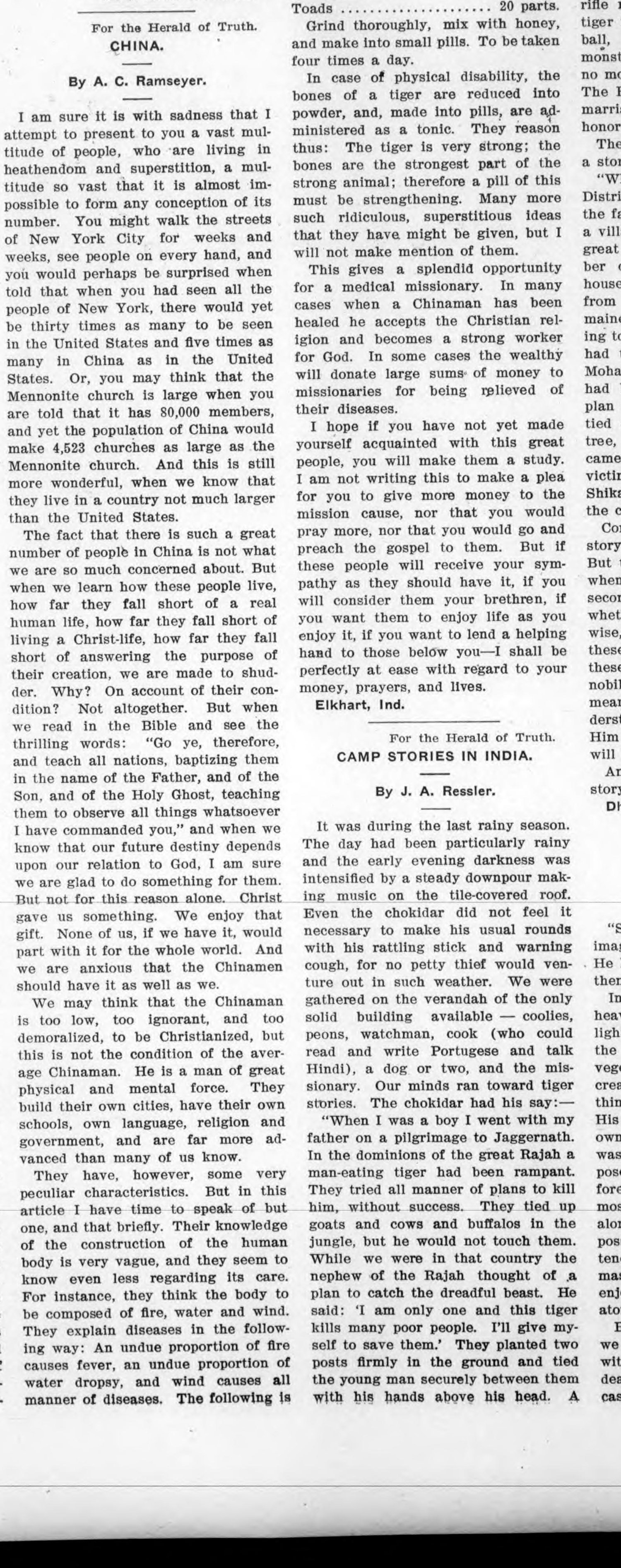
CHINA.
By A. C. Ramseyer.I am sure it is with sadness that I attempt to present to you a vast multitude of people, who are living in heathendom and superstition, a multitude so vast that it is almost impossible to form any conception of its number. You might walk the streets of New York City for weeks and weeks, see people on every hand, and you would perhaps be surprised when told that when you had seen all the people of New York, there would yet be thirty times as many to be seen in the United States and five times as many in China as in the United States. Or, you may think that the Mennonite church is large when you are told that it has 80,000 members, and yet the population of China would make 4,523 churches as large as the Mennonite church. And this is still more wonderful, when we know that they live in a country not much larger than the United States.
The fact that there is such a great number of people in China is not what we are so much concerned about. But when we learn how these people live, how far they fall short of a real human life, how far they fall short of living a Christ-life, how far they fall short of answering the purpose of their creation, we are made to shudder. Why? On account of their condition? Not altogether. But when we read in the Bible and see the thrilling words: “Go ye, therefore, and teach all nations, baptizing them in the name of the Father, and of the Son, and of the Holy Ghost, teaching them to observe all things whatsoever I have commanded you,” and when we know that our future destiny depends upon our relation to God, I am sure we are glad to do something for them. But not for this reason alone. Christ gave us something. We enjoy that gift. None of us, if we have it, would part with it for the whole world. And we are anxious that the Chinamen should have it as well as we.
We may think that the Chinaman is too low, too ignorant, and too demoralized, to be Christianized, but this is not the condition of the average Chinaman. He is a man of great physical and mental force. They build their own cities, have their own schools, own language, religion and government, and are far more advanced than many of us know.
They have, however, some very peculiar characteristics. But in this article I have time to speak of but one, and that briefly. Their knowledge of the construction of the human body is very vague, and they seem to know even less regarding its care. For instance, they think the body to be composed of fire, water and wind. They explain diseases in the following way: An undue proportion of fire causes fever, an undue proportion of water dropsy, and wind causes all manner of diseases. The following is a prescription you would perhaps use if you were a Chinaman:
Powdered snakes 2 parts. Wasps and their nests 1 part. Centipedes 6 parts. Scorpions 4 parts. Toads 20 parts. Grind thoroughly, mix with honey, and make into small pills. To be taken four times a day.
In case of physical disability, the bones of a tiger are reduced into powder, and, made into pills, are administered as a tonic. They reason thus: The tiger is very strong; the bones are the strongest part of the strong animal; therefore a pill of this must be strengthening. Many more such ridiculous, superstitious ideas that they have might be given, but I will not make mention of them.
This gives a splendid opportunity for a medical missionary. In many cases when a Chinaman has been healed he accepts the Christian religion and becomes a strong worker for God. In some cases the wealthy will donate large sums of money to missionaries for being relieved of their diseases.
I hope if you have not yet made yourself acquainted with this great people, you will make them a study. I am not writing this to make a plea for you to give more money to the mission cause, nor that you would pray more, nor that you would go and preach the gospel to them. But if these people will receive your sympathy as they should have it, if you will consider them your brethren, if you want them to enjoy life as you enjoy it, if you want to lend a helping hand to those below you—I shall be perfectly at ease with regard to your money, prayers, and lives.
Elkhart, Ind.
”The Missing Link of Modern Civilization” (Herald of Truth, 28 July 1904, pp. 246–247)
His senior oration at Goshen College, delivered 17 June 1904 (Goshen College Record, 1903–04, academic class program). Page on archive.org
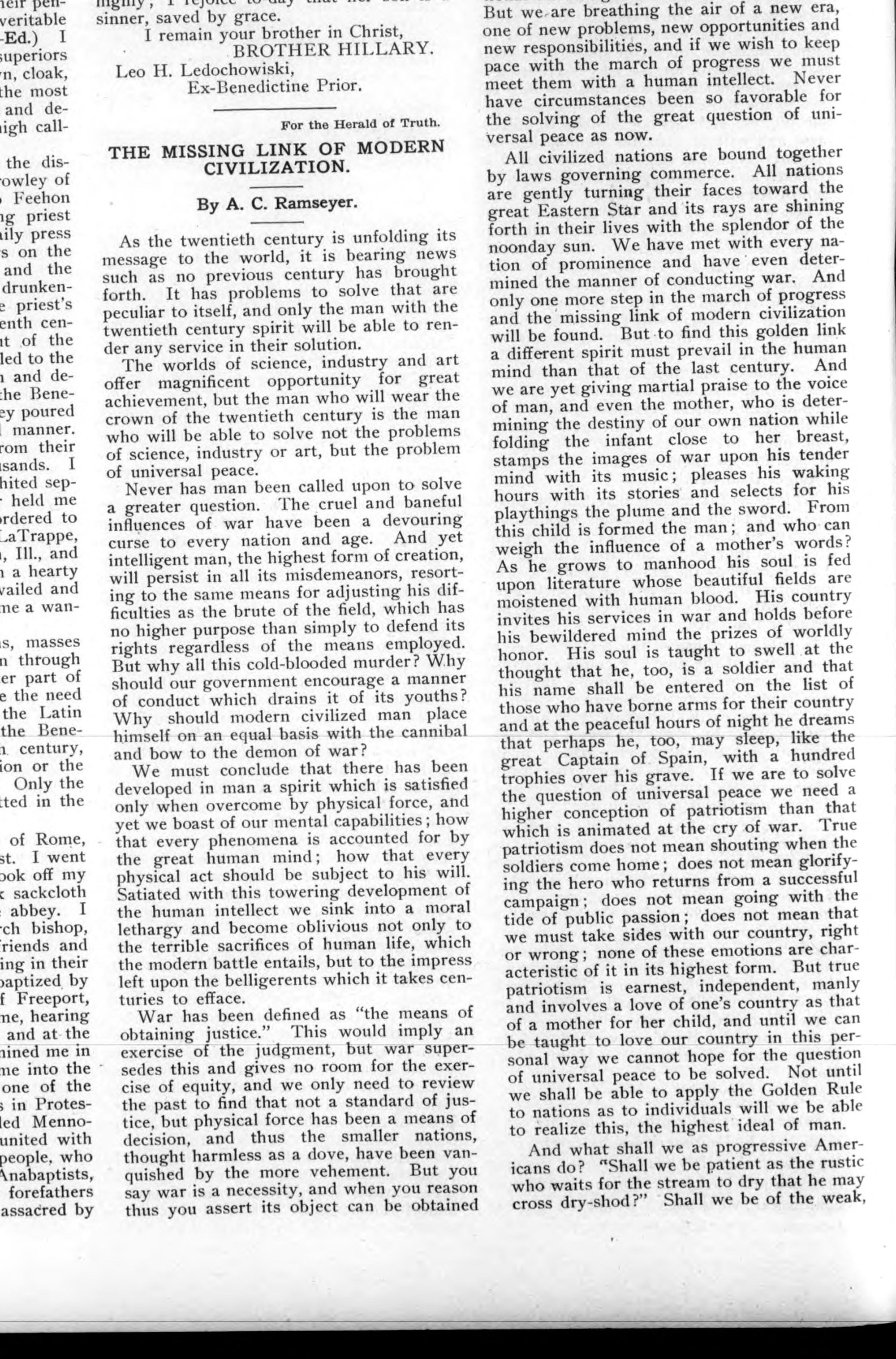
THE MISSING LINK OF MODERN CIVILIZATION.
By A. C. Ramseyer.As the twentieth century is unfolding its message to the world, it is bearing news such as no previous century has brought forth. It has problems to solve that are peculiar to itself, and only the man with the twentieth century spirit will be able to render any service in their solution.
The worlds of science, industry and art offer magnificent opportunity for great achievement, but the man who will wear the crown of the twentieth century is the man who will be able to solve not the problems of science, industry or art, but the problem of universal peace.
Never has man been called upon to solve a greater question. The cruel and baneful influences of war have been a devouring curse to every nation and age. And yet intelligent man, the highest form of creation, will persist in all its misdemeanors, resorting to the same means for adjusting his difficulties as the brute of the field, which has no higher purpose than simply to defend its rights regardless of the means employed. But why all this cold-blooded murder? Why should our government encourage a manner of conduct which drains it of its youths? Why should modern civilized man place himself on an equal basis with the cannibal and bow to the demon of war?
We must conclude that there has been developed in man a spirit which is satisfied only when overcome by physical force, and yet we boast of our mental capabilities; how that every phenomena is accounted for by the great human mind; how that every physical act should be subject to his will. Satiated with this towering development of the human intellect we sink into a moral lethargy and become oblivious not only to the terrible sacrifices of human life, which the modern battle entails, but to the impress left upon the belligerents which it takes centuries to efface.
War has been defined as “the means of obtaining justice.” This would imply an exercise of the judgment, but war supersedes this and gives no room for the exercise of equity, and we only need to review the past to find that not a standard of justice, but physical force has been a means of decision, and thus the smaller nations, thought harmless as a dove, have been vanquished by the more vehement. But you say war is a necessity, and when you reason thus you assert its object can be obtained in no other way, and since its object is justice, and justice is obtained solely by the exercise of reason and judgment, and these are silent in the din of arms, this reason must be vain. If then the very purpose for which war is fought is not attained, if it cannot be shown to be a necessity, what remains to justify civilized man to participate in that which causes more miseries, more hardships, more immolation of life than any other evil of our land?
In our disapproval of war we do not mean to censure former generations who were willing to shed their blood for a country they loved and for a cause they believed to be just. They lived in a different age, an age which did not have our modern educational advantages of science, law and art. But we are breathing the air of a new era, one of new problems, new opportunities and new responsibilities, and if we wish to keep pace with the march of progress we must meet them with a human intellect. Never have circumstances been so favorable for the solving of the great question of universal peace as now.
All civilized nations are bound together by laws governing commerce. All nations are gently turning their faces toward the great Eastern Star and its rays are shining forth in their lives with the splendor of the noonday sun. We have met with every nation of prominence and have even determined the manner of conducting war. And only one more step in the march of progress and the missing link of modern civilization will be found. But to find this golden link a different spirit must prevail in the human mind than that of the last century. And we are yet giving martial praise to the voice of man, and even the mother, who is determining the destiny of our own nation while folding the infant close to her breast, stamps the images of war upon his tender mind with its music; pleases his waking hours with its stories and selects for his playthings the plume and the sword. From this child is formed the man; and who can weigh the influence of a mother’s words? As he grows to manhood his soul is fed upon literature whose beautiful fields are moistened with human blood. His country invites his services in war and holds before his bewildered mind the prizes of worldly honor. His soul is taught to swell at the thought that he, too, is a soldier and that his name shall be entered on the list of those who have borne arms for their country and at the peaceful hours of night he dreams that perhaps he, too, may sleep, like the great Captain of Spain, with a hundred trophies over his grave.
If we are to solve the question of universal peace we need a higher conception of patriotism than that which is animated at the cry of war. True patriotism does not mean shouting when the soldiers come home; does not mean glorifying the hero who returns from a successful campaign; does not mean going with the tide of public passion; does not mean that we must take sides with our country, right or wrong; none of these emotions are characteristic of it in its highest form. But true patriotism is earnest, independent, manly and involves a love of one’s country as that of a mother for her child, and until we can be taught to love our country in this personal way we cannot hope for the question of universal peace to be solved. Not until we shall be able to apply the Golden Rule to nations as to individuals will we be able to realize this, the highest ideal of man.
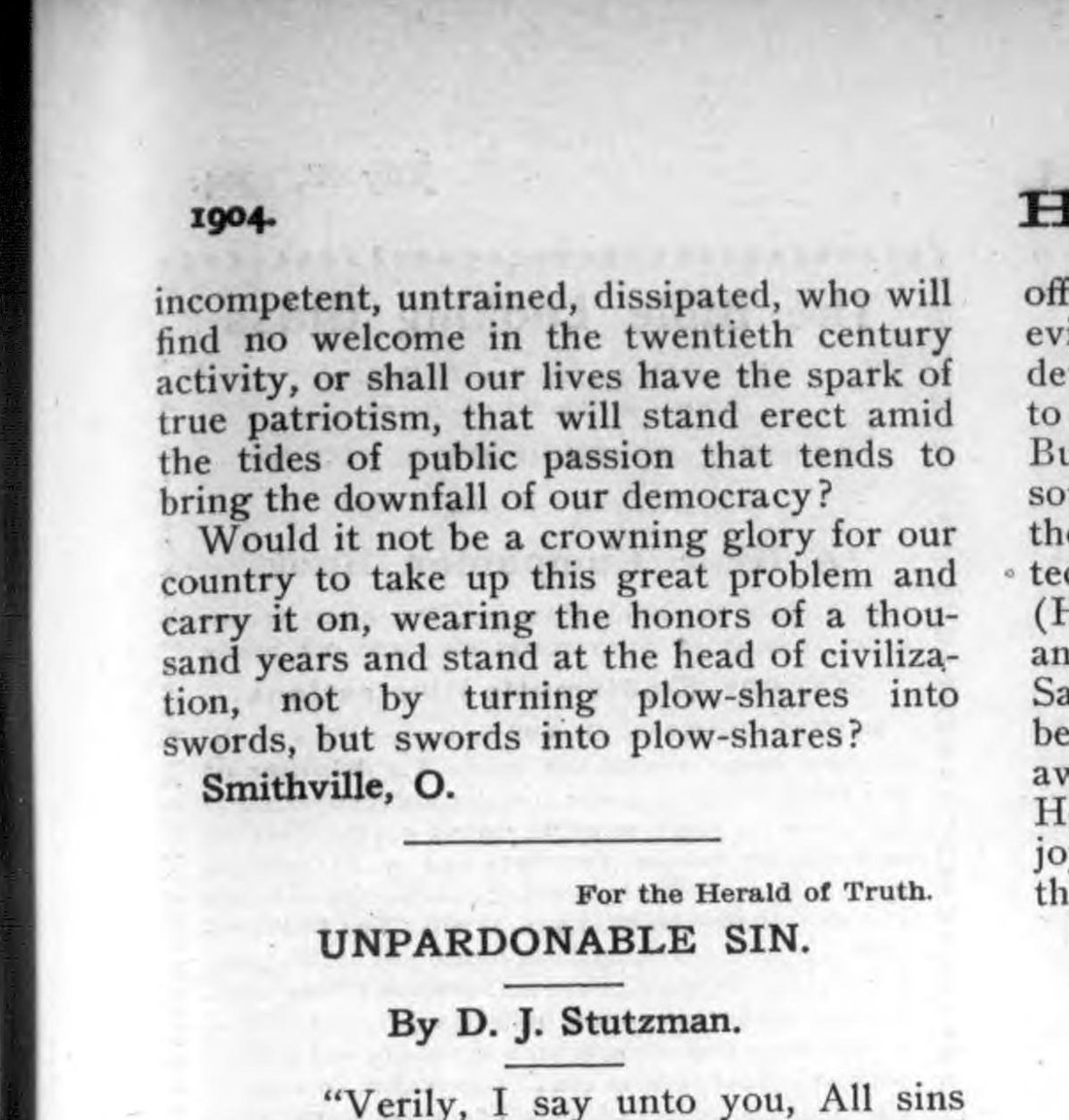
And what shall we as progressive Americans do? “Shall we be patient as the rustic who waits for the stream to dry that he may cross dry-shod?” Shall we be of the weak, incompetent, untrained, dissipated, who will find no welcome in the twentieth century activity, or shall our lives have the spark of true patriotism, that will stand erect amid the tides of public passion that tends to bring the downfall of our democracy?
Would it not be a crowning glory for our country to take up this great problem and carry it on, wearing the honors of a thousand years and stand at the head of civilization, not by turning plow-shares into swords, but swords into plow-shares?
Smithville, O.
Notes
- “The great Captain of Spain” is Gonzalo Fernández de Córdoba (1453–1515), el Gran Capitán.
- The 1902 essay’s description of Chinese medicine reflects the missionary attitudes of its time.
Record compiled 31 October 2026.
About this research
Supporting documentation is linked throughout. This project is an exercise in AI-assisted research and development, and I haven’t manually verified every link or conclusion. All transcriptions and translations of Swiss parish records were made with AI, and their accuracy should be treated accordingly.