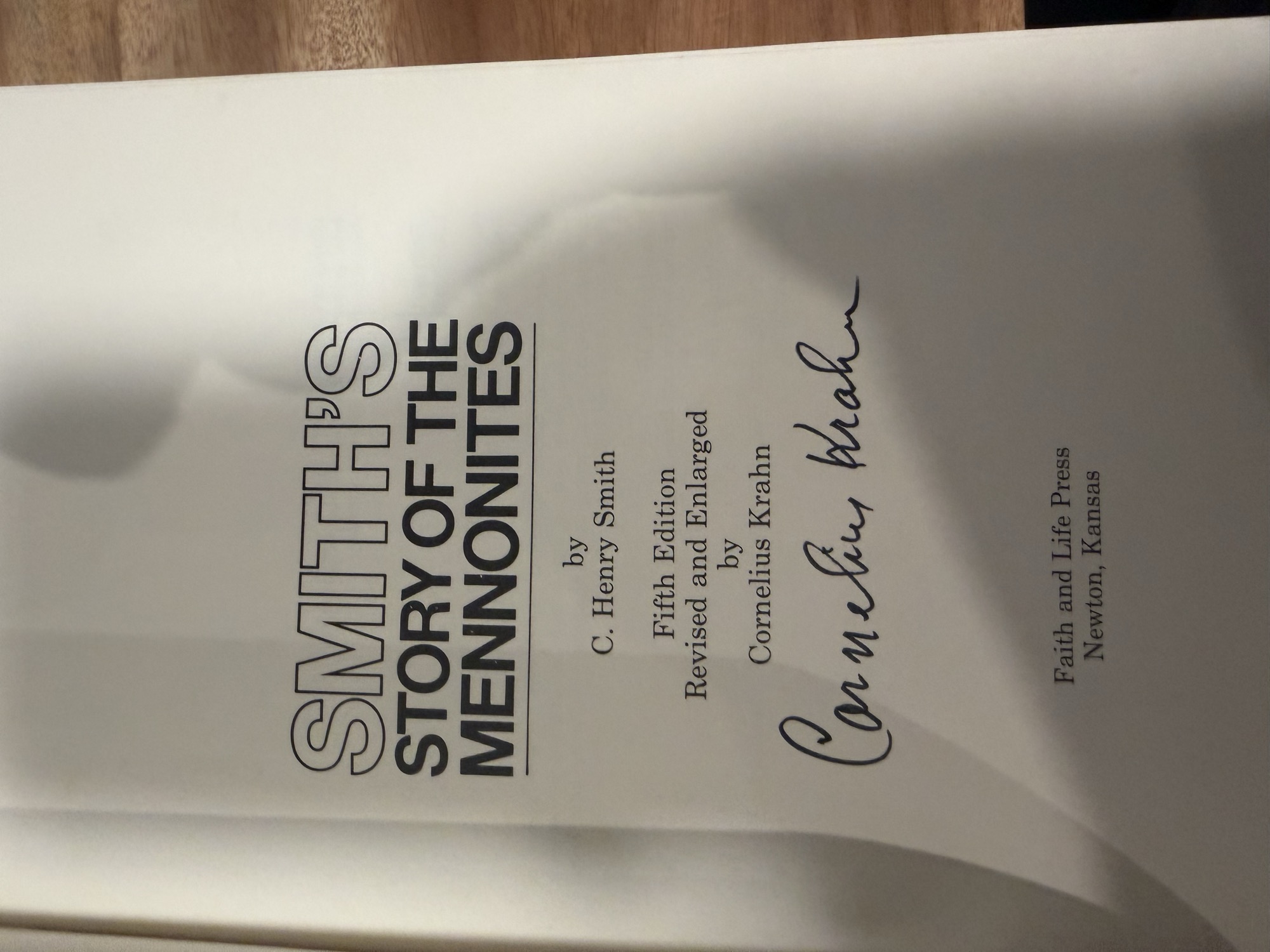
C. Henry Smith, Smith’s Story of the Mennonites, fifth edition, revised and enlarged by Cornelius Krahn (Newton, Kansas: Faith and Life Press, 1981; earlier editions 1941, 1945, 1950, 1957). 589 pages.
This copy
- The title page is signed by Cornelius Krahn, Christopher’s great-uncle by marriage (Cornelius Krahn - the family’s historian of Dutch Anabaptism).
- Flyleaf inscription: a Christmas 1981 gift “from Dad + Mom (D. Paul + Anne Miller)”, that is, D. Paul Miller (1917–2018) and Anna Bertha Wiebe (1914–2010), whose sister Hilda was Krahn’s wife. (The recipients are living and are not named in the vault.)
Chapters (from the bibliography’s chapter references)
| Pages | Chapter | For |
|---|---|---|
| 3–52 | I. The Anabaptists | origins; Peasants’ Revolts 11, 24, 26 |
| 53–73 | II. Menno Simons | |
| 75–102 | III. Switzerland and South Germany | Ramseyer, Neuenschwander, Miller lines |
| 103–146 | IV. The Netherlands | |
| 147–187 | V. Northern Germany (incl. Prussia) | the Wiebe side before 1869 |
| 189–223 | VI. (Alsace, Palatinate, France and others) | Montbéliard (Ramseyers) |
| 225–248 | VII. The Hutterites | |
| 249–356 | VIII. Russia | Am Trakt, the 1874 emigration |
| 359–379 | IX. First Settlements, Pennsylvania | Lancaster, Northkill |
| 381–393 | X. Westward Expansion (19th century) | Ohio, Indiana |
| 395–424 | XI. (American groups) | |
| 425–472 | XII. Russo-German groups in America | Kansas, Nebraska, Beatrice |
| 473–506 | XIII. In Search of Freedom of Conscience | |
| 507–533 | XIV. Cultural Developments | Bethel College |
| 535–560 | XV. Witnessing in War and Peace |
What the index shows (read 2026-10-31)
Wiebe side
| Entry | Pages | Note |
|---|---|---|
| Wiebe, Aron | 183 | In the Prussia chapter, on the same page as Heubuden, Fürstenwerder and Elbing-Ellerwald. Which Aron is not known: test against Aron J. Wiebe (1845–1922) |
| Wiebe, Gerhard; Jacob A.; Jakob; Johann; P. H. | 436–438, 442; 427; 276; 275, 442; 483 | Gerhard here is probably the Bergthal elder in Manitoba, not Gerhard A. Wiebe (1873–1942); check |
| Trakt, Samara; Trakt Mennonites | 260; 294 | Am Trakt, where the Wiebes and Fieguths lived 1869–1894 |
| Epp, Claasz (Claas Epp) | 260, 296 | The Am Trakt end-times leader who led the “Great Trek” to Central Asia (1880): the Wiebes’ own settlement |
| Beatrice, Nebr. | 299, 449, 458 | Beatrice (Nebraska) |
| Paso Robles, Calif. | 435 | where Aron J. Wiebe went in 1896 |
| Heubuden; Fürstenwerder; Elbing-Ellerwald; Marienburg; Danzig | 183, 185; 183; 183; 166, 169, 177, 181, 258; 66, 134, 166–185, 218, 256, 277 | Prussian congregations of the Wiebe-side lines |
| Penner, Bernhard; Reimer, Klaas; Claassen, David; Toews, Cornelius | 254; 274, 438; 289; 289 | probably not ancestors; context |
| Bethel College | 434, 521, 559 | |
| Names (family names) | 77, 101, 172, 216, 261, 361, 365, 367, 379, 387 | Smith’s discussion of Mennonite surnames |
Swiss side
| Entry | Pages |
|---|---|
| Bern; Emmental; Langnau | 75–79, 95; 75, 85, 91, 94, 96, 98–100, 385; 85 |
| Jura; Sonnenberg; Neuchâtel; Montbéliard | 75, 95, 96, 99, 385; 95, 98, 385; 75, 98; 210, 261 |
| Neuenschwander, Michael | 385 (founder of the Putnam County, Ohio settlement, 1833) |
| Bluffton, Ohio; Berne, Ind.; Wayne County | 385, 464, 523; 385; 385 |
| Sprunger, S. F. | 464, 465 (pastor at Berne, Indiana) |
| Thirty Years’ War; Napoleonic Wars | 77, 192; 179, 202, 384 |
Pennsylvania and Amish (Miller side)
| Entry | Pages |
|---|---|
| Hochstetler, Jacob | 372 (Jacob Hochstetler (1712–1776) and the 1757 attack) |
| Northkill; Lancaster County | 371; 366, 367, 369, 373, 378, 381, 382 |
| Amish (incl. names 93, 371, 390, 391); Ammann, Jakob | 73, 84, 91–92, 161, 207–214, 261, 371, 376, 382–392, 409, 422, 459; 73, 84, 211, 213, 228, 409, 415 |
| Yoder, Joseph; J. W. | 411; 516 |
In the bibliography: James O. Lehman, Creative Congregationalism: Oak Grove Mennonite Church, Smithville, Ohio (1978), the history of Christopher’s home church; and Edna Ramseyer Kaufman (ed.), Melting Pot of Mennonite Cookery (Bethel College Women’s Association, 1974): see Edna Ramseyer Kaufman - a life of service.
Chapter pages read (photographed 2026-10-31)
| Pages | What Smith says | For |
|---|---|---|
| 183 | After the 1868 Cabinet Order allowed noncombatant service, “Aron Wiebe of the Fürstenwerder congregation resigned his charge and left for Russia when he found that his members would accept the new order of things almost unanimously. A few years later some members of the Heubuden congregation and others migrated to America, settling in Kansas and Nebraska.” | Wiebe side; Claassens (Heubuden congregation) |
| 184–185 | Prussian congregations after the world wars; the [[Elbing | Elbing]] and Danzig Mennonites’ flight in 1945 |
| 254–258 | Chortitza’s hard beginnings (1789); the Molotschna settlement from 1803, largely from the Marienburg and Elbing region; villages named after West Prussian homes (Tiegenhagen, Ladekopp, Rosenort, Tiege, Ohrloff) | the Prussian villages of the Fieguths and Epps |
| 260–261 | Am Trakt: founded 1853 under Claasz Epp, east of the Volga in Samara province; officially Köppenthal; grew to ten villages (Hahnsau, Ohrloff …). Each family deposited 350 Thaler; 20 years’ military exemption. A second colony, Alt-Samara, from 1861. “Several hundred families migrated to these two Volga colonies nearly all from West Prussia, and most of them fairly well-to-do.” Also the Swiss in Russia (Galicia, Palatinate, Montbéliard, Amish descent; names Krehbiel, Schrag, Rupp, Stucky, Kaufman, Flickinger, Miller, Graber, Goering) | the Wiebes’ and Fieguths’ home 1869–1896 |
| 294–299 | The trek to Central Asia (1880–1884) from Am Trakt under Claasz Epp Jr.: the first group left the Trakt on 31 July 1880; Epp’s own 70-wagon party (25 families) in September; Aulie Ata; Ak Mechet in Khiva (1882); Epp’s predicted date of 8 March 1889. p. 299: “Many … were helped to make this trip to Kansas and Nebraska … Some of them settled in the West Prussian Mennonite communities of Beatrice, Nebraska, and Newton, Kansas.” | the world Aron J. Wiebe (1845–1922) lived in as a Trakt preacher; the Beatrice link |
| 371–373 | Early Amish: arrived mostly 1735–1755; Smith’s list of ancestors includes Jacob Hochstetler, Jacob Beiler, Christian and Jacob Jotter (Yoder), Christian, Moritz and Johannes Zug (Zook), Christian Herschberger, Christian Stutzman. Northkill, Berks County, from 1736: Amish in 18th-century Pennsylvania were “perhaps all told not over five hundred souls”. 1757: Jacob Hochstetler’s home attacked, wife and two children killed, he and another son captured | Jacob Hochstetler (1712–1776); The Hochstetler massacre of 1757 |
| 384–386 | The 1820–1860 immigration: Benedikt Schrag (Wayne Co., 1817); the Sonnenberg congregation near Dalton founded 1819 by four Jura families (Peter Lehman, Isaac Sommer, Ulrich Lehman, David Kirchhofer); Michael Neuenschwander, in Wayne County ten years, founds the Allen County settlement on Riley Creek, three miles northwest of Bluffton, in 1833; Daniel Baumgartner in Adams County before 1838; mass arrivals at Berne 1852–54. Journey by wagon through France to Le Havre, about six weeks at sea (a 175-person group in 1852 had its own 800-ton cotton freighter), New York, then wagons to Ohio, six months in all; land at $1.25 an acre. 1878 conference at Sonnenberg: ministers included John Moser (Allen County) and Christian Sprunger and Christian B. Lehman (Berne). Hessian Mennonites in Butler County, Ohio (1830s): names incl. Nafziger, Holly, Kennel | 1833 First Swiss Mennonite settler in Putnam County, Ohio; Neuenschwander, Sprunger, Lehman, Moser lines |
Names to test, not links
- Aron Wiebe of Fürstenwerder (p. 183) was an elder who left for Russia after 1868. Aron J. Wiebe (1845–1922) went to Russia in 1872–73 and became a preacher at Am Trakt, but he was baptized in the Ladekopp congregation and was only about 23 in 1868. Probably a different (older) Aron Wiebe, possibly a relative. Unresolved.
- Peter Lehman of the 1819 Sonnenberg settlement is not Peter Lehman (1782–1861), who married at Moutier in 1820.
- Michael Neuenschwander (p. 385) is already in the vault: Michael Neuenschwander (1778–1852), a cousin of Christopher’s line.
Next pages to photograph
- pp. 183–185, 254–261, 294–299, 371–373, 384–386 (2026-10-31)
- pp. 289, 435, 449, 458 (Claassen and Toews; Paso Robles; Beatrice) task/human
- pp. 75–79, 85, 91–100 (Bern, Emmental, Jura) task/human
Photos so far (in Attachments/Books/Smith 1981 - Story of the Mennonites/): flyleaf, title page, copyright, contents, list of maps, chapter pages above, bibliography pp. 561–572, index pp. 573–589.
Record compiled 31 October 2026.
About this research
Supporting documentation is linked throughout. This project is an exercise in AI-assisted research and development, and I haven’t manually verified every link or conclusion. All transcriptions and translations of Swiss parish records were made with AI, and their accuracy should be treated accordingly.