Christian Burkholder, Nützliche und erbauliche Anrede an die Jugend (1804)
Nützliche und Erbauliche Anrede an die Jugend, von der wahren Buße, von dem seligmachenden Glauben an JEsu Christo, und der reinen Liebe zu GOtt und seinem Nechsten. Nebst der Gehorsame der Worte GOttes, und der reinen Übergab der Seelen, an die Hand GOttes. Vorgestellt in Frag und Antwort. Motto: Psalm 119:9, “Wie wird ein Jüngling seinen Weg unsträfflich gehen? Wenn er sich hält nach deinen Worten.” Gedruckt im Jahr MDCCCIV (1804). No place or printer on the title page.
“Useful and edifying address to the young, on true repentance, saving faith in Jesus Christ, and pure love of God and neighbour … set out in question and answer.” A Mennonite catechism for young people preparing for baptism. The preface (dated 21 February 1792) speaks of instructing the young “auf das neue vor die Väter” in “the baptismal covenant” (Tauffs-Bund). Its author was Christian Burkholder, bishop in the Lancaster Mennonite Conference, who wrote it in 1792.
Which edition this is
Harold S. Bender, Two Centuries of American Mennonite Literature (1929; free on archive.org, twocenturiesofam00bend), lists:
- First edition: title exactly as in Christopher’s copy (“Vorgestellt in Frag und Antwort”, Psalm 119:9), “(Ephrata?): Gedruckt (bey Bauman und Cleim) im Jahr MDCCC[IV]”, 39 pp., quarto; the only copy Bender knew was at the Historical Society of Pennsylvania.
- Second edition: “Zum zweytenmal herausgegeben”, Ephrata: Bauman und Cleim, 1804, 92 pp., 12mo, with an appendix of 35 questions and hymns.
- Later editions: Allentown 1829, Berlin (Ontario) 1839, Doylestown 1848, Elkhart 1868 and 1873, Lancaster 1869; English from 1857. From 1868 it was printed as an appendix to the Christliches Gemüthsgespräch.
Christopher’s copy matches the first edition (wording, no “zweytenmal”, no printer named). If so it was printed by Bauman & Cleim at Ephrata, Lancaster County, in 1804, and it is a rare book. Checked by Christopher (2026-10-31): 35 pages; page width about 6 in (the length of an iPhone 17 Pro), height greater, so roughly 6 × 7½–8 in. That is far too big for the 92-page 12mo second edition (about 4 × 6½ in) and fits a small quarto, so it supports the first edition. The 35 vs. 39 pages difference may mean the last leaf or two are missing, or that Bender counted unnumbered pages; check whether the text ends mid-section and what the last page number is. Kept in an archival box.
Christopher’s copy (photographed 2026-10-31)
| Photo | What it shows |
|---|---|
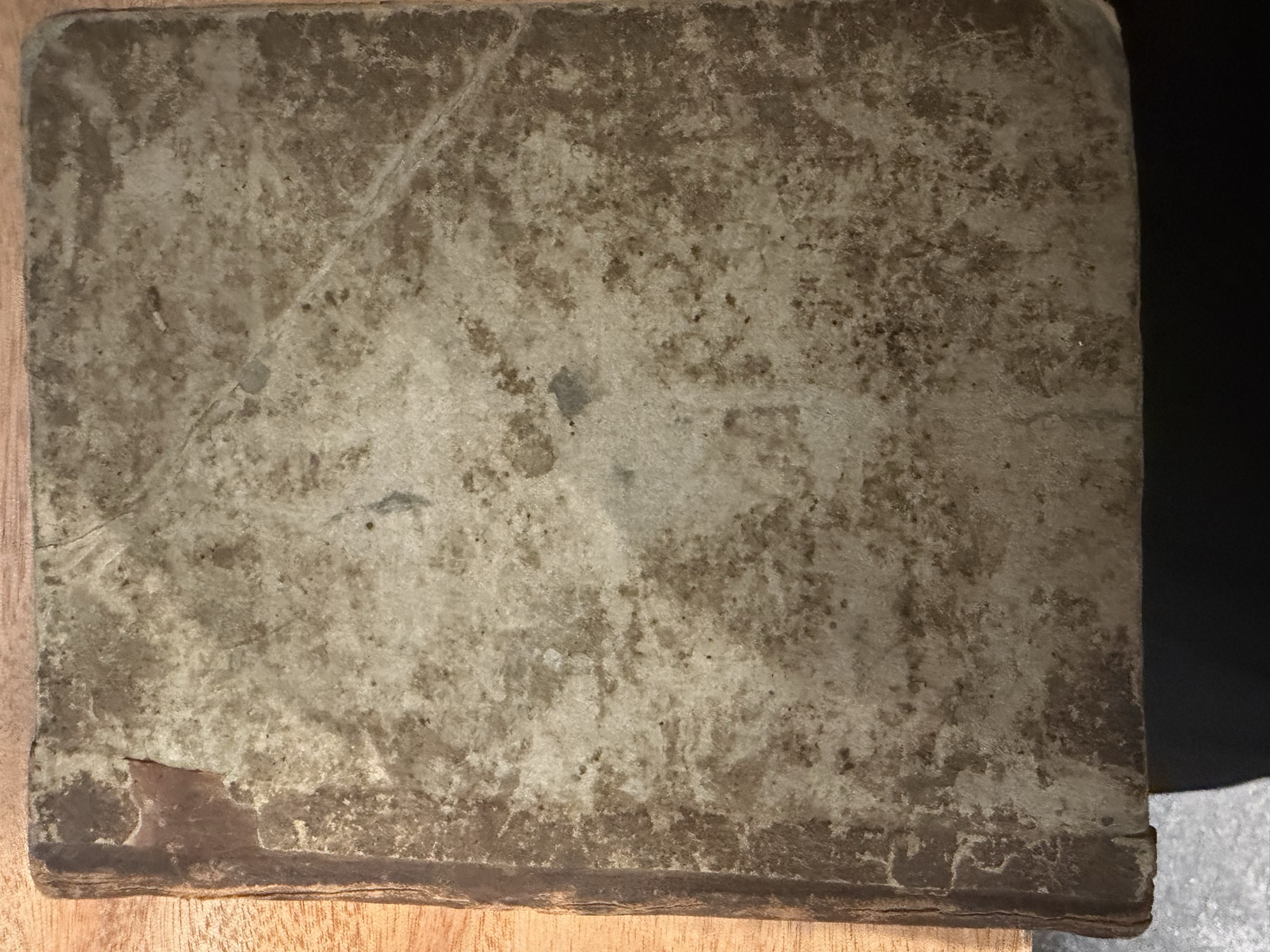 | Cover: paper-covered boards, leather spine |
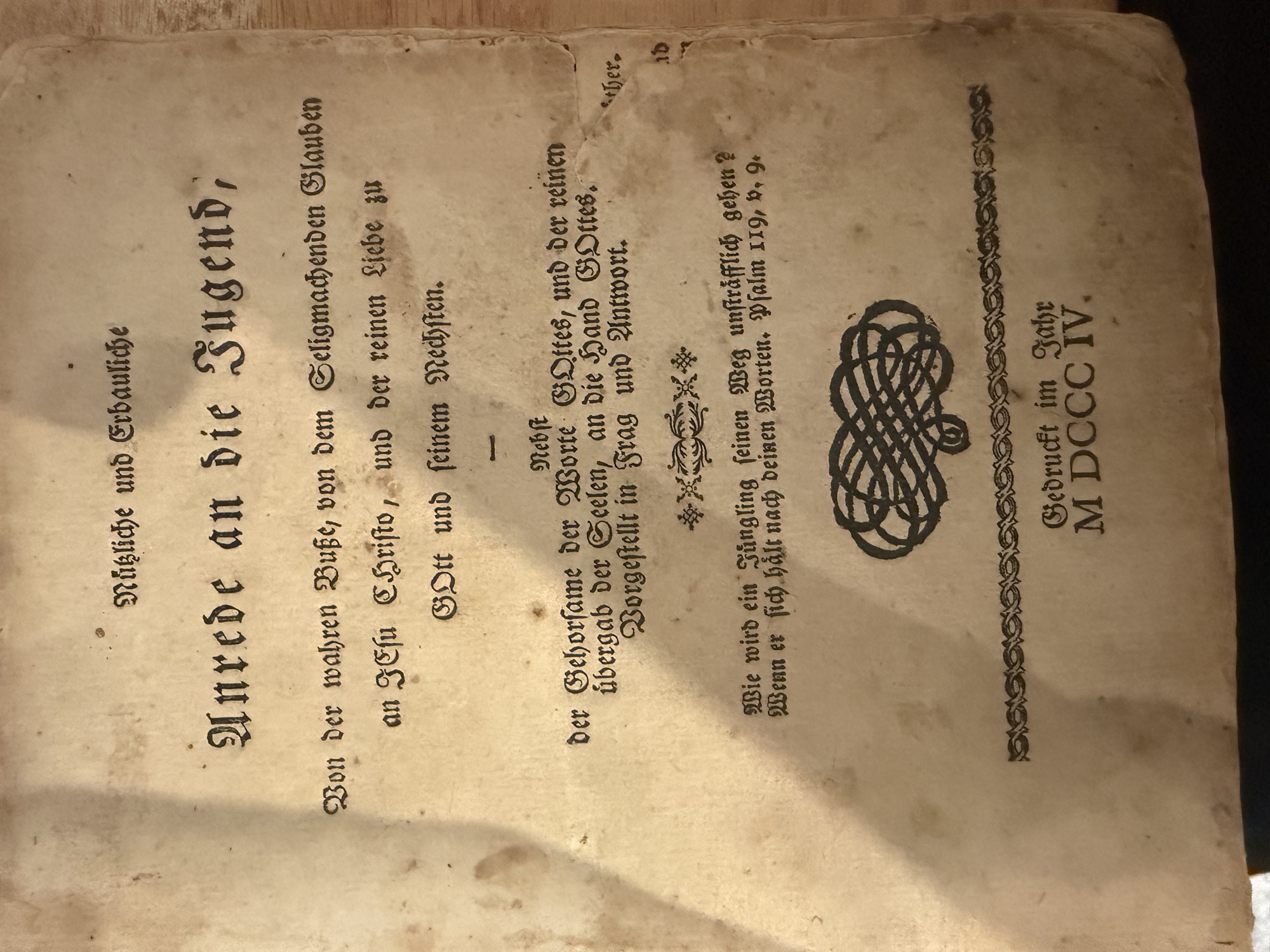 | Title page, 1804. A torn edge shows letters of another printed page underneath (…ther., …nd): possibly a second work bound in |
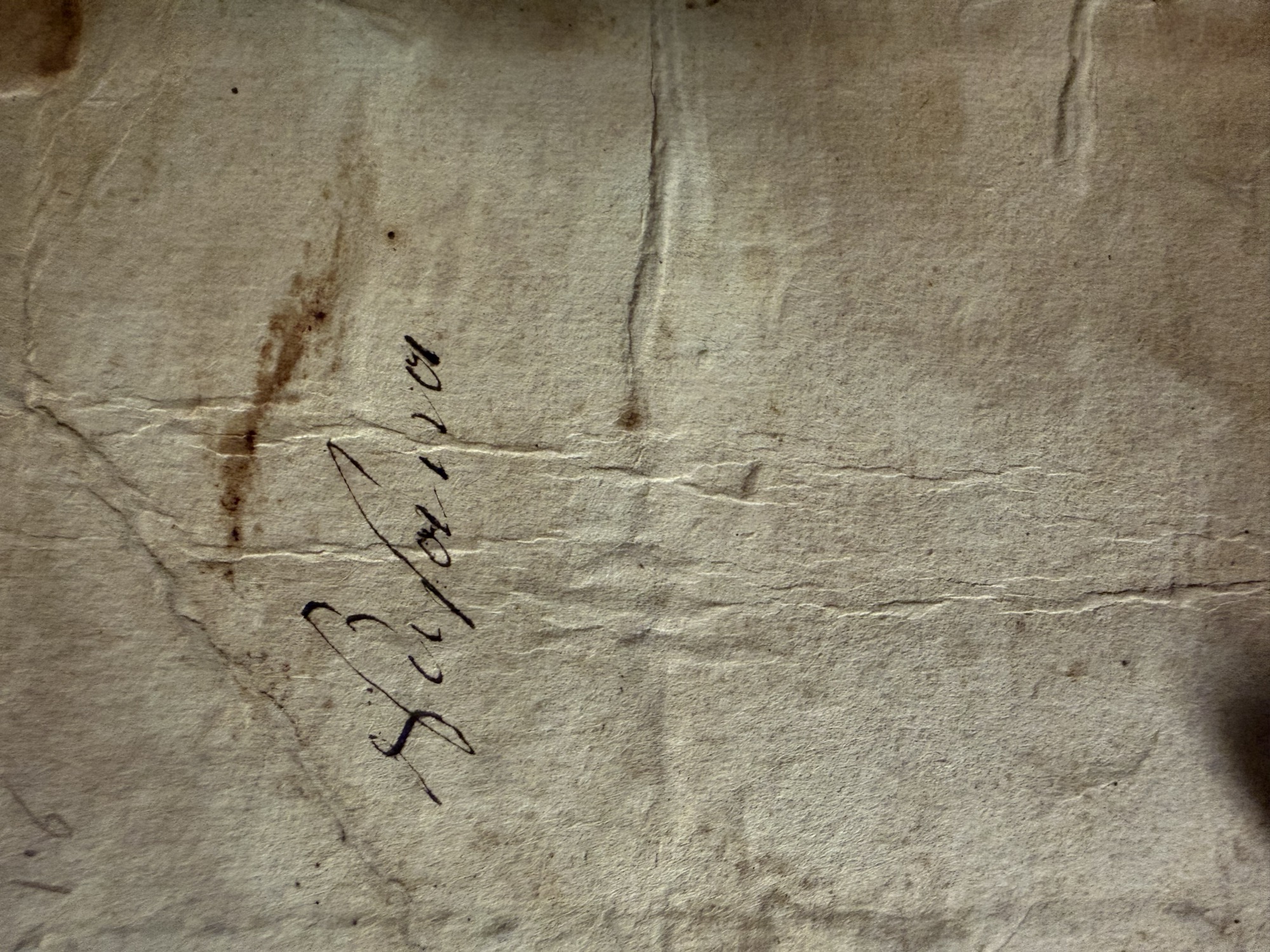 | Handwritten name on a blank leaf, written sideways: a surname beginning Sch… (not confidently read; possibly Schrock) and a faint number “9.1” |
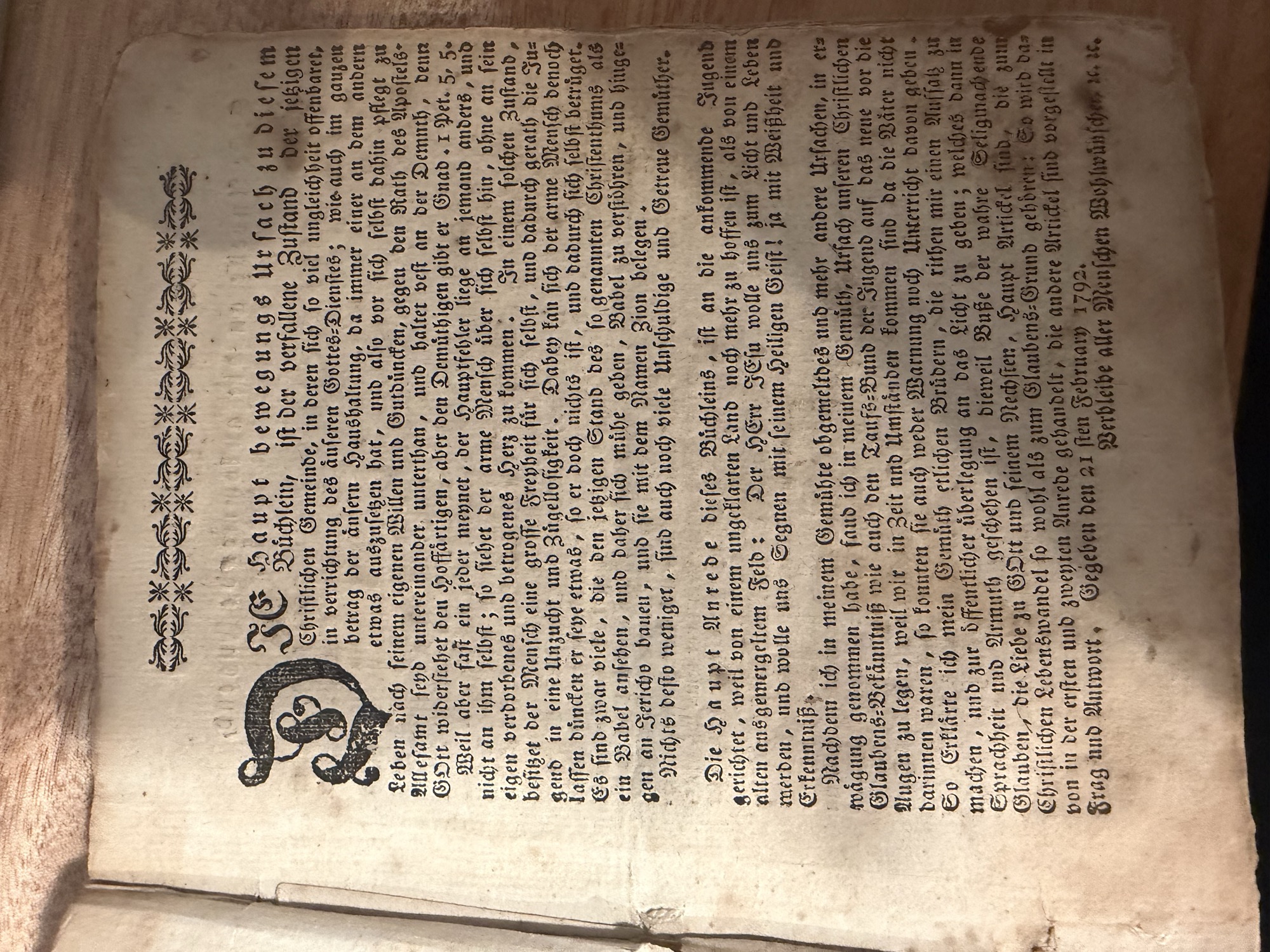 | Preface “Die Haupt-Bewegungs-Ursach zu diesem Büchlein”, dated 21 Feb 1792 |
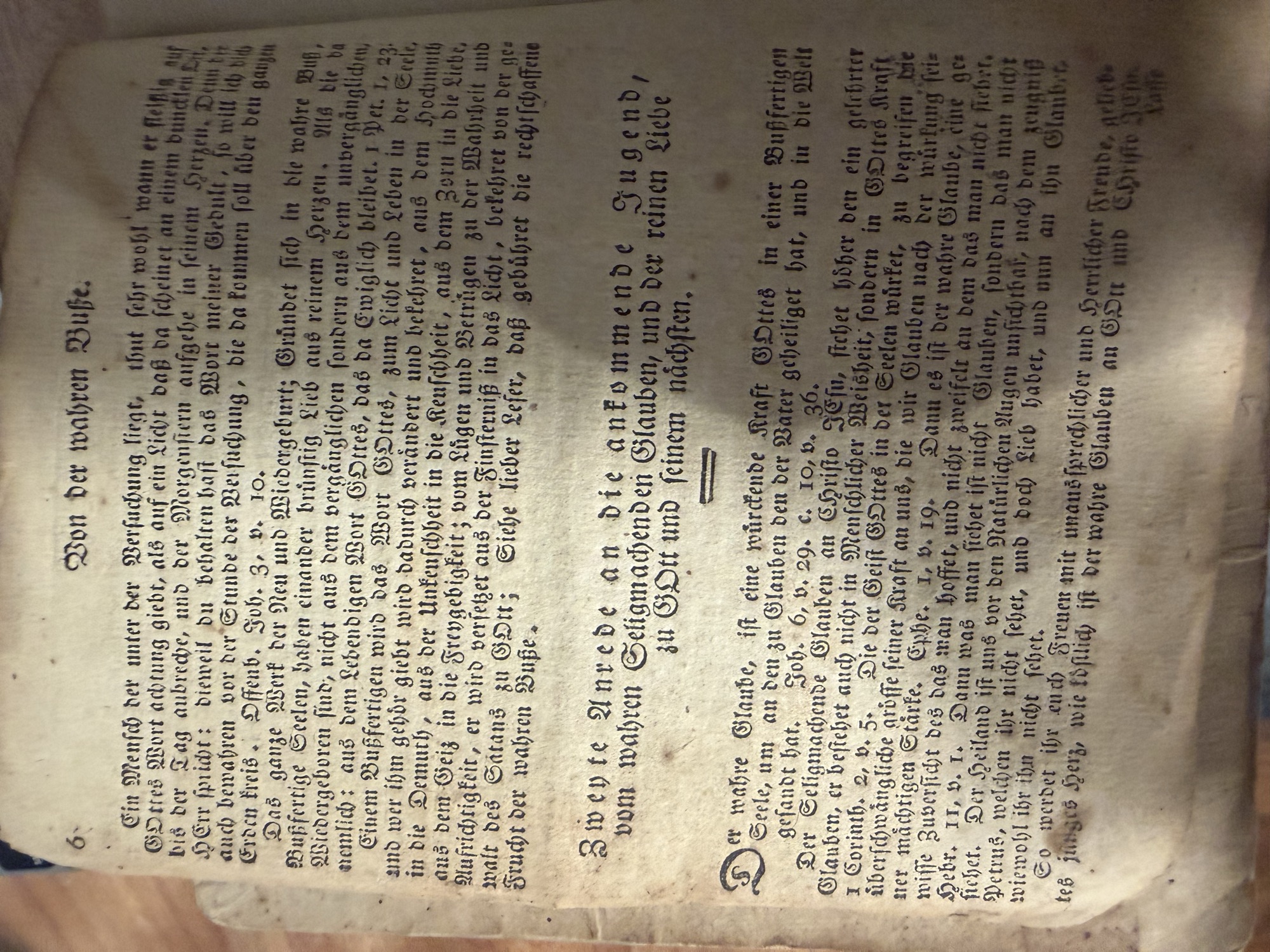 | p. 6: end of “Von der wahren Buße”; start of the second address, on saving faith and pure love |
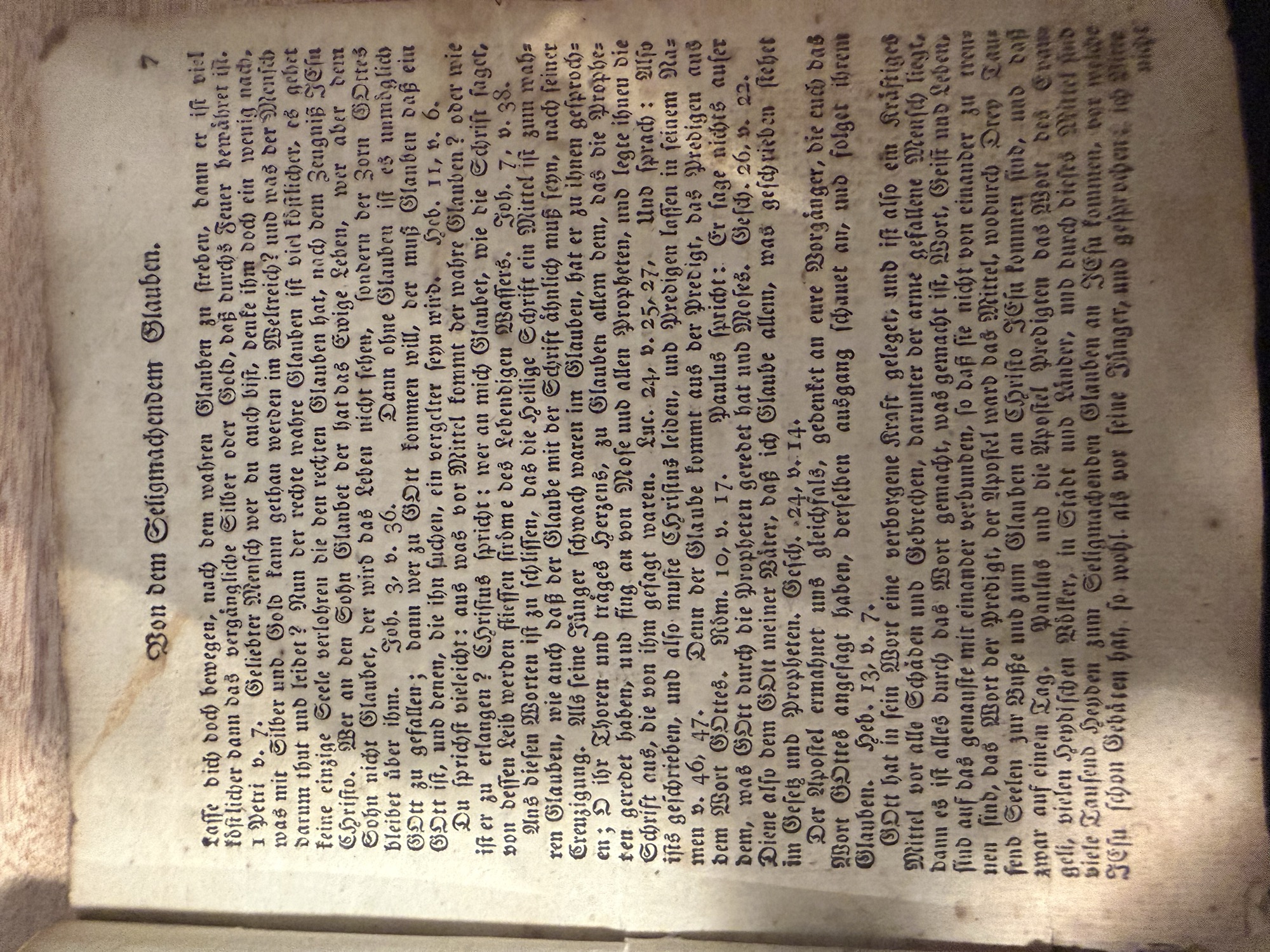 | p. 7: “Von dem seligmachenden Glauben” |
Originals (HEIC) are kept in Attachments/Books/Burkholder - Anrede an die Jugend (1804)/originals/ (not in git).
Known copies of the first edition (searched 2026-10-31)
| Holder | Evidence |
|---|---|
| Historical Society of Pennsylvania, Philadelphia | Bender 1929 (only copy he knew); Springer, Mennonite Bibliography 1631–1961 (1961), no. 21291 (“HSP”) |
| Mennonite Historical Library, Goshen College, Indiana | Springer 1961, no. 21291 (“G”) |
| Possibly Bethel College (Mennonite Library and Archives), North Newton, Kansas | Springer 1961 lists “Be?” (with a question mark) |
| Elizabethtown College, Hess Archives (Spohn Collection of Ephrata imprints) | Digitized: https://archive.org/details/spohn1097; bought at the Chester Hartzler auction, Ephrata; “38, [1] pages; 19 cm”; ends with “Ein Lied von der wahren Demuth”; spine restored |
| Christopher Miller (from his mother’s family) | This copy |
So four known, possibly five. Not checked: WorldCat (it rate-limited automated searches), Arndt & Eck, First Century of German Language Printing in the United States (1989), entry 1369 (lists holding libraries; lending-only online), and the Lancaster Mennonite libraries. The second edition (92 pp., Ephrata: Bauman & Cleim) is commoner: Elizabethtown (spohn1098), Harvard (Google scan ntzlicheunderba00burkgoog), Goshen, and microfiche in Early American Imprints (e.g. UNT).
Print run: not recorded anywhere found. Small country printers like Bauman & Cleim typically printed a few hundred copies of a pamphlet like this, but that is a general estimate, not evidence.
Digital copy kept in the vault: elizabethtown-first-edition-spohn1097.pdf and its OCR text, in this book’s attachments folder. Compare with Christopher’s copy page by page without handling it.
Missing pages in Christopher’s copy? The Elizabethtown copy has 38 numbered pages plus one, ending with the hymn “Ein Lied von der wahren Demuth” (A song of true humility, 8 stanzas). Christopher counts 35, so the last leaves (pp. 36–39, with the hymn) are probably missing.
Translation of the photographed pages (Claude, 2026-10-31)
English translation of the four printed pages photographed. Old spelling modernized; Bible quotations given in the King James wording; […] marks words not legible in the photos. The book (1804) is in the public domain.
Title page
A Useful and Edifying Address to the Young, on true repentance, on saving faith in Jesus Christ, and on pure love to God and one’s neighbour. Together with obedience to the Word of God, and the pure surrender of the soul into the hand of God. Set out in question and answer.
“Wherewithal shall a young man cleanse his way? By taking heed thereto according to thy word.” Psalm 119:9
Printed in the year 1804.
Preface (dated 21 February 1792)
The chief reason that moved me to write this little book is the fallen state of the Christian congregation today. So much inequality shows itself in how outward worship is carried out, and in the whole conduct of household life, that one person always finds fault with another, and so each lives for himself after his own will and fancy. This is against the counsel of the Apostle: “All of you be subject one to another, and be clothed with humility: for God resisteth the proud, and giveth grace to the humble.” (1 Peter 5:5)
But because nearly everyone thinks the main fault lies with someone else and not with himself, the poor soul looks past himself and never reaches his own corrupt and deceived heart. In such a state a person takes great liberty for himself, and so the young fall into lewdness and lawlessness. Meanwhile the poor soul can still imagine he is something when he is nothing, and so deceives himself. There are indeed many who regard the present state of so-called Christianity as a Babel, and therefore labour to destroy Babel, and instead build on Jericho and give it the name of Zion. Nevertheless, there are still many innocent and faithful hearts.
The main address of this little book is directed to the young people coming of age, because there is more to hope for from unploughed land than from an old, worn-out field. May the Lord Jesus become light and life to us, and bless us with His Holy Spirit, yes, with wisdom and understanding.
Having weighed these and other reasons in my mind, I felt moved to set our Christian confession of faith, and the baptismal covenant, before the eyes of the young once more. For we have come into times and circumstances that our fathers did not live through, so they could give neither warning nor instruction about them. So I opened my mind to some of the brethren, who advised me to write it down and bring it into the light for public consideration. This has been done in simplicity and poverty. Repentance, true saving faith, and love to God and one’s neighbour are the chief articles, belonging to the Christian walk of life as much as to the foundation of faith. So they are treated in the first and second addresses; the other articles are set out in question and answer.
Given the 21st of February, 1792. I remain the well-wisher of all people, etc.
Page 6: end of the first address, “On True Repentance”
A person who lies under temptation does very well to pay diligent heed to God’s Word, “as unto a light that shineth in a dark place, until the day dawn, and the day star arise in your hearts.” For the Lord says: “Because thou hast kept the word of my patience, I also will keep thee from the hour of temptation, which shall come upon all the world.” (Revelation 3:10)
The whole work of new birth and rebirth is grounded in true repentance. Penitent souls love one another fervently with a pure heart, “being born again, not of corruptible seed, but of incorruptible, by the word of God, which liveth and abideth for ever.” (1 Peter 1:23) To the penitent, the Word of God becomes light and life in the soul, and whoever listens to it is changed and turned: from pride to humility, from unchastity to chastity, from anger to love, from greed to generosity, from lying and deceit to truth and uprightness. He is moved from darkness into light, and turned from the power of Satan to God. See, dear reader, that is the true fruit of genuine repentance.
Page 6, continued: start of the second address
Second Address to the Young Coming of Age: On True Saving Faith, and Pure Love to God and One’s Neighbour
True faith is a working power of God in a penitent soul, to believe in Him whom the Father has sanctified and sent into the world (John 6:29; 10:36). Saving faith in Christ Jesus sees higher than a learned faith. It does not stand in human wisdom but in the power of God (1 Corinthians 2:5), which the Spirit of God works in the soul, so that we may grasp “the exceeding greatness of his power to us-ward who believe, according to the working of his mighty power” (Ephesians 1:19). For true faith is a sure confidence in what one hopes for, and does not doubt what one does not see (Hebrews 11:1). For what one sees is not faith. […] The Saviour is invisible to our natural eyes. As Peter says: “Whom having not seen, ye love; in whom, though now ye see him not, yet believing, ye rejoice with joy unspeakable and full of glory.” […]
Page 7: “On Saving Faith”, continued
Let yourself be moved to strive after true faith, for it is far more precious than perishable silver or gold that is tried by fire (1 Peter 1:7). Beloved, whoever you are, think a little about what can be done in this world with silver and gold, and what people will do and suffer for it! Yet true faith is far more precious. Not a single soul that has the right faith is lost, according to the witness of Jesus Christ: “He that believeth on the Son hath everlasting life: and he that believeth not the Son shall not see life; but the wrath of God abideth on him.” (John 3:36) For without faith it is impossible to please God: whoever would come to God must believe that He is, and that He rewards those who seek Him (Hebrews 11:6).
Perhaps you ask: by what means does true faith come, or how is it obtained? Christ says: “He that believeth on me, as the scripture hath said, out of his belly shall flow rivers of living water.” (John 7:38) From these words we may conclude that Holy Scripture is a means to true faith, and that faith must agree with Scripture. After His crucifixion, when His disciples were weak in faith, He said to them: “O fools, and slow of heart to believe all that the prophets have spoken,” and beginning at Moses and all the prophets, He explained to them the scriptures concerning Himself (Luke 24:25, 27). And He said: “Thus it is written, and thus it behoved Christ to suffer… and that repentance… should be preached in his name” (verses 46–47). Paul says: “saying none other things than those which the prophets and Moses did say should come” (Acts 26:22), and “so worship I the God of my fathers, believing all things which are written in the law and in the prophets” (Acts 24:14). The Apostle likewise urges us: “Remember them which have the rule over you, who have spoken unto you the word of God: whose faith follow, considering the end of their conversation.” (Hebrews 13:7)
God has laid a hidden power in His Word, so it is a powerful remedy for all the harm and frailty under which poor fallen man lies, for everything that was made was made through the Word. Word, Spirit and life are bound together so closely that they cannot be separated. The word of the apostles’ preaching was the means by which three thousand souls came to repentance and faith in Christ Jesus, and that in a single day. Paul and the apostles preached the word of the Gospel to many heathen peoples, in cities and lands, and by this means many thousands of heathen came to saving faith in Jesus […]
What it tells us
- Written for young people preparing for baptism, because the young faced “times and circumstances that our fathers did not live through”. In 1792 that meant the generation after the Revolutionary War.
- Humble and practical in tone: against pride and fault-finding in the congregation; Scripture, repentance and love of neighbour at the centre.
- The young are “unploughed land” rather than “an old, worn-out field”: an image from a farming people.
- Christopher’s copy probably belonged to a young person of his mother’s family, likely in Pennsylvania, around the time of their baptism.
Why it matters for the family
- Christopher’s Amish and Mennonite ancestors were in Lancaster, Berks and Somerset Counties when it was printed; it is the kind of book a young person was given before baptism. Who owned this copy is the genealogical question: the inscription, any family record pages, and how it came down to Christopher.
- Provenance (Christopher, 2026-10-31): given to him by his mother, so it comes down through the Ramseyer or Neuenschwander side.
- Ramseyer side is the likelier home: its lines include Pennsylvania Amish families who were in Lancaster, Berks and Somerset Counties in 1804 (Schrock, Plank, Kurtz, Yoder, Zook) before moving to Ohio.
- Neuenschwander side is less likely: its families came straight from the Jura and Bern to Ohio and Indiana in the 1830s–50s, after this book was printed, though they could have acquired it in America.
- If the inscription is Schrock, it could belong to the Casper Schrock family of Somerset County (Casper Schrock (immigrant), Michael Schrock (1782–1860)). Unconfirmed.
Follow-up
- Photograph every handwritten mark (inside covers, blank leaves, back pages), the full inscription in good light, and the title page of any second work bound in task/human
- Counted (35 pp.) and measured (about 6 in wide): fits the first edition, not the second
- When convenient, check the last page number against the Elizabethtown scan (pp. 36–39 and the closing hymn probably missing) task/human
- Ask Goshen’s Mennonite Historical Library, Bethel’s Mennonite Library and Archives and the Lancaster Mennonite libraries whether they hold the 1804 first edition (38 pp.) task/human
- Provenance: from Christopher’s mother (Ramseyer or Neuenschwander side)
- Ask whether the family knows which grandparent’s house it came from task/human
- Read the inscription once a clear photo exists, and check the name against the tree task/ai
Record compiled 31 October 2026.
About this research
Supporting documentation is linked throughout. This project is an exercise in AI-assisted research and development, and I haven’t manually verified every link or conclusion. All transcriptions and translations of Swiss parish records were made with AI, and their accuracy should be treated accordingly.