Sample page 302: what the register looks like
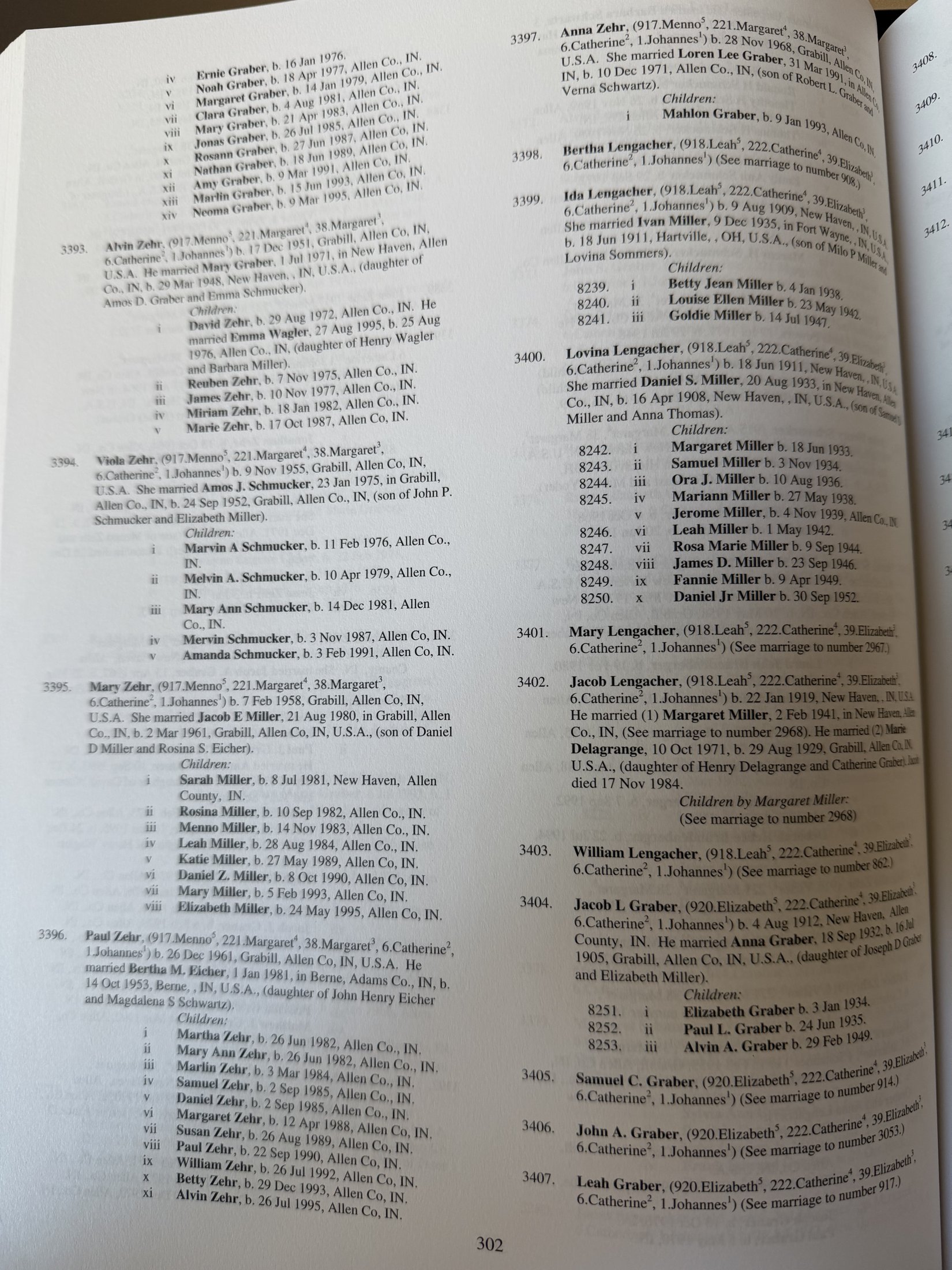
Not transcribed: almost everyone on this page was born between 1933 and 1995 and may be living (AGENTS rule 1). This note describes the format only.
Format
Each entry has:
- A running number (e.g. 3393). Johannes is no. 1, and his ten children are nos. 2–11, in birth order. So 6 = Catherine (b. 1810) is confirmed by this page, and Peter (b. 1822) should be no. 11.
- The line back to Johannes, written as number.Name^generation: for example “917.Menno⁵, 221.Margaret⁴, 38.Margaret³, 6.Catherine², 1.Johannes¹”. This makes it easy to walk any entry back to the emigrant.
- Birth date and place; marriage date and place; the spouse’s birth date and place, and the spouse’s parents (“son of … and …”).
- Children, numbered i, ii, iii…, with birth dates and places. Children who have families of their own get their own numbered entry later (“See marriage to number 908”).
- Occasional death dates and second marriages.
What page 302 covers
Descendants of Catherine Ramseyer (b. 1810) and Jacob Schwartz in Allen County, Indiana (Grabill, New Haven), the Amish community there. Surnames on the page: Graber, Zehr, Lengacher, Schmucker, Miller, Wagler, Eicher, Delagrange, Sommers.
Why this matters
- Spouses’ parents are named throughout, so the book also maps families married into the Ramseyers. That’s useful for Christopher’s other Amish lines (Miller, Schrock, Plank, Conrad, Smiley).
- With about 45,000 names on roughly 650 pages, most entries after about page 100 will be 20th-century people. For the tree, the useful pages are the first generations (roughly pp. 1–100) and the entries for Christopher’s direct line.
Record compiled 31 October 2026.
About this research
Supporting documentation is linked throughout. This project is an exercise in AI-assisted research and development, and I haven’t manually verified every link or conclusion. All transcriptions and translations of Swiss parish records were made with AI, and their accuracy should be treated accordingly.